Why Gujarati Thalis Always Make Room for Sweetness
Reference library · 941 words
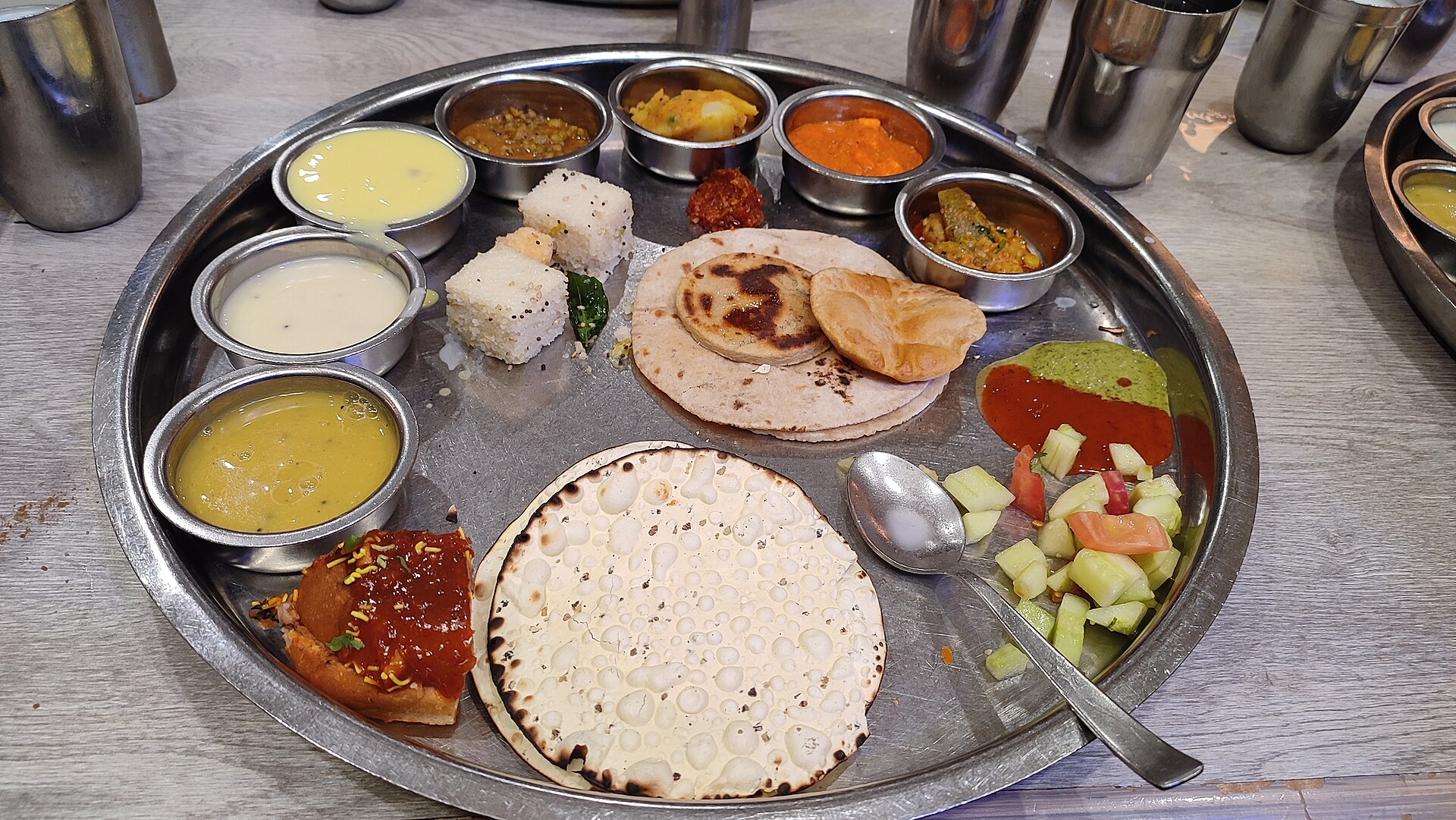

The first Gujarati thali most outsiders eat is a surprise, and the surprise is usually the dal. It is thin, soupy, sharply sour with kokum or tamarind, studded with peanuts, and unmistakably sweet with jaggery. To a palate trained on the dals of Punjab or Tamil Nadu this reads as a mistake. It is not. It is a deliberate compositional choice, and understanding why it exists is a good way into the whole cuisine.
A full Gujarati thali is a structured object rather than an assortment. There will be rotli or bhakri, one or more shaak of vegetables in varying degrees of dryness, dal and rice, a kadhi of buttermilk thickened with gram flour, at least one farsan or savoury snack, a pickle and a fresh or cooked relish, a small sweet, and buttermilk to finish. The pieces are laid out in a fixed relationship on the plate and are meant to be eaten in combination, not in sequence. Sweetness is one voice in that arrangement, not a dessert appended to it.
Where the sugar comes from, and why
Gujarat is sugarcane country, and jaggery, called gol, has long been the cheap and available sweetener rather than an expensive refined one. That is the supply side. On the demand side, several explanations circulate, and it is worth being honest that these are widely offered rather than firmly demonstrated. One is climatic: heat and heavy perspiration, and the argument that a little sugar and salt together aid recovery. Another concerns water, since parts of the state have brackish groundwater and cooks say jaggery softens the resulting harshness. A third is culinary logic, that jaggery rounds off the bitterness of fenugreek, the astringency of gram flour and the aggression of chilli, none of which the cuisine is short of. A fourth is philosophical: the Ayurvedic principle that a complete meal should carry all six tastes, sweet among them, in the same sitting.
There is also a strong argument from what Gujarati cooking leaves out. A large proportion of the state's food tradition is shaped by Jain and Vaishnav vegetarianism, and in its stricter forms that means no onion, no garlic and no root vegetables at all. Remove that entire savoury foundation and something has to supply depth and roundness. Jaggery, along with generous asafoetida, ginger, green chilli, sesame and peanut, does a considerable amount of that work. Seen this way the sweetness is less an indulgence than a structural substitution.
The generalisation that fails
Say Gujarati food is sweet in Rajkot and you will be corrected. The state's regional cuisines differ sharply, and the sweet reputation belongs mainly to Surat and to central Gujarat around Ahmedabad and Vadodara. Surti cooking is the richest and sweetest of all, and its winter speciality undhiyu, a mixed vegetable dish with surti papdi beans, yam, banana and gram flour dumplings called muthiya, takes its name from the practice of cooking it in an inverted earthen pot buried over embers.
Kathiawadi food from the Saurashtra peninsula is a different proposition: drier, considerably hotter, heavier on garlic and red chilli, built around bajra rotla, chhaas and preparations such as sev tameta. Many Kathiawadi cooks put no jaggery in dal at all and regard the practice as a Surti habit. Kutchi cooking differs again, and north Gujarat leans on buttermilk and pulses. Treating all of it as one sweet cuisine is a flattening that Gujaratis themselves do not accept.
Trade history sits behind the differences. Gujarat's ports carried spice, textile and bullion traffic across the Arabian Sea for centuries, and its merchant communities settled in East Africa, the Gulf, Britain, North America and Australia, taking the food with them and bringing things back. The chilli itself arrived through Portuguese maritime trade in the sixteenth century and was absorbed so thoroughly that it is now impossible to imagine Kathiawadi cooking without it. Jain dietary rules travelled the same routes, which is why Gujarati restaurants in Melbourne, Leicester or Nairobi will usually offer a Jain preparation without being asked, and why the sweet and sour dal is one of the most widely dispersed Indian regional dishes on earth.
Farsan, and the sweets proper
The farsan category is where Gujarat is genuinely distinctive, and much of it is steamed or fermented rather than fried, which is unusual among Indian snack traditions. Dhokla and khaman are steamed, the first traditionally from a fermented rice and split gram batter, the second from gram flour, and the two names are often used interchangeably outside the state although the batters differ. Khandvi is a gram flour and buttermilk mixture cooked to a paste, spread thin, set, and rolled into tight cylinders. Patra uses colocasia leaves smeared with spiced gram flour, rolled, steamed and then sliced. Thepla, a fenugreek flatbread that keeps for days, is the reason Gujarati travellers are famously well fed on trains and aeroplanes.
The formal sweets sit apart from the sweetness inside the savoury food. Shrikhand is yoghurt hung until thick, then beaten with sugar, cardamom and saffron. Basundi and doodhpak are reduced milk preparations. Mohanthal is a set gram flour fudge, and sukhdi, also called gol papdi, is wheat flour cooked in ghee with jaggery and pressed into a tray, about as economical as a sweet can be. Several are tied to the calendar rather than to appetite: ghari, a rich stuffed disc associated with Surat, belongs to the full moon celebration of Chandi Padvo after Diwali, and fafda with jalebi is the fixed breakfast of Dussehra. That calendar attachment is the clearest sign that sweetness here is a social language and not simply a taste preference.
References
- WikipediaGujarati cuisine
- WikipediaThali
- WikipediaUndhiyu
- WikipediaDhokla
This is a reference article, written from the sources above. It is background, not news reporting.