Wandering the Tea Trails of Northeast India
Reference library · 1048 words
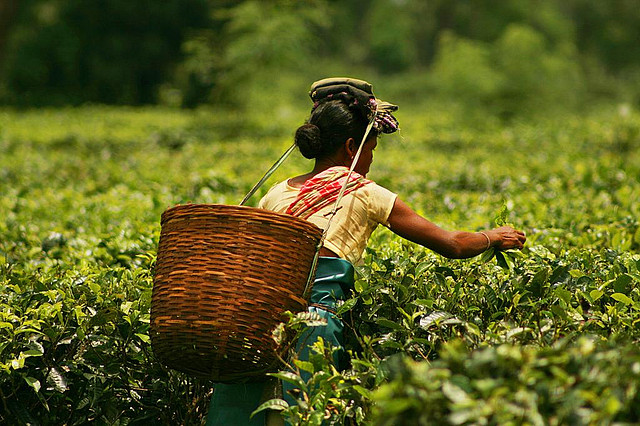

The tea route through India's northeast is really a route through a single river valley. The Brahmaputra runs some seven hundred kilometres across Assam between the eastern Himalaya and the Meghalaya plateau, and its floodplain and low terraces carry the densest concentration of tea gardens anywhere in the world. Travelling it means moving between plantation bungalows, a national park or two, the temple towns of a forgotten dynasty and a research station that has shaped how tea is grown globally. It also means confronting a labour history that the marketing does not mention.
How a Wild Assam Plant Became an Industry
The plant is native. Camellia sinensis variety assamica grows wild in the forests of upper Assam and adjoining hills, and Singpho and Khamti communities were preparing the leaf long before any company existed, a fact recorded by the earliest British observers rather than discovered later. Robert Bruce is credited with encountering the plant in the 1820s through Singpho contacts; his brother Charles Alexander Bruce did the practical work of establishing nurseries and processing. The commercial trigger was political: the East India Company wanted a tea source outside China. The first Assam made tea reached London in the late 1830s and was judged saleable, and the Assam Company was floated in 1839, among the earliest joint stock tea enterprises anywhere. Within a few decades the valley had been converted into an industrial monoculture.
Assam's character in the cup comes from that variety and that climate: broad leaved bushes, heavy rainfall, low altitude and high humidity, producing a brisk, malty, deeply coloured liquor. The second flush, plucked around late May and June, gives the tippy malty teas that command the highest prices. Most of the crop, however, is made by the crush, tear, curl method rather than the orthodox rolled leaf, because CTC suits the strong milky tea the Indian domestic market drinks. Bulk selling runs largely through auction, and the Guwahati Tea Auction Centre, opened in the 1970s, became one of the largest CTC auction centres in the world. The Tocklai Tea Research Institute at Jorhat, established in 1911, is the oldest tea research station anywhere and remains the reason so much of the world's agronomic literature on tea has an Assamese address.
One charming survival is Assam's unofficial time. Gardens have long run on bagan time, an hour ahead of Indian Standard Time, because IST is calculated for a meridian far to the west and the sun rises in upper Assam well before six. Estates that keep it start work in daylight and finish before dusk.
The Labour the Gardens Were Built On
Assam's own population would not work the plantations on the terms offered, so labour was recruited under indenture from Chotanagpur, the Santhal Parganas, Chhattisgarh and Odisha, moved by river and rail across the country, and held under legislation that made desertion a criminal offence. Mortality on the journeys and in the early gardens was severe, and the system was documented and criticised in its own time before being progressively dismantled in the twentieth century. Their descendants form the large community known in Assam as Adivasis or, in the state's political vocabulary, the tea tribes, with their own languages, Sadri as a link tongue, and the Jhumur dance. Any honest tea trail passes through the labour lines as well as the manager's bungalow, and estates that acknowledge this openly are better company than those that do not.
A Route Through Upper Assam
Begin at Guwahati, with the Kamakhya temple on Nilachal hill and the auction centre in the city, then move east along the north or south bank. Kaziranga National Park, a World Heritage site on the Brahmaputra's southern floodplain, holds the largest population of the greater one horned rhinoceros and is ringed by tea estates that offer garden stays; the park closes through the monsoon and reopens around November. Further east, Jorhat is the working capital of the tea belt, with Tocklai, the Gymkhana Club and its long established racecourse and golf course, and heritage plantation houses including Thengal Manor. From Jorhat a ferry crosses to Majuli, the large river island whose Vaishnava monasteries, the satras founded in the tradition of Srimanta Sankardeva, preserve mask making, dance drama and manuscript painting, and whose land area shrinks each year to erosion.
Sivasagar, further upriver, was the capital of the Ahom kingdom, which ruled Assam for six centuries and repeatedly repelled Mughal armies. The tank at the centre of town is overlooked by the Sivadol, the Rang Ghar pavilion built for watching sports, and the multi storey Talatal Ghar. Nearby at Charaideo are the Ahom moidams, burial mounds of the royal line, inscribed on the World Heritage List in 2024. Dibrugarh and Tinsukia sit at the far eastern end, closest to the original Singpho country and to Digboi, where an oil refinery has run since the nineteenth century. Manas National Park, another World Heritage site, lies in the opposite direction on the Bhutan border and rewards the detour.
Beyond Assam, and the Darjeeling Question
Darjeeling is often folded into the northeast in travel writing. It is in West Bengal, its bushes are largely the China variety rather than assamica, and its high altitude produces an entirely different tea: the light floral first flush of March and April, and the muscatel second flush whose flavour is generated by leafhopper feeding damage to the leaf. Darjeeling tea was the first Indian product to be granted a geographical indication, and confusing it with Assam is a category error rather than a shortcut.
The genuine northeastern extensions run elsewhere. Sikkim's Temi estate, state owned and established in the 1960s, is the only large plantation in a state that later moved wholly to organic certification. Tripura has a long established if small industry. Meghalaya's Ri Bhoi district and Arunachal Pradesh's Lohit and Changlang districts have seen a rise in small grower and speciality production, including orthodox and hand rolled teas sold direct. Nagaland and Manipur have modest plantings. Travellers should plan for permits: Arunachal Pradesh, Nagaland, Mizoram and Manipur require Inner Line Permits for Indian citizens, and foreign nationals face separate requirements. The best months are roughly October to April, which unfortunately excludes the second flush, so the choice is between seeing the gardens at work and travelling comfortably.
References
- Tea Board of IndiaTea Board of India
- Tea Board of IndiaTea Board information pages
- UNESCO World Heritage CentreKaziranga National Park
- Assam TourismAssam Tourism Development Corporation
- Incredible India, Ministry of TourismAssam
This is a reference article, written from the sources above. It is background, not news reporting.