The Ghazal: Urdu Poetry's Most Enduring Form
Reference library · 1015 words
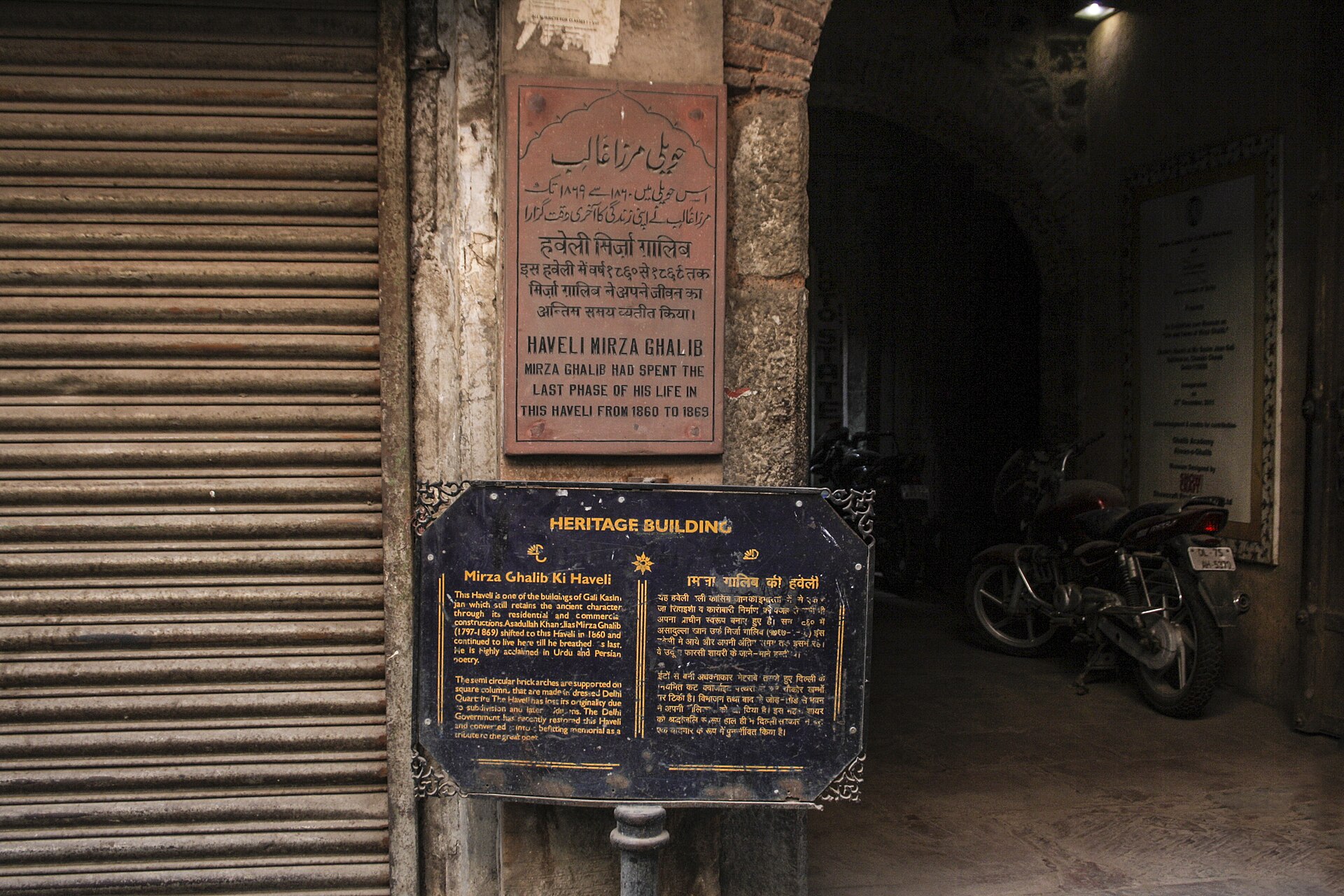

The ghazal is a short poem, usually between five and fifteen couplets, in which every couplet is a self contained statement and all of them share a rhyme and a metre. It is the most prestigious form in Urdu, the one by which poets have been judged for three centuries, and it has survived changes of empire, language politics, partition and the collapse of the courtly world that produced it. It survives partly because its architecture is unusually strong and partly because it can be sung.
How the form works
The ghazal came into Urdu from Persian, and into Persian from Arabic, where it began as the amatory prelude to a longer ode. In Persian hands, with Rumi, Saadi and Hafez, it became an independent lyric and acquired the mystical double meaning it has never lost. Persian was the language of administration and high literature across much of the Indian subcontinent for centuries, so Indians wrote Persian ghazals long before they wrote Urdu ones. The shift to Urdu began in the Deccan sultanates and reached northern India around the turn of the eighteenth century, a moment often associated with the poet Wali, whose Delhi visit is traditionally credited with convincing north Indian poets that the local language could carry serious verse.
The mechanics are precise. Each couplet is a sher. The opening couplet, the matla, rhymes in both lines and establishes two things at once: the qafia, the rhyming element, and the radif, a word or phrase repeated verbatim at the end of every rhyming line. Every subsequent couplet rhymes only in its second line, but must reproduce that same qafia and radif exactly. A single metre, or beher, governs the whole poem. The closing couplet, the maqta, conventionally contains the poet's pen name, the takhallus, which is why Urdu poets are known by names such as Ghalib, Mir, Dard and Faiz rather than by their legal ones.
The consequence of this design is what makes the ghazal unlike a Western lyric. Because each couplet is complete in itself, a ghazal has no narrative and no argument. It is a set of variations held together by sound. Couplets can be quoted individually, memorised individually, and in performance are received individually, which is why a mushaira audience responds couplet by couplet rather than at the end. Poets exploit this by making the compulsory refrain do unexpected work, so that the same repeated phrase means something different in every couplet. Judging a ghazal is largely a matter of judging how much pressure a poet can put on a fixed constraint.
The great line of poets
Mir Taqi Mir, who lived through the sacking of Delhi in the eighteenth century and eventually moved to Lucknow, is the acknowledged master of plainness, and later poets called him the god of poetry. His subject is loss handled without ornament. Khwaja Mir Dard brought a genuinely Sufi sensibility, Mirza Sauda a satirical edge. Mirza Ghalib, who died in Delhi in 1869, is the poet most often quoted today: difficult, sceptical, wittily blasphemous, obsessed with paradox, and privately convinced that his Persian work mattered more than his Urdu, a judgement posterity has firmly overturned. His prose letters, written in a colloquial Urdu that broke with formal convention, are almost as celebrated as his verse, and his account of Delhi during the upheaval of 1857 is a rare eyewitness document.
The classical themes are fixed: unattainable love, the cruelty and indifference of the beloved, the tavern and the wine cup, the rival, the preacher and his hypocrisy, separation and the pleasures of complaint. Crucially, Urdu grammar allows the beloved to remain ungendered, and the tradition exploits that ambiguity heavily. The beloved may be a woman, a boy, a patron, or God, and a competent ghazal is usually readable in more than one of those ways at once. Wine may be wine, or it may be divine intoxication. This is not evasion, it is the form's central technique.
Critics have long divided the classical tradition into a Delhi school, praised for restraint and emotional directness, and a Lucknow school, characterised as more decorative and technically showy. The distinction is a useful teaching device and an unreliable description; plenty of Lucknow poets are plain and plenty of Delhi poets are ornate, and the reformist critic Altaf Hussain Hali, who did much to popularise the framework in the nineteenth century, had his own polemical reasons for it.
The modern ghazal and the sung ghazal
The form did not die with the Mughal court. Muhammad Iqbal used it for philosophical and political argument in the early twentieth century. Faiz Ahmed Faiz performed the most interesting operation on it, taking the entire classical vocabulary of the beloved, separation and the wound and redirecting it towards politics, so that the lament of a lover becomes the lament of a prisoner or a citizen. His much quoted line about the beloved no longer being asked for the love once given is simultaneously a personal renunciation and a political one. Firaq Gorakhpuri, Jigar Moradabadi and later poets kept the form current, and the ghazal has since been written in English, Hindi, Gujarati and other languages, with varying fidelity to the rules.
Most people today meet the ghazal through music rather than print. Singing a ghazal is a separate art with its own conventions, in which the singer repeats and re shapes a line to bring out different meanings before completing the couplet. Begum Akhtar brought the practice of the courtesan salons into the concert hall and the recording studio; Mehdi Hassan and Ghulam Ali in Pakistan set a standard of classical rigour; Jagjit Singh, working with simpler settings and lighter instrumentation, took the ghazal to a mass Indian audience in the 1970s and 1980s. Purists complained that the music was becoming easier as the poetry became simpler, and they had a point. But the sung ghazal is why a form built for eighteenth century Delhi salons is still recited from memory by people who have never read a line of it on a page.
References
- Columbia UniversityA Desertful of Roses: the Urdu ghazals of Mirza Ghalib
- Columbia UniversityUrdu literature resources, Frances Pritchett
- Encyclopaedia BritannicaGhazal
- Encyclopaedia BritannicaMir Taqi Mir
- Poetry FoundationFaiz Ahmed Faiz
This is a reference article, written from the sources above. It is background, not news reporting.