The Welcome and Farewell of Ganesh Chaturthi
Reference library · 949 words

Almost every Indian festival is a welcome. Ganesh Chaturthi is unusual in being equally a farewell, and the structure of the ten days only makes sense once you see that the immersion at the end is not a disposal but the second half of the ritual. A guest is invited into the house through pranapratishtha, the rite that installs breath and presence in a clay figure. The guest is fed, sung to, shown to visitors and kept company. Then the guest is walked to the water and released, with the customary parting cry that asks him to come back early next year.
The festival begins on Chaturthi, the fourth lunar day of the bright fortnight of Bhadrapada, falling in late August or September, and runs to Anant Chaturdashi on the fourteenth. Not every household keeps the full span. Domestic Ganpatis are commonly immersed after one and a half days, or on the fifth, seventh or tenth, according to family custom, which is why the visarjan processions build in waves rather than arriving all at once. Ganesha himself is Vinayaka, Ganapati and Vighnaharta, and it is worth noting that the older epithet is Vighnaraja, lord of obstacles, meaning the one who places them as well as removes them. The propitiatory logic of invoking him first at any beginning follows from that ambivalence.
From Household Shrine to Public Street
The most repeated claim about this festival is that Bal Gangadhar Tilak invented it in 1893. He did not. Ganesha worship in Maharashtra is old, the Peshwa rulers of Pune treated Ganapati as a tutelary deity and patronised public celebration in the eighteenth century, and the Ashtavinayak circuit of eight Ganesha temples in western Maharashtra at Morgaon, Siddhatek, Pali, Mahad, Theur, Lenyadri, Ozar and Ranjangaon long predates the colonial period. What Tilak did from 1893 was promote and popularise the sarvajanik or public form of the festival through his newspapers, so that neighbourhood committees installed large images in street pandals and used the ten days for lectures, poetry, drama and political speech at a time when colonial law restricted political assembly but not religious gathering. Even the priority of particular mandals is contested locally, with claims made for Bhausaheb Rangari's Pune mandal, for the Kasba Peth Ganpati, and for the Keshavji Naik Chawl mandal in Girgaum in Mumbai. The safer statement is that a household rite became a mass civic institution in the 1890s, and that Tilak was the most effective advocate of that shift rather than its inventor.
The largest public mandals now function as year round institutions with trusts, security operations and queue systems. Lalbaugcha Raja in Mumbai, established in the 1930s and associated by tradition with a vow made by fisherfolk and traders of the Lalbaug market, draws queues that last many hours. Pune's Dagdusheth Halwai Ganpati was founded, again by tradition, by a sweet seller who lost a son in a plague epidemic. Hyderabad's Khairatabad Ganesh is built to towering heights each year. These are not quaint survivals; they are among the largest voluntary gatherings in the country.
Clay, Plaster and the Water
How the image is made has become the central controversy of the modern festival. Traditional murtis were formed from shadu mati, a fine river clay, which softens and disperses in water within hours. From the mid twentieth century plaster of Paris took over, because it is light, cheap, allows far taller and thinner figures, and takes bright synthetic paint. It also does not dissolve. Plaster fragments and heavy metal pigments accumulate in lakes, creeks and coastal shallows, and the annual immersion of many thousands of large images concentrates that load into a few days. Central pollution guidelines and successive state directives have pushed towards natural clay, natural colours and immersion in constructed artificial tanks rather than open water, and courts have intervened repeatedly. Enforcement is uneven and the debate is genuinely unsettled, with artisans pointing out that clay limits the scale that mandals demand and that the cost falls on the workshop rather than the buyer. Pen, in Raigad district, remains the best known murti making town in Maharashtra, and its kilns and yards are the place to see the argument in physical form.
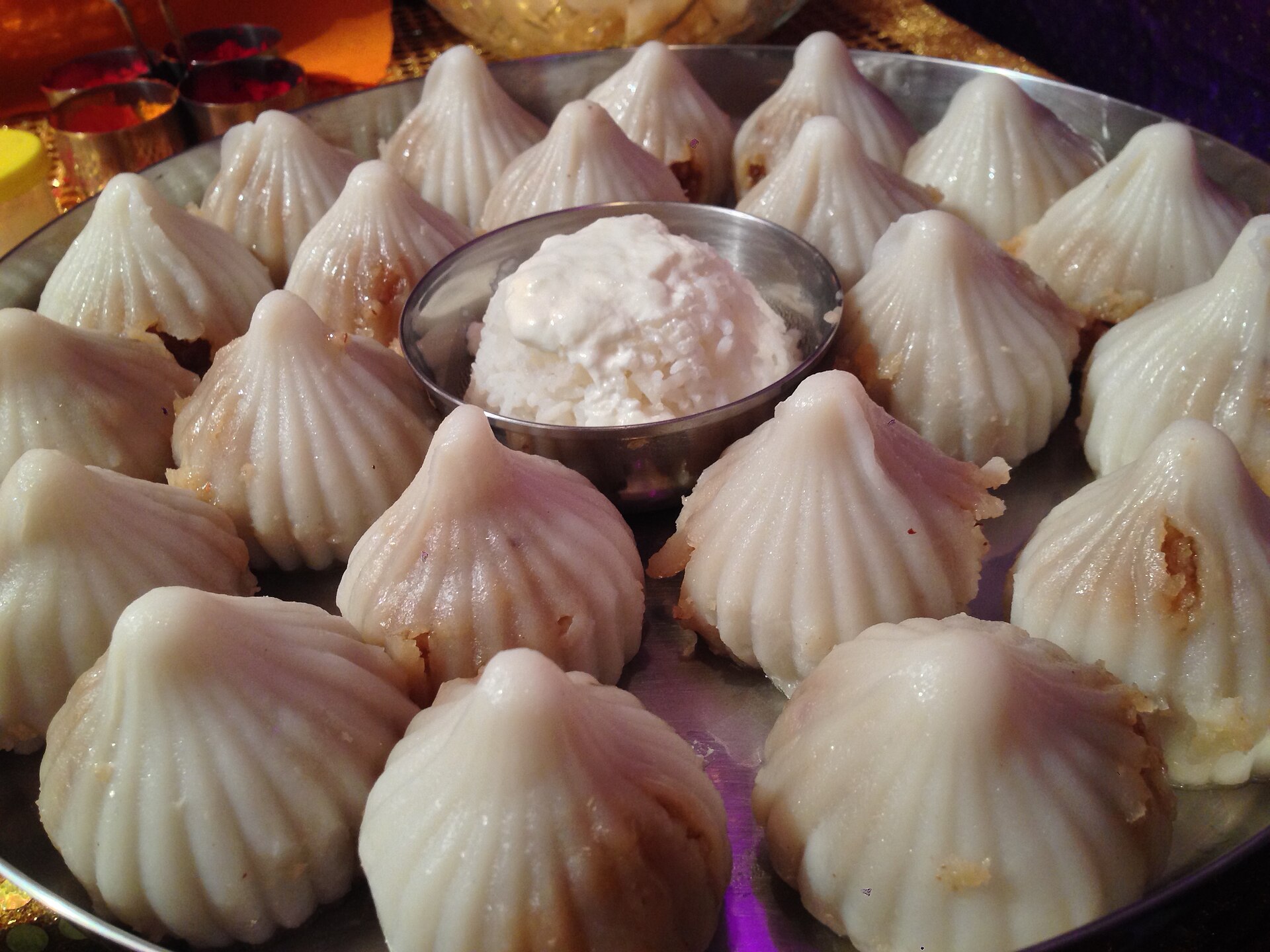
Offerings are specific and stable. Twenty one modaks, steamed rice flour dumplings filled with coconut and jaggery, are the classic naivedya, along with durva grass, red hibiscus and jaggery. The chant that carries the processions, Ganpati Bappa Morya, embeds a name that puzzles many visitors: Morya refers to Morya Gosavi, a saint of Chinchwad near Pune associated with the Morgaon shrine, whose devotion was folded into the acclamation. It is a rare case where a household chant preserves a regional saint's name inside a national festival.
Beyond Maharashtra
Goa keeps Chovoth, where the essential object is the matoli, a canopy of wild fruits, vegetables, tubers and forest produce hung above the deity, a straightforwardly agricultural gesture that has little to do with the Mumbai pandal tradition. In Karnataka, Gauri Habba the previous day honours Ganesha's mother and gives the sequence its logic: the mother arrives, then the son comes to fetch her home. Tamil Nadu's Vinayaka Chaturthi centres on kozhukattai, the southern cousin of the modak, and on temple worship rather than street installations. Andhra Pradesh and Telangana favour clay images with turmeric and vermilion, and large civic processions to tanks and rivers.
The ten days end with the walk to the water, dhol and tasha ahead, colour thrown, the image lifted above the crowd, and then the abrupt quiet of an empty pedestal in a front room. That deliberate emptiness, arranged and then accepted, is what distinguishes Ganesh Chaturthi from every other festival in the calendar.
References
- SahapediaGanesh Chaturthi
- Incredible India, Ministry of TourismMaharashtra
- Incredible India, Ministry of TourismGoa
- Indian Culture Portal, Ministry of CultureStories from the Indian Culture Portal
This is a reference article, written from the sources above. It is background, not news reporting.