The Understated Craft of Malayalam Cinema
Reference library · 998 words

Malayalam cinema is the smallest of India's major film industries by revenue and one of the most consistently admired by critics, and the relationship between those two facts is not accidental. Kerala accounted for roughly six per cent of Indian box office revenue in 2022, a fraction of the Telugu, Tamil and Hindi shares. A film made for a state of about thirty five million Malayalam speakers cannot recoup a spectacle budget, and that constraint has pushed the industry, repeatedly, toward writing, performance and observed detail rather than scale.
The beginning was inauspicious. Vigathakumaran, released in 1928 and directed by J. C. Daniel, is the first Malayalam feature and Daniel is called the father of Malayalam cinema, but he was ruined by the venture and no print survives. The first talkie, Balan, came in 1938. The industry consolidated slowly and largely in Chennai rather than Kerala for its first decades, with production shifting decisively to Kerala only later.
The Film Society Generation
Two developments in the 1960s and 1970s set the industry's character. The first was a wave of adaptations from Malayalam literature, in a state with unusually high literacy and an unusually strong publishing culture. Neelakuyil in 1954, directed by Ramu Kariat and P. Bhaskaran and written by Uroob, dealt directly with caste and won the President's silver medal. Chemmeen in 1965, Kariat's adaptation of Thakazhi Sivasankara Pillai's novel, became the first South Indian film to win the National Film Award for Best Feature Film.
The second was the film society movement. Adoor Gopalakrishnan co-founded the Chitralekha Film Society and film cooperative, and his first feature, Swayamvaram in 1972, is generally taken as the start of the Malayalam new wave. It won National Awards for Best Film and Best Director and travelled to festivals in Moscow, London and Paris. Adoor's subsequent work is remarkably disciplined: Elippathayam in 1981, a study of a feudal household decaying in isolation, won the British Film Institute's award for the most original and imaginative film of its year and the Sutherland Trophy at the London Film Festival; Mukhamukham in 1984 provoked a public quarrel with the Kerala left over its portrait of a communist organiser; Mathilukal in 1989 adapted Vaikom Muhammad Basheer's prison memoir in which the protagonist falls in love with a woman he never sees. He received the Padma Shri in 1984, the Dadasaheb Phalke Award in 2004 and the Padma Vibhushan in 2006.
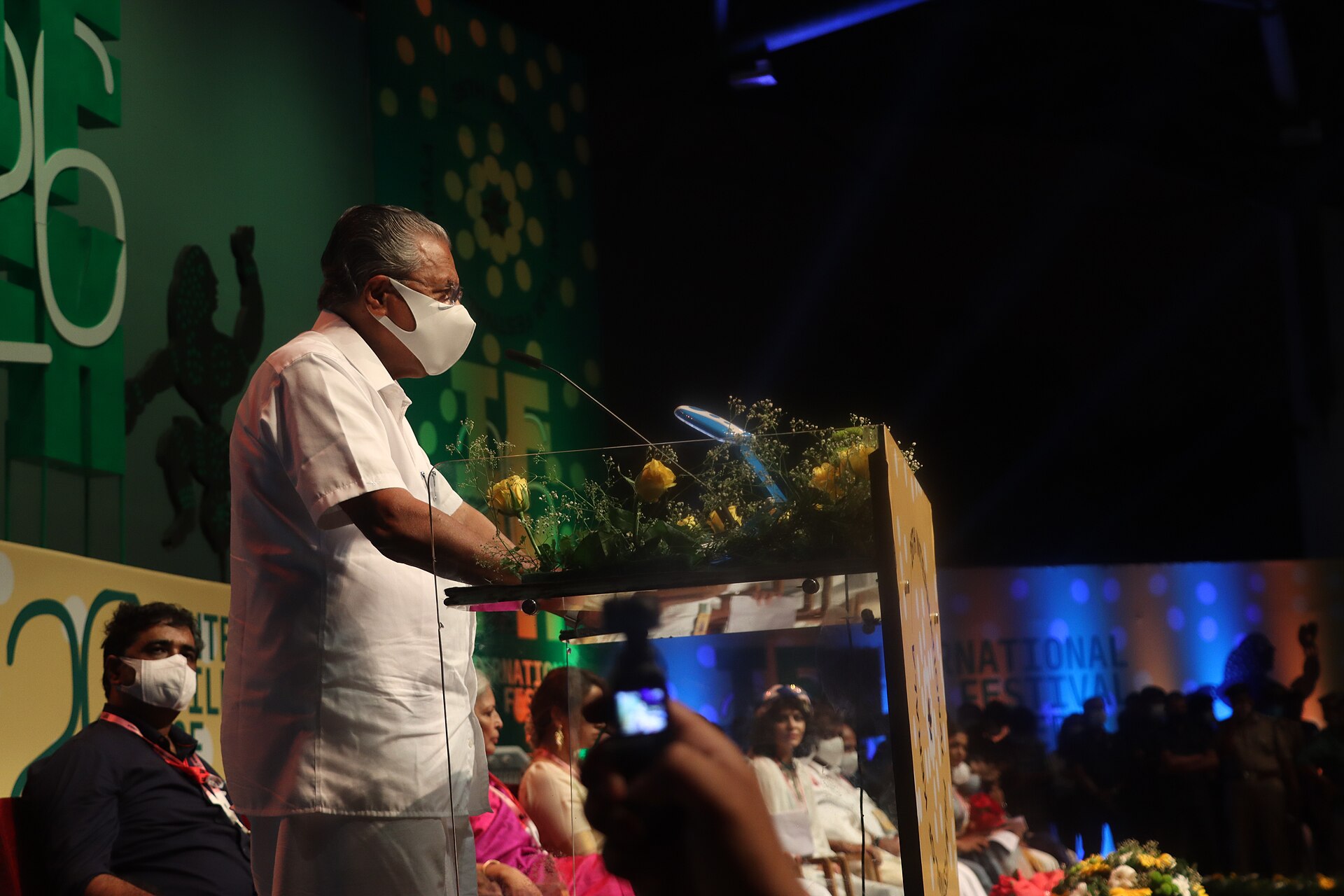
G. Aravindan worked in a looser, more contemplative register in films including Kanchana Sita, Thampu and Esthappan, and John Abraham, associated with the Odessa Collective, took the funding of cinema itself as a political question by raising money from the public and screening in villages. Kerala's parallel cinema was unusual in India for having an audience: state film societies, a strong critical press and, from 1996, the International Film Festival of Kerala gave difficult films somewhere to be seen.
The Middle Cinema That Made the Difference
What distinguishes Kerala from other Indian industries is less the art cinema than the durable middle ground between art and commerce that opened in the 1980s. Padmarajan and Bharathan, both working with a naturalism that neither preached nor pandered, made films about desire, jealousy and small town social pressure that were commercially viable and formally serious. K. G. George brought a cold analytical eye to marriage and to the film industry itself. The screenwriters John Paul, Dennis Joseph and, above all, M. T. Vasudevan Nair, a major novelist who wrote directly for the screen, gave the period its dialogue.
Mammootty and Mohanlal both rose in the early 1980s and have dominated for more than four decades, but the more interesting point is what they were allowed to be. Both built careers alternating between mass entertainers and demanding character work, and neither settled into a single persona in the way that stardom in some neighbouring industries has required. Mohanlal's performances in films such as Kireedam and Mammootty's in Vidheyan, Adoor's adaptation of a Zacharia novella that won him a National Award for Best Actor in 1993, indicate the range that the industry's economics made possible.
The New Wave and Its Reckoning
After a decline in the 1990s and 2000s, when formula comedies and star vehicles dominated, Malayalam cinema went through a widely noted revival from around 2010. The films grouped under the label of the new generation cinema, and the more recent wave that followed, share a preference for locations over sets, non-professional or lightly known casts, ambient sound and plots built from ordinary logistics. Rajeev Ravi, Dileesh Pothan, Lijo Jose Pellissery, Anjali Menon, Aashiq Abu and Sanal Kumar Sasidharan work very differently from one another, but the common ground is a refusal of the establishing gestures of commercial cinema. Jallikattu, directed by Pellissery, was India's official entry for the Academy Award for Best International Feature Film for the ninety third ceremony.
The industry has also confronted its own conduct more directly than most. Following the abduction and assault of a leading actress in 2017, the Women in Cinema Collective was formed and the Kerala government appointed a committee under the retired judge K. Hema to examine the position of women in Malayalam cinema. Its report, submitted in 2019 and released publicly in 2024, described widespread harassment and exclusion and prompted resignations from the industry's main actors' association. No other Indian film industry has produced a comparable state commissioned account of itself.
The romantic version of Malayalam cinema, in which a small industry simply chooses quality, is too flattering. Kerala has produced as much formula as anywhere, and the streaming era has brought budget inflation and pan-Indian ambitions that sit awkwardly with the industry's strengths. What the record does support is narrower and more useful: a state with high literacy, a serious literary culture, an active film society network and a market too small to reward spectacle has, for sixty years, kept making films in which the script is the most expensive thing on screen.
References
- WikipediaMalayalam cinema
- WikipediaAdoor Gopalakrishnan
- WikipediaCinema of India
This is a reference article, written from the sources above. It is background, not news reporting.