The Simple Thread That Is Raksha Bandhan
Reference library · 1037 words
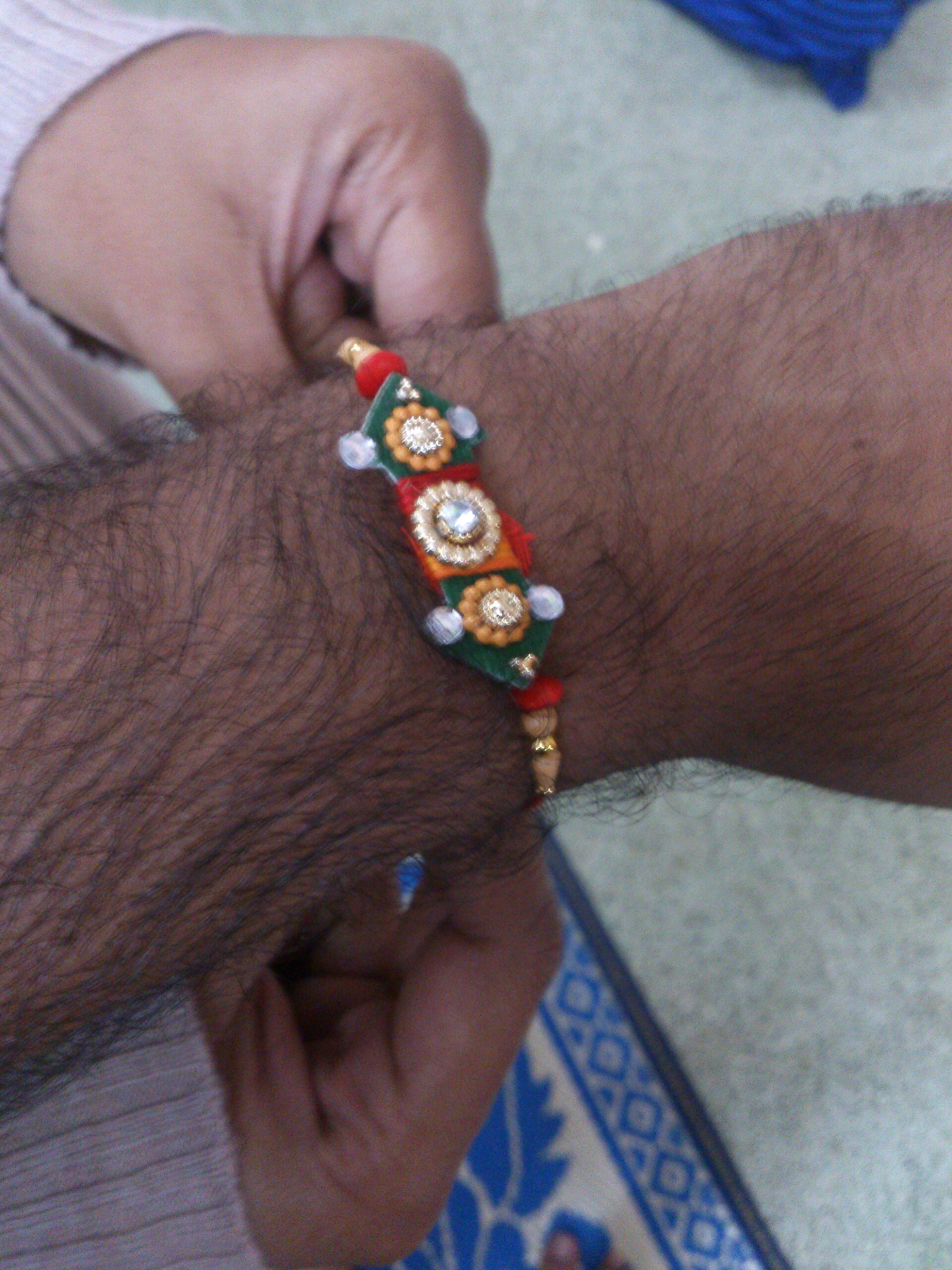

The object at the centre of Raksha Bandhan costs almost nothing. A length of coloured cotton or silk thread, sometimes with a small ornament stitched to it, is tied around a wrist. The name states the transaction plainly: raksha is protection, bandhan is a binding. A sister ties, a brother receives, sweets are exchanged, and money or a gift passes the other way. In its modern popular form it is one of the most legible festivals in the Indian calendar, which is exactly why the things it is not are worth setting out carefully.
The date is Shravana Purnima, the full moon of the month of Shravana, falling in August. That full moon is one of the busiest days in the Hindu ritual year, and Raksha Bandhan shares it with several observances that have nothing to do with siblings. On the Konkan and Maharashtra coast it is Narali Purnima, when fishing communities offer coconuts to the sea and the monsoon fishing ban lifts, marking the point at which boats can safely go out again. Among many Brahmin communities in Tamil Nadu, Andhra Pradesh, Kerala and Maharashtra it is Avani Avittam or Upakarma, the day the sacred thread worn across the torso is ceremonially replaced. In Bengal it is Jhulan Purnima, the swing festival for Radha and Krishna. In Gujarat it is Pavitropana. In parts of Uttar Pradesh and Bihar it is Kajari Purnima, tied to the sowing of barley and to the kajari songs of the rainy season. In Nepal and among Nepali speaking communities it is Janai Purnima, where the same protective thread, there called doro or rakshabandhan, is tied by a priest rather than a sister.
The Thread Is Older Than the Sibling
That last detail is the key to the festival's actual history. Tying a consecrated thread for protection is a very widespread Indian ritual gesture, not a specific sibling one. The red and yellow kalava or mauli knotted on the wrist at the start of any puja, the thread tied by a priest to a patron, the thread tied to a doorway or a vehicle: these all belong to the same family of practices, in which a physical binding stands for an undertaking. Raksha Bandhan as a brother and sister festival is a particular narrowing of that gesture, dominant in north and west India, and it grew into its present near national form during the twentieth century through print culture, calendar art, the postal system and Hindi cinema. In much of Tamil Nadu, Kerala and the northeast it was not traditionally observed at all, and where it is now kept, it usually arrived within living memory.
Several origin stories circulate with far more confidence than the evidence supports. The most repeated is that Rani Karnavati of Chittor sent a rakhi to the Mughal emperor Humayun seeking help against Bahadur Shah of Gujarat. There is no contemporary sixteenth century source for this exchange; it appears in later retellings and became fixed in school textbooks and popular history. Another has Alexander's wife sending a thread to Puru, the ruler the Greeks called Porus, before the battle at the Hydaspes, which is equally unattested. A third has Draupadi tearing a strip from her garment to bind Krishna's bleeding finger, with Krishna repaying the debt later; this scene is not part of the critical text of the Mahabharata in the way it is usually told. A fourth confuses Raksha Bandhan with the story of Yama and the river Yamuna, which properly belongs to Bhai Dooj, the sibling festival that falls after Diwali. Repeating any of these as fact is common. It is still wrong, and a reader is better served by knowing that the festival's antiquity lies in the ritual thread rather than in any of the anecdotes attached to it.
One Documented Political Use
There is, however, a well recorded moment when the thread was deliberately turned outward. In 1905, during the agitation against the first Partition of Bengal, Rabindranath Tagore proposed that Hindus and Muslims in Calcutta tie rakhis on one another as a public demonstration that the province's people would not be administratively separated along communal lines. The mass thread tying that followed is documented, and it established a template that has been reused ever since: rakhis tied to soldiers at border posts, to police officers, to trees in forest protection campaigns, and between women as a statement of solidarity rather than of kinship. Whatever one thinks of these adaptations, they are continuous with the original logic of the object, which is a promise made visible.
How the Day Is Actually Kept
The ritual sequence is short and rarely varies. A thali is prepared with the rakhi, a lamp, rice grains, vermilion and sweets. The sister applies a tilak, performs a small arti, ties the thread on the right wrist, and feeds the brother a mouthful of something sweet, commonly barfi, ladoo or ghewar, the honeycomb textured fried sweet that appears in Rajasthan and western Uttar Pradesh specifically in the monsoon weeks around this festival. He gives cash or a gift and, in the traditional framing, undertakes to look after her. Fasting until the tying is done is customary in some families. In much of Rajasthan and Gujarat there is also a version in which a sister in law ties a lumba rakhi to the bangle of her brother's wife, acknowledging that the obligation runs to the household rather than to one man.
The festival's commercial life is now substantial: postal services in India and abroad publicise despatch deadlines weeks in advance, and the volume of rakhis posted to brothers in Australia, Canada, the United Kingdom and the Gulf is a small annual index of Indian migration. It has also drawn steady criticism from within, on the grounds that a rite in which a woman requests protection encodes an unequal relationship, and many families now treat it simply as a mutual bond, with siblings of any gender tying threads to one another. That argument is unresolved and probably will remain so. What is not in dispute is the durability of the object itself: a piece of cotton, tied in a knot, standing in for something that would otherwise have to be said aloud.
References
- Indian Culture Portal, Ministry of CultureRaksha Bandhan
- Incredible India, Ministry of TourismMaharashtra
- Incredible India, Ministry of TourismRajasthan
- Incredible India, Ministry of TourismUttar Pradesh
This is a reference article, written from the sources above. It is background, not news reporting.