The Quiet Geometry of Warli Art
Reference library · 919 words
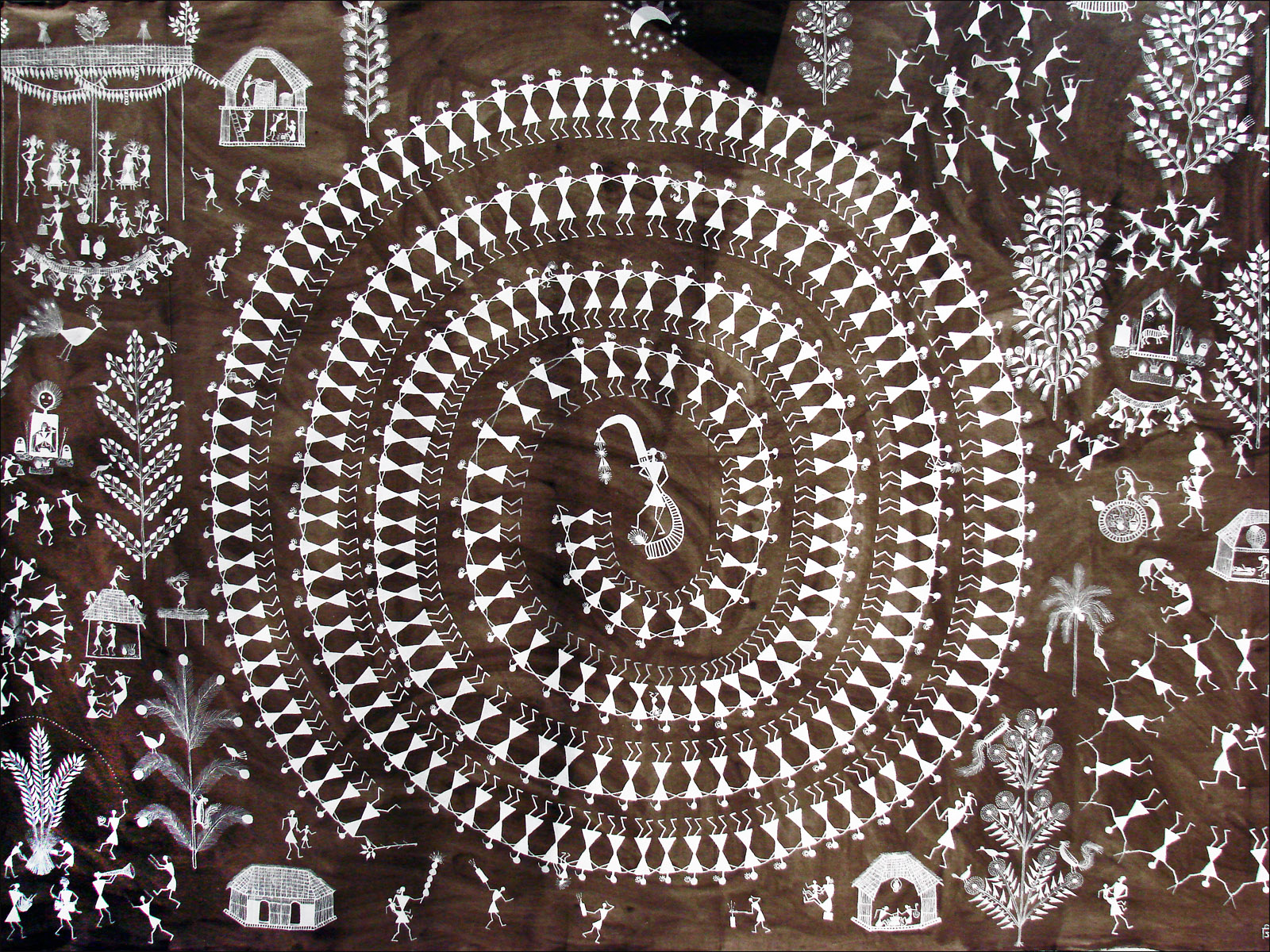

Warli painting is built from three shapes. A circle, a triangle and a square are enough to produce every human figure, every animal, every hut and every dancing chain in the tradition. A person is two triangles meeting at a point, with a circle for a head and single lines for limbs. The economy is severe, and it is not a stylistic choice made in a studio. It is the visual grammar of a ritual practice that had a specific purpose and a specific set of practitioners.
The Warli are an Adivasi community of the northern Sahyadri hills and the coastal strip along the Maharashtra and Gujarat border, concentrated in Palghar district around Dahanu, Talasari, Jawhar, Vikramgad and Mokhada, and extending into Valsad, Navsari and the Dangs. They speak Varli, an unwritten language of the southern Indo-Aryan group. Once semi-nomadic forest dwellers, they are now largely cultivators. The absence of a written language is directly relevant to the painting: for a community without script, a painted wall carries information that elsewhere would be entrusted to text.
The Chauk and the Savasini
The central ritual painting is the chauk or chaukat, a square frame painted on the inner wall of a house for a wedding and for certain other rites of passage. Inside the square sits the mother goddess, usually named Palaghata and understood in connection with fertility and the successful outcome of the marriage. The chauk was traditionally painted not by anyone who could draw but by savasini, married women whose husbands were living, working under ritual constraint. The painting was made because a rite required it. It was not made to be looked at afterwards, and it was not made to be sold.
The materials followed from the setting. The wall was a mixture of earth, cow dung and red laterite, giving a warm dark ground. The pigment was rice flour ground with water, sometimes with gum as a binder, producing an opaque white. The brush was a bamboo stick chewed at one end until the fibres separated. The result is a bright white line on a dull red brown surface, and the strong contrast that makes Warli work so legible in reproduction is simply the contrast between rice paste and a dung plastered wall.
Around the sacred square, and on other walls, the painters recorded the ordinary world: hunting, fishing, sowing and harvesting, the toddy tapper climbing a palm, cattle, tigers, birds, wedding processions, and above all the tarpa dance. In the tarpa scene, men and women link arms and spiral in a chain around a musician playing the tarpa, a wind instrument made from a gourd and bamboo. The spiral is generally understood as a figure of the cycle of life, and it is the single most reproduced image in the entire tradition.
Jivya Soma Mashe and the Move to Paper
The transformation of Warli painting into an art form with named authors is closely associated with Jivya Soma Mashe, who lived from 1934 to 2018. Born at Dhamangaon in Talasari, he lost his mother as a small child and, by the account given in his own community, stopped speaking for a period and communicated through drawings in the dust. From the 1970s he began painting continuously rather than only for rituals, and as a man he was working outside the traditional rule that the sacred paintings belonged to married women. He was also willing to compose freely, filling large surfaces with dense, teeming scenes rather than the prescribed ritual layout. He received the National Award for Tribal Art in 1976, the Shilp Guru honour in 2002, a Prince Claus Award in 2009 and the Padma Shri in 2011, and he was given a state funeral.
Once the work moved onto paper, cloth and canvas, and once government emporia, exhibitions and export buyers entered the picture, the economics changed faster than the imagery. Warli motifs are now applied to textiles, ceramics, hotel interiors, corporate murals and advertising, frequently by designers with no connection to the community and with no payment flowing back to it. This is the tradition's central contemporary tension: a visual language that is instantly recognisable and trivially easy to imitate, produced by a community with very little commercial leverage. Attempts have been made to protect the form through collective marks and cooperative selling, with mixed results.
How Old Is It, Really
Popular writing routinely dates Warli painting to around 2500 BCE, or alternatively to the tenth century of the common era, and these figures are repeated so often that they read as established fact. They are not. Rice paste on a mud wall does not survive, and there is no excavated or datable corpus of Warli painting. The early dates rest on formal resemblance to prehistoric rock art elsewhere in India, which shows that stick figure conventions are ancient and widespread, not that this particular tradition is. Sustained outside documentation of Warli wall painting begins in the twentieth century. The sensible statement is that the practice is a long standing ritual tradition of undetermined antiquity, and that its enormous public visibility is a phenomenon of the last fifty years.
None of this diminishes the work. If anything it clarifies what is being looked at. A Warli painting is not a survival from prehistory preserved in amber. It is a living ritual practice that, within one lifetime, was taken up by named artists, carried onto portable surfaces, exhibited internationally and then widely copied, and it has been negotiating the consequences ever since.
References
- WikipediaWarli painting
- WikipediaWarli
- WikipediaJivya Soma Mashe
- Indira Gandhi National Centre for the ArtsIndira Gandhi National Centre for the Arts
This is a reference article, written from the sources above. It is background, not news reporting.