The Patient Precision of Ikat Weaving
Reference library · 1100 words
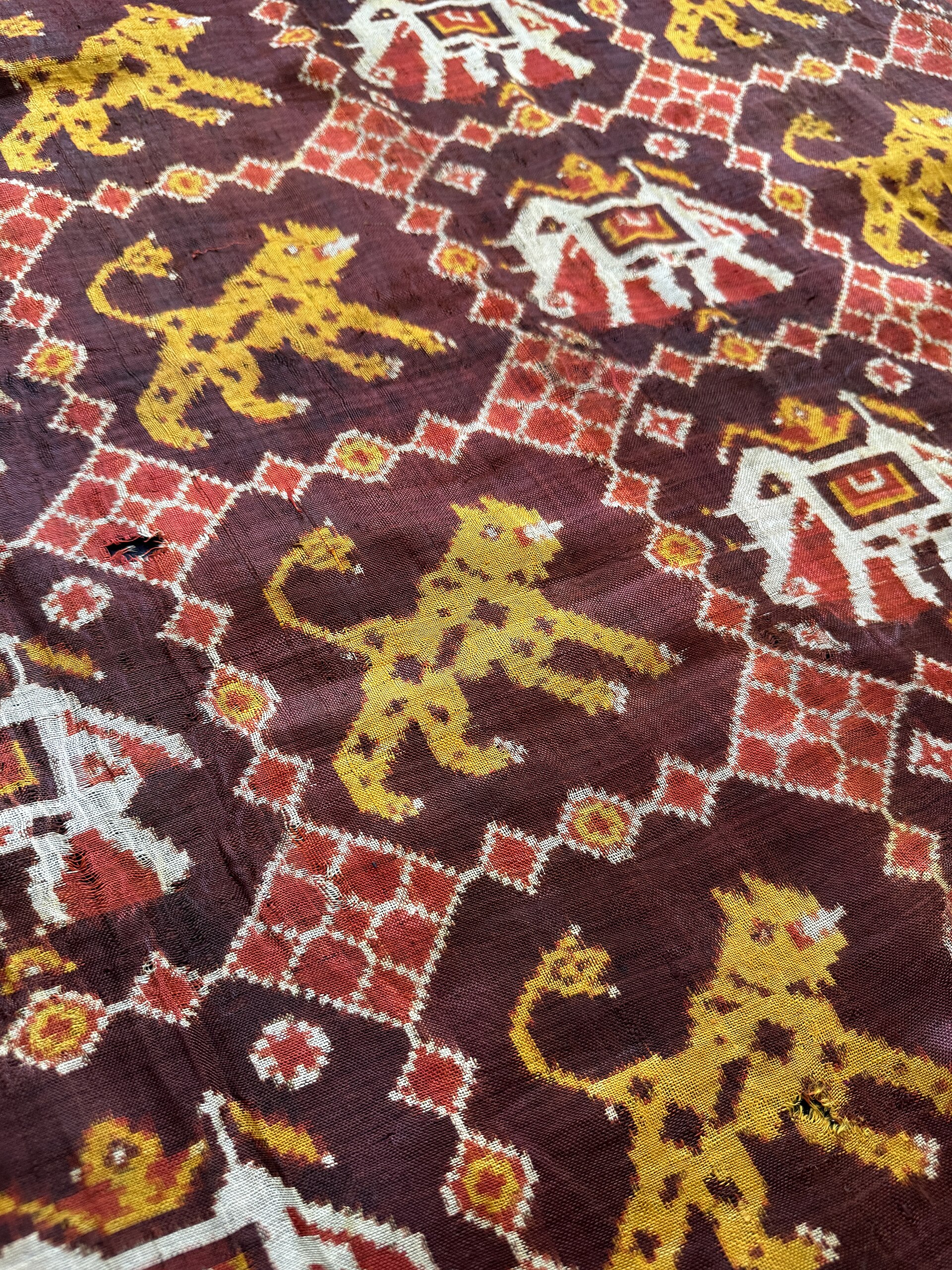

Most patterned cloth is decorated after it exists. Ikat reverses that order. The pattern is dyed into the yarn before a single thread is put on the loom, so the design exists first as a calculation, then as a bundle of tied and dyed threads, and only afterwards as fabric. Nothing is printed, nothing is embroidered, and the colour goes all the way through, which is why a true ikat looks identical on both faces. The characteristic soft feathering at the edge of every motif is not a flaw or a fading effect. It is the small unavoidable slippage between where the dyer intended a colour boundary and where the weaver's beat actually places it, and skilled buyers read it as the signature of the technique.
One Word, Three Techniques
The word itself is worth explaining, because it misleads people about origins. Ikat comes from Malay and Indonesian, from a root meaning to tie or bind, and it entered European and then global usage through Dutch scholarship on Indonesian textiles in the early twentieth century. It became the international term for the technique wherever it occurs. Indian weavers do not traditionally use it: Odisha says bandha, Gujarat says patola for its own product, Telangana and Andhra Pradesh use pagdu bandhu, buddavasi and chitki for different methods. That an Indonesian word names an Indian craft tells you about the history of textile scholarship, not about where the craft began.
There are three forms. In warp ikat, only the lengthwise threads are resist dyed, and the pattern appears as soon as the warp is stretched on the loom, before any weaving. In weft ikat, only the crosswise threads carry the design, and the weaver must adjust the beat of every pick to keep the motif from wandering. In double ikat, both warp and weft are dyed and the two must be aligned so that the colours meet exactly where the design requires. Double ikat is extraordinarily demanding and is made in only a handful of places on earth: Patan in Gujarat, a small number of villages in Telangana, the kasuri traditions of Japan, and the sacred geringsing cloths of Tenganan in Bali.
The process is the same everywhere in outline. The yarn is degummed and prepared, then wound in an exact order on a frame so that every thread's position in the future cloth is known. Sections are wrapped tightly with rubber or plastic strip, or in older practice with cotton thread or plant fibre, to keep dye out. The bundle goes into the lightest dye bath first, is dried, some ties are cut and others added, and the sequence repeats through successively darker colours, since a dyed thread can be made darker but not lighter. Only when every bath is finished is the yarn unwrapped, straightened, and dressed on the loom. A mistake in the tying cannot be repaired later; it is woven permanently into the cloth.
Patan, Pochampally and Nuapatna
Patan in north Gujarat makes the double ikat silk patola, worked by a very small number of Salvi families. Motifs are named and largely geometric or stylised: narikunj with its women, elephants and parrots, pan bhat of leaf forms, ratan chowk, navratna bhat. A single sari can occupy a family for many months, and prices reflect that. Patola were a major export commodity, and in the islands of Indonesia, at Toraja in Sulawesi, in Flores and in Sumatra, Gujarati patola were kept as sacred heirlooms and influenced local weaving design. This trade is documented by surviving cloths in museum collections. A related but separate body of evidence, the medieval Gujarati cotton fragments recovered at Fustat in Egypt, concerns block printed rather than ikat cloth, and the two are often merged. Rajkot, elsewhere in Gujarat, produces a single ikat patola in which only the weft carries the design. It is genuine, skilled and far cheaper, and is frequently sold to unwary buyers as Patan work.
In Telangana, Bhoodan Pochampally in Nalgonda district gives its name to Pochampally ikat, which carries a geographical indication. Most Pochampally is single ikat, with the sharper double ikat work associated particularly with the nearby village of Puttapaka. The tradition's older ancestor is the telia rumal, a square cotton cloth whose name comes from oil. The yarn is worked for weeks with a paste of oil and alkaline ash before dyeing, a treatment that softens the cotton, helps it take deep alizarin red and black, and leaves a distinctive smell. Chirala on the Andhra coast was the historic centre, and the cloths were worn as head cloths and waist cloths and exported to the Gulf, Aden and Burma. The craft came close to extinction and survives through revival efforts by a small number of weaver families.
Odisha's bandha is different in feel. Centred on Bargarh, Sonepur, Sambalpur and Nuapatna, it favours curvilinear and figurative motifs, the conch, the wheel, the lotus, fish, deer and flowering creepers, and a characteristically feathery outline produced by a different combing and tying method. At Nuapatna in Cuttack district, weavers produce cloth with verses of Jayadeva's Gitagovinda woven into it in the Odia script, made for use at the Jagannath temple at Puri. Weaving text into ikat, where every letter must be dyed into the yarn before the loom knows it exists, is about as hard as the technique gets.
Claims, Copies and Prices
Where ikat began is not settled, and anyone who tells you confidently is overreaching. The technique is documented over long periods in India, in insular Southeast Asia, in Central Asia and in Japan, and the arguments for diffusion across the Indian Ocean and for independent invention in several places all have serious support. Indian states also press competing claims of primacy, Gujarat against Odisha against Telangana, usually as heritage promotion rather than evidence. The presence of a Malay derived name is not an argument for Southeast Asian origin, and the export of patola eastward is not an argument for Indian origin either; both are facts about trade.
The practical risk for a buyer is simpler. Power looms and screen printing produce cloth marketed as ikat print, and the distinction is easy to check: printed cloth is paler on the reverse, and its motif edges are crisp rather than feathered. Genuine ikat is slow, and the price has to carry months of unpaid, uninsured skilled labour. Geographical indication registrations exist for several of these traditions, but enforcement against imitation is weak, and the surest protection is buying in the weaving town itself, where the tied bundles can be shown before the dye pot.
References
- Indian Culture Portal, Ministry of CultureTextiles and Fabrics of India
- Indian Culture Portal, Ministry of CulturePatola Sarees
- Incredible India, Ministry of TourismPochampally Ikat
- Gujarat TourismPatan Patola Heritage Museum
- Virtual Museum of Images and SoundsTelia Rumal
This is a reference article, written from the sources above. It is background, not news reporting.