The Long Resonance of the Sitar
Reference library · 983 words
.jpg)
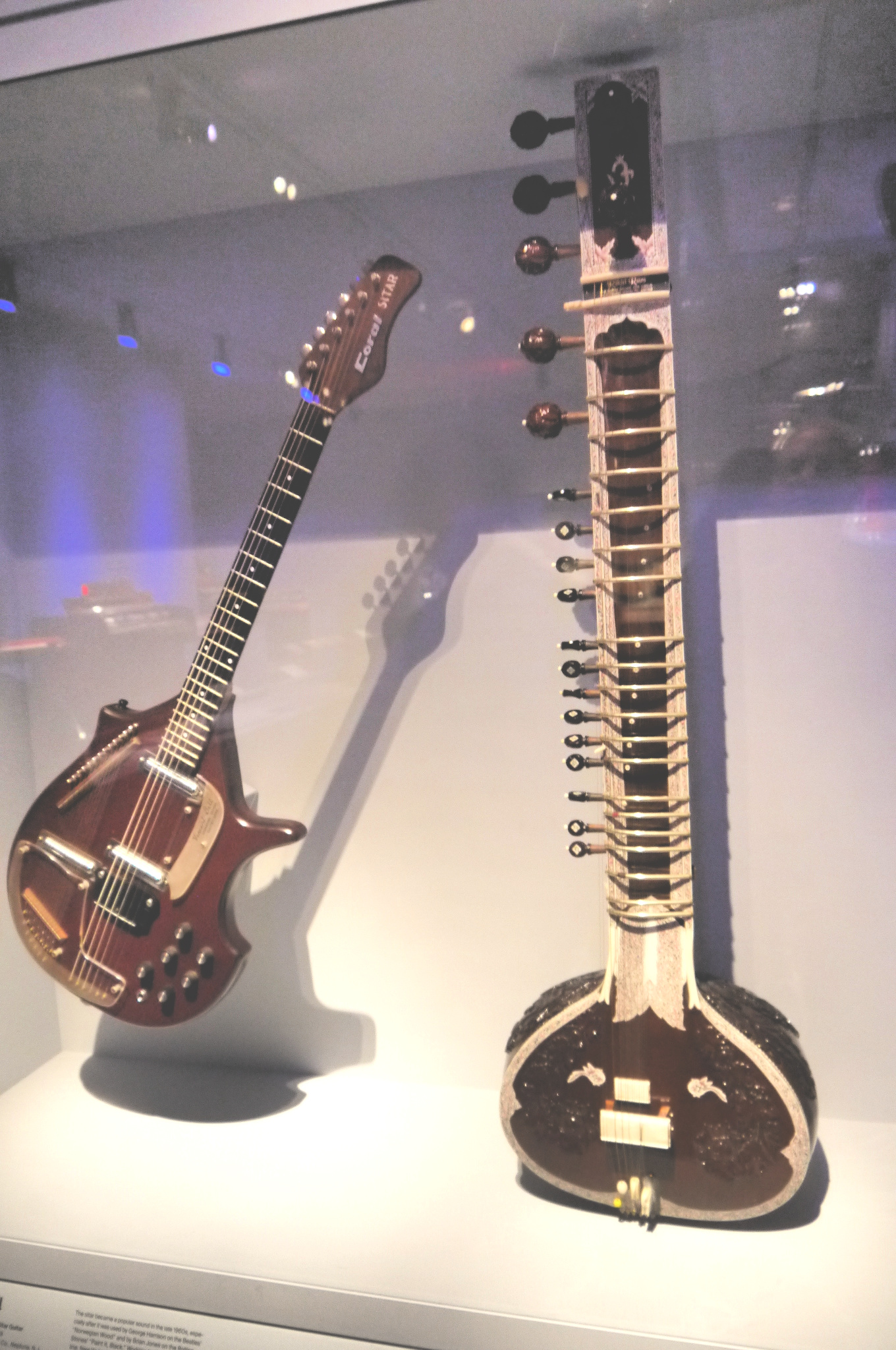
Strike one string on a sitar and something like twenty things happen. The note itself rings, the bridge feeds it a shimmering halo of overtones, the drone strings behind it answer, and a bank of thin wires running beneath the frets, never touched by the player, begins to sound on its own. The instrument is built so that a single deliberate act produces a cloud of sympathetic consequence, and every design decision in it serves that end.
The body is a resonator made from a large dried gourd, cut and faced with a wooden soundboard, joined to a long hollow neck of teak or tun wood. Many instruments carry a second gourd, the tumba, fixed near the top of the neck, which adds resonance and helps balance the weight across the player's body. The neck carries somewhere between sixteen and twenty two arched metal frets, and crucially these frets are tied on with thread rather than fixed. They can be slid along the neck to reposition the intervals for a particular raga. A sitar is therefore not a fixed pitch instrument in the way a guitar is; it is retuned in its geometry, not just its strings.
Jawari, Meend and the Sound Itself
The most important component is the least visible. A sitar's main bridge is not a knife edge but a broad, gently curved plateau, usually of bone or horn, across which the string lies. As the string vibrates it makes and breaks contact with this curve, and that repeated grazing generates the buzzing, sustained, overtone rich tone that defines the instrument. Shaping and maintaining that curve is called jawari, and it is a specialist craft. A bridge with too little curve sounds thin and dead; too much and the note collapses into noise. Instruments are sent back to makers for rejawari the way a piano is sent for regulation.
The arched frets serve a second purpose beyond intonation. Because they stand clear of the neck, the playing string can be pulled sideways across the fret rather than pressed straight down, and pulling raises the pitch continuously. A skilled player can bend a single stopped note upward by five scale degrees or more, producing meend, the sliding connection between pitches that is fundamental to Hindustani melody. Indian classical music treats the movement between notes as musical material in its own right, not as an ornament, and the sitar's fret and bridge design exists to make that movement possible.
Beneath the frets run the tarab strings, commonly eleven to thirteen of them, tuned to the notes of the raga being played and never plucked. They vibrate in sympathy, so the instrument continues to sound after the player stops, in the notes appropriate to that raga and no others. Alongside the main playing strings are chikari strings, drone strings struck rhythmically with the little finger, which supply pulse and tonal anchor. The player wears a wire plectrum, the mizrab, on the index finger.
Two Sounds, Two Lineages
Modern sitar playing divides into two broad approaches, and instruments are built differently for each. The style associated with Ravi Shankar, who lived from 1920 to 2012, uses a heavily decorated instrument with carved floral or grape motifs and celluloid inlay, typically with thirteen sympathetic strings, and a playing approach derived from the Maihar lineage of Allauddin Khan, under whom Shankar trained from 1938. This approach draws on been and dhrupad instrumental vocabulary, with elaborate rhythmic development, fast jhala passages and extended interplay with the tabla.
The other, associated with Vilayat Khan, who lived from 1928 to 2004, is gayaki ang, the vocal manner. Vilayat Khan belonged to the Imdadkhani or Etawah gharana and represented a sixth generation of hereditary musicians. He set out to make the sitar imitate the human singing voice, developing techniques for bending a note after it had been struck so the pitch moved without a further pluck, and he modified the instrument to suit, favouring a plainer build and altering the string arrangement. He also composed the music for Satyajit Ray's Jalsaghar, for which he received a silver medal at the first Moscow International Film Festival in 1959.
The distinction between these two schools has been sharpened in retrospect and it can be overstated, since both players drew freely on each other's innovations and both were far more versatile than the labels suggest. But it is a real difference of priority: one lineage asks what a string instrument can do that a voice cannot, and the other asks how closely a string instrument can approach a voice.
The Origin Story That Will Not Die
Almost every popular account states that Amir Khusrau invented the sitar in the thirteenth century, sometimes adding that he adapted a three stringed Indian veena. Scholarship regards this as discredited. There is no record of an instrument called sitar from Khusrau's period. The name is Persian, from seh tar, meaning three strings, and points to the Persian setar family. The instrument as recognised today is now generally traced to the eighteenth century Mughal court and to a musician known as Khusrau Khan, whose name almost certainly explains how the older Khusrau came to be credited. It is a clean example of how a similar name plus a famous figure will, given a few centuries, produce a confident historical claim with nothing behind it.
The sitar's global fame came from a narrow window in the 1960s. George Harrison studied with Ravi Shankar, the instrument appeared on Beatles recordings, and a generation of Western listeners came to associate a single timbre with an entire subcontinent. Shankar had an ambivalent relationship with this, since the audiences it brought him often expected exoticism rather than a two hour raga exposition. Nearly six decades on, the sitar remains the most recognisable Indian instrument in the world and, for the same reason, one of the most misunderstood.
References
- WikipediaSitar
- WikipediaRavi Shankar
- WikipediaVilayat Khan
- WikipediaGharana
- Sangeet Natak AkademiSangeet Natak Akademi, Ministry of Culture, Government of India
This is a reference article, written from the sources above. It is background, not news reporting.