The Layered Legacy of Hyderabadi Biryani
Reference library · 940 words

Biryani is the most argued about dish in India, and Hyderabad occupies the loudest corner of the argument. What makes the Hyderabadi version worth understanding is not that it is the best, a claim no one can settle, but that it is technically the most demanding, because in its classic form the meat and the rice are cooked together from raw in a sealed pot and there is no opportunity to correct anything once the lid goes on.
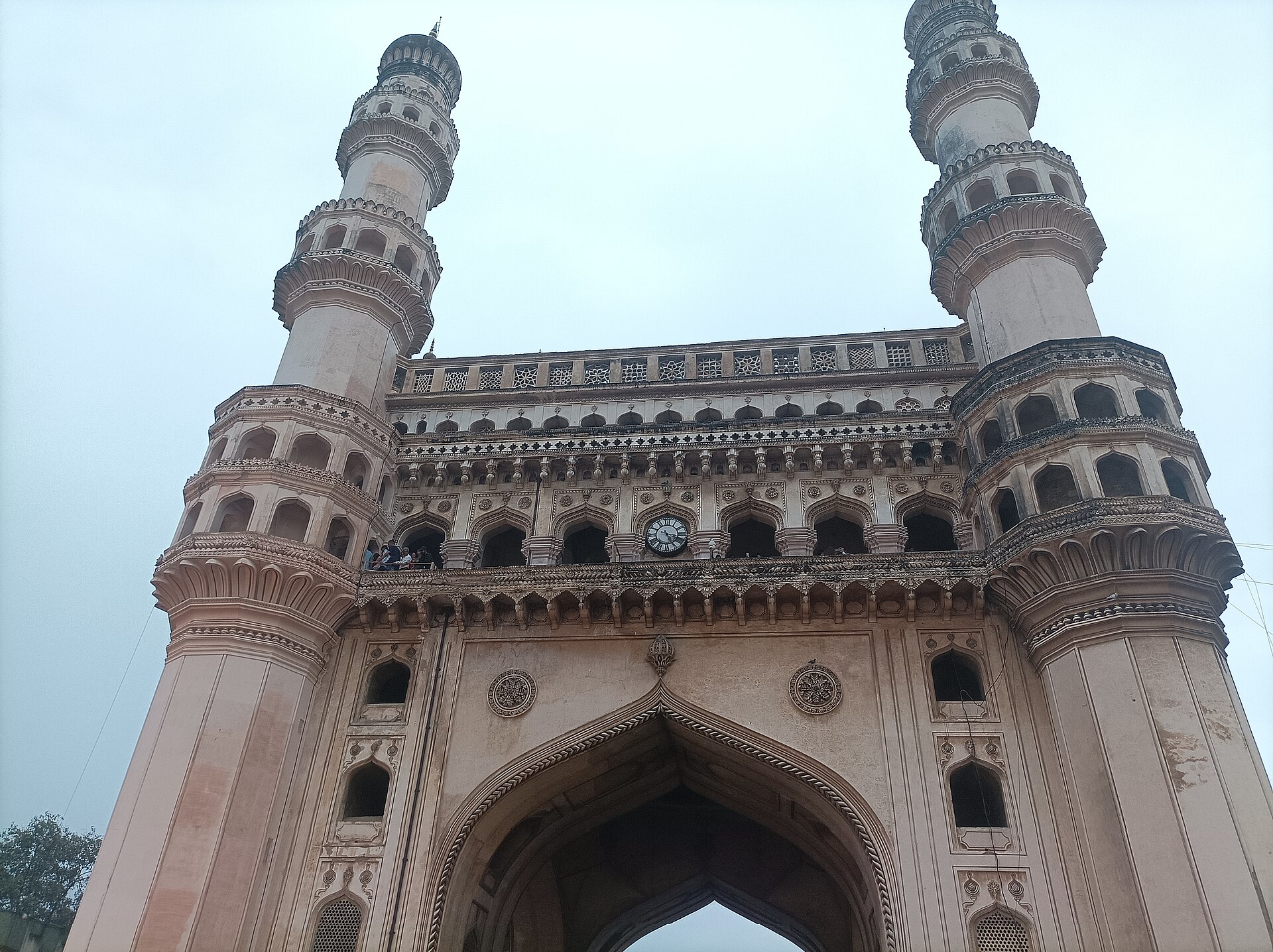
The dish sits at a genuine cultural junction. Hyderabad was founded in the late sixteenth century by the Qutb Shahi rulers and from 1724 was the seat of the Asaf Jahi Nizams, a dynasty of northern origin governing a Deccan territory. Its kitchens therefore inherited the Persianate and Mughal rice tradition of the north, with its saffron, its ghee, its whole spices and its sealed pot cooking, and set it down among Telugu and Marathwada foodways built on chilli, tamarind, curry leaf, sesame and peanut. Almost every accompaniment on a Hyderabadi biryani plate comes from the second tradition rather than the first, which is why the dish tastes distinctly southern despite its northern ancestry.
Kachchi and pakki
The two methods matter more than any ingredient list. In pakki biryani, the meat is cooked to doneness first in a gravy, then layered with parboiled rice and finished briefly so the flavours marry. It is forgiving and is what most restaurants outside Hyderabad actually serve. In kachchi biryani, raw marinated meat goes into the base of the vessel, parboiled rice is piled over it, and the whole thing cooks together. Getting that right requires the meat and the rice to reach doneness in the same window, which is why goat meat on the bone is standard, why the marinade includes yoghurt and often raw papaya as a tenderiser, and why the pieces are cut to a consistent size.
The seal is the other half of the technique. The pot, traditionally a wide copper or brass degh, is closed with a lid luted on with a rope of wheat dough, and cooked over a low fire with coals sometimes placed on the lid so heat comes from above as well as below. This is dum, and it is not merely slow cooking. Sealing traps steam and aromatic volatiles that would otherwise be lost, so the rice absorbs the fat, saffron and spice released by the meat rather than the kitchen absorbing it. Break the seal early and the dish is finished, in the wrong sense. The layering is deliberate: fried onions, or birista, mint, green chilli, lemon and saffron steeped in warm milk are distributed between the strata so that no two spoonfuls are identical.
The accompaniments are not optional garnishes. Mirchi ka salan, long green chillies in a sauce thickened with peanut, sesame and coconut and soured with tamarind, supplies the acidity and heat the rice deliberately lacks. Dahi ki chutney or a thin raita with onion and mint cools it. Baghara baingan, small aubergines in a related peanut and sesame sauce, often appears alongside. Take those away and the biryani reads as heavy, which tells you it was composed as a plate rather than a dish.
Rice selection is treated as seriously as the meat. Long grain aged basmati is preferred because ageing reduces moisture and starch stickiness, so the grains stay separate and elongate rather than swelling and breaking. The rice is soaked, then boiled in heavily salted water with whole spices such as cardamom, clove, bay and caraway until it is distinctly underdone, because it will finish cooking in the sealed pot on the steam rising from the meat below. Judging that parboil is the skill that separates a good biryani from a porridge, and it cannot be timed reliably from a recipe, since it depends on the age of the particular rice. Cooks test by pressing a grain and looking for a firm white core.
Contested origins
Here the honest position is that nobody knows. The name almost certainly comes from Persian, from words connected with rice and with frying or roasting before cooking, and the technique of cooking meat with rice has deep roots in Persian and Central Asian pilaf traditions. But South Asia also had its own long history of spiced rice dishes, and the notion that biryani arrived fully formed from Persia is a simplification. The much repeated story that the dish was invented by Mumtaz Mahal for undernourished soldiers is a legend with no supporting evidence, and it should be treated as folklore.
Regional claims are equally unresolvable. Lucknow's Awadhi biryani is lighter and more fragrant, closer to a pulao in seasoning. Kolkata's version characteristically includes a potato and a boiled egg, a feature widely explained by the exile of the deposed Nawab of Awadh to the city in the 1850s, an account that is often told though the detail is not firmly documented. Thalassery biryani in Kerala uses the short grained local kaima rice rather than basmati. Ambur and Dindigul in Tamil Nadu, Bhatkal on the Karnataka coast, Sindhi and Memoni versions in Pakistan, and the Bohra communities all have distinct, defensible traditions. Hyderabad's own claim to primacy is a claim about refinement, not about origin.
One further nuance is worth keeping. The line between biryani and pulao is itself contested and is drawn differently in different kitchens. Some cooks distinguish them by whether the rice is cooked separately and layered, others by the ratio of meat to rice, others by whether the dish is finished under seal. A confident definition usually reveals where the person defining it grew up.
References
- WikipediaHyderabadi biryani
- WikipediaBiryani
- WikipediaPulao
- WikipediaNizam of Hyderabad
- WikipediaHyderabad
This is a reference article, written from the sources above. It is background, not news reporting.