The Harvest Beat Behind Bhangra
Reference library · 999 words
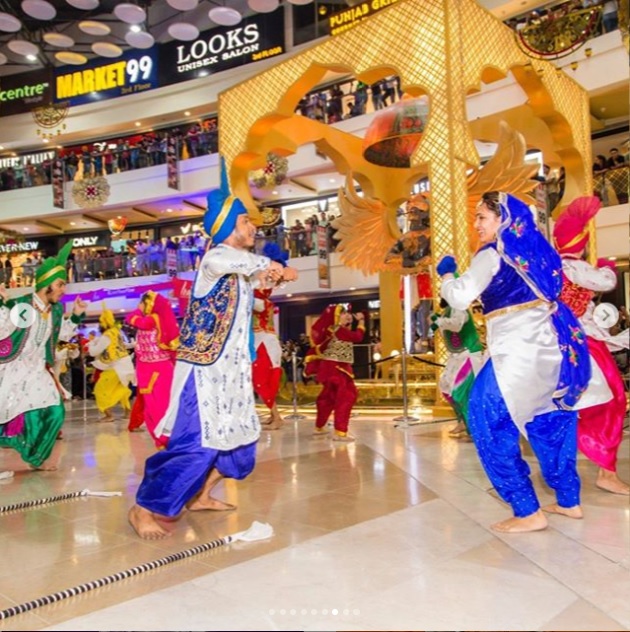

Bhangra is one of the very few folk forms in the world that has been through three complete reinventions inside a single century and remains recognisably itself. It began as a men's harvest dance in the Punjab, was rebuilt in the 1950s as a competitive stage item, and was rebuilt again in Britain in the 1970s and 1980s as a form of recorded popular music. Each version overwrote parts of the last, which is why arguments about what counts as real bhangra have no clean resolution.
The agricultural origin is real but narrower than the popular account suggests. Bhangra belongs to a family of Punjabi folk dances that includes jhumar, luddi, sammi, kikkli, giddha and malwai giddha, and for much of its history bhangra was not the most prominent of them. Jhumar, slower and more circular, was widely considered the more prestigious dance in western Punjab. Bhangra is associated above all with Vaisakhi, which falls on 13 or 14 April in the present century and is fixed by the sun's entry into Mesha, the first sign of the solar zodiac. That solar basis is why the date barely moves from year to year, unlike lunar festivals such as Diwali. Vaisakhi is simultaneously a harvest festival and, since Guru Gobind Singh inaugurated the Khalsa in 1699, a Sikh commemoration, and bhangra is entangled with both.
What the Dhol Actually Does
Everything in bhangra rests on one instrument. The dhol is a double headed barrel drum, the shell traditionally turned from mango or sheesham, with hide or synthetic skins at each end held under tension by interlaced rope or by bolts. It is slung from the shoulder and struck with two very different sticks, and the difference between them is the whole musical argument. The dagga is thick and curved, historically cut from a naturally angled hardwood branch, and it drives the bass head. The tilli or teeli is thin, whippy and cane-like, and it plays the treble head at speed. A dhol player is therefore doing two jobs at once: laying down a heavy low pulse with one hand and a fast, chattering counter rhythm with the other.
The characteristic swing comes from the way those two layers sit against each other. Bhangra rhythms are usually counted in a cycle of eight, with the bass strokes displaced so that the beat lands slightly ahead of or behind the treble pattern rather than squarely on it. Dancers do not count; they follow the dagga. This is also why the form survived transplantation so easily: the essential information is carried by a drum pattern that can be reproduced on a sampler without losing its identity.
Around the dhol sit other Punjabi instruments. The tumbi, a single string plucked instrument with a piercing high tone, supplies the melodic hook that later became bhangra's most sampled sound. The algoze, paired fipple flutes played with circular breathing, the chimta, a fire tong fitted with jingles, and the dholak all appear. The vocal material is often boliyan, short couplets, frequently improvised, frequently comic or barbed, traded between singers rather than sung as continuous song.
The Stage and the Studio
The version of bhangra now performed at weddings and competitions is substantially a mid twentieth century construction. In 1953 a staged bhangra performance was commissioned in connection with the Maharaja of Patiala, and through that decade the Deepak brothers and the dhol player Bhana Ram Sunami developed a choreographed form suited to a proscenium and a fixed time slot. Mohindra College in Patiala hosted competitions that helped standardise it. The consequences were significant: moves from several different Punjabi dances were absorbed into one item, a folk practice acquired judges and scoring, and bhangra was promoted from one dance among many into the emblem of Punjabi identity.
The third reinvention happened outside India altogether. Punjabi migration to Britain concentrated in Birmingham, Southall, Bradford and Wolverhampton, and from the 1970s bands there began putting folk material through Western pop production. The Bhujhangy Group, formed in Birmingham in 1971, is generally credited with the first recordings combining traditional Punjabi song with modern Western instruments. Alaap, formed in 1977 and fronted by Channi Singh, who later received an OBE, became the first genuine bhangra pop stars. Malkit Singh and Golden Star toured widely, and Malkit Singh received an MBE. Bally Sagoo pushed the sound further into bass heavy remix production.
British bhangra developed an economy that the mainstream charts could not see. Cassettes sold in tens of thousands a week through Asian grocers and record shops that were not counted by chart compilers, so a record could be ubiquitous in one community and invisible nationally. Daytime concerts, the so called daytimers, grew up because young British Asians could attend during school and college hours without a confrontation at home. Bhangra in this period was less a folk survival than a youth subculture with its own venues, labels and distribution.
Where It Sits Now
Since the 1990s bhangra has fused repeatedly with hip hop, house, reggae and Punjabi film music, and a bhangra derived hook periodically surfaces in mainstream Western pop. Collegiate bhangra competition circuits in North America and Britain have produced a highly athletic, tightly synchronised style that would be barely recognisable to a Punjabi farmer of the 1930s. In Punjab itself the term now often refers to commercial Punjabi pop rather than to the dance.
Two caveats are worth stating plainly. First, the frequently repeated story that bhangra was danced by farmers in the fields to lighten their work is a plausible tradition rather than a documented history, and the dance's early record is thin. Second, bhangra is often presented as the Punjabi folk dance, which flattens a genuinely diverse regional repertoire in which women's forms such as giddha and sammi had their own long standing place. The modern global form is a real and vital tradition. It is also a recent one, assembled deliberately, by people whose names are known.
References
- WikipediaBhangra (dance)
- WikipediaBhangra (music)
- WikipediaFolk dances of Punjab
- WikipediaDhol
- WikipediaVaisakhi
This is a reference article, written from the sources above. It is background, not news reporting.