The Flowering of the Bengali Literary Renaissance
Reference library · 891 words
.jpg)
Between roughly the 1810s and the 1910s, Bengali went from being a language with almost no printed prose to one carrying novels, journalism, satire, epic poetry, textbooks and philosophical argument at a professional level. That transformation is conventionally called the Bengal Renaissance, and the label is worth examining before the achievement is described, because it does a certain amount of quiet work. It implies a rebirth of something dormant, on the European model, and it flatters a period whose energy was inseparable from colonial rule. Since the 1970s historians have taken a more sceptical view, emphasising that the movement's institutions, patrons and audiences were shaped by the East India Company and its successor state, and that its reach was largely confined to an educated, mostly upper caste Hindu and increasingly Muslim urban class in and around Calcutta. Both things are true: the criticism is fair, and the literature produced is genuinely major.
Printing, prose and Fort William
The precondition was prose. Bengali literature before the nineteenth century was overwhelmingly verse, in forms such as the mangalkavya narrative poems and Vaishnava devotional lyric. There was no settled register for exposition, argument or narrative in plain sentences. The institution that forced one into existence was Fort William College, established in Calcutta on 18 August 1800 by Lord Wellesley to train Company administrators in Indian languages. Wellesley had wanted something grander and was scaled back, but the college needed textbooks, and textbooks required a workable prose.
Two figures matter here. Mrityunjay Vidyalankar, a pandit attached to the college, is often described as the first conscious artist of Bengali prose, producing among other things an early published history in the language. William Carey, the Baptist missionary who taught at the college from 1801, compiled a Bengali grammar and dictionary and oversaw scriptural translation and printing at Serampore. Neither man was writing literature. They were building the plumbing, and the ornate Sanskritised register they favoured would be argued over for the next century.
The college was dissolved in 1854, but by then the machinery had spread: presses, periodicals, a reading public, and a school system. Rammohan Roy, later called the father of the Indian renaissance and the founder of the Brahmo Sabha in 1829, was also a controversialist who wrote and published in Bengali, Persian and English, and who co-founded Hindu College in 1817. Iswar Chandra Vidyasagar, the greatest Sanskritist of the reforming generation, wrote the primers on which Bengali children learned to read and campaigned for widow remarriage, work in which literary and social argument were the same activity.
The making of a modern literature
The first writer to make Bengali carry a modern poetic ambition was Michael Madhusudan Dutt. Having converted to Christianity and spent years writing English verse to little effect, he turned to Bengali and produced in rapid succession Tilottama Sambhava Kavya in 1860, then in 1861 both Meghnadbadh Kavya and Brajangana, and a sonnet collection published in 1866. Meghnadbadh Kavya is the pivotal work: an epic drawn from the Ramayana that takes the side of the demon prince Meghnad and his father Ravana against Rama, written in blank verse that Dutt effectively introduced into Bengali. Both moves were transgressive. Rhyme had been near universal, and rewriting the Ramayana to make its villains tragic was a deliberate provocation.
Prose fiction found its author in Bankim Chandra Chattopadhyay. His first Bengali novel, Durgeshnandini, appeared in 1865, followed by Kapalkundala in 1866, Bishabriksha in 1873, Anandamath in 1882 and Devi Chaudhurani in 1884. In 1872 he founded the journal Bangadarshan, in which much of his later work was serialised, and which became the central literary forum of its generation. Anandamath contains the song Vande Mataram, which personifies the land as mother goddess and later became a nationalist anthem, a legacy complicated both by the novel's hostility toward Muslim rule and by Bankim's own acceptance of British authority. He is called Sahitya Samrat, emperor of literature, in Bengali, and he wrote fourteen novels alongside a large body of essays.
Tagore and after
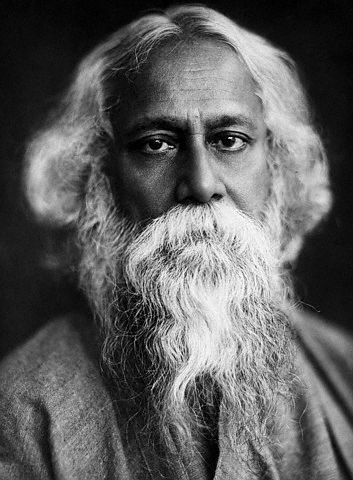
Rabindranath Tagore, awarded the Nobel Prize in Literature in 1913, is usually treated as the movement's summit, and in one sense he was: he wrote across poetry, song, short fiction, novel, drama, essay and painting, and effectively created the modern Bengali short story. But he is better understood as the point at which the project turned on itself. His novels Gora and Ghare Baire interrogate exactly the nationalism and reformist confidence that the preceding generations had built, and his songs, the Rabindrasangeet, embedded literary Bengali into daily domestic life in a way no novel could.
The period's boundaries were also being pushed from outside its original constituency. Kazi Nazrul Islam brought a rebellious, Persianate and explicitly anti colonial voice into Bengali verse, and Rokeya Sakhawat Hossain wrote both fiction and polemic on the education of Muslim women, including a satirical utopia in English. Their presence complicates the standard account, which for a long time treated the movement as a Hindu bhadralok affair.
What the century produced, in the end, was not a rebirth of anything. It was the construction, under colonial conditions and often in argument with them, of a language capable of doing everything a modern literature needs to do. That is a rarer achievement than a renaissance, and the misleading label should not obscure it.
References
- WikipediaBengal Renaissance
- WikipediaFort William College
- WikipediaMichael Madhusudan Dutt
- WikipediaBankim Chandra Chatterjee
This is a reference article, written from the sources above. It is background, not news reporting.