The Enduring Dome: Understanding Buddhist Stupa Architecture
Reference library · 1035 words
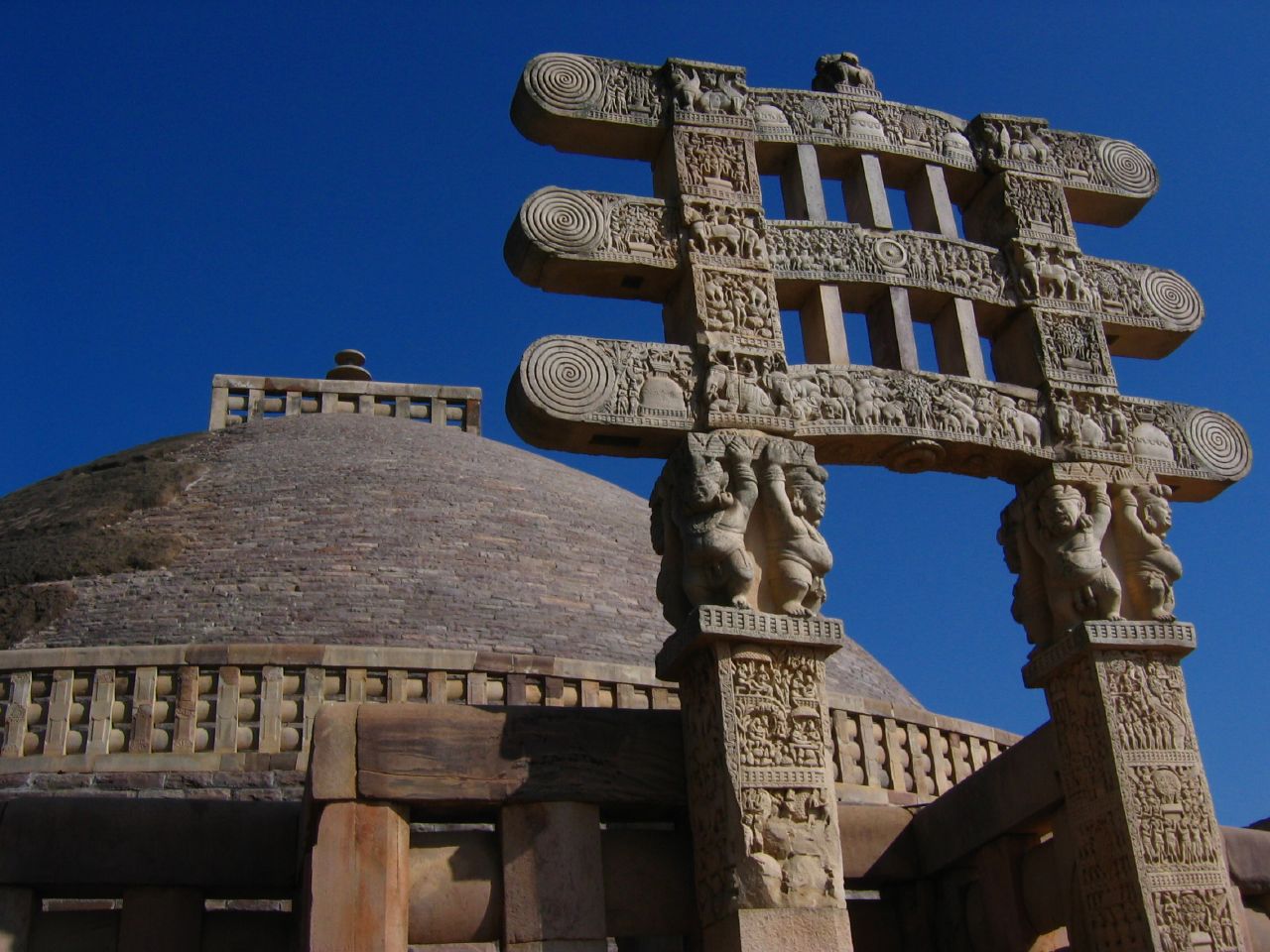

The stupa is the oldest surviving building type in the Buddhist world and one of the strangest. It is not a temple, since nobody goes inside it. It has no interior at all in its classic form: it is a solid mound of brick or rubble faced in stone, with a relic chamber sealed at its heart. Everything a worshipper does at a stupa happens on the outside, walking around it. Understanding that single fact explains almost every element of its design.
Its origins are pre Buddhist. Burial mounds raised over the ashes of holy men, and over the dead more generally, are found across South Asia and around the Mediterranean, and the stupa appears to descend from tumuli in which ascetics were interred in a seated position. Buddhist tradition holds that after the Buddha's cremation his remains were divided and buried beneath eight mounds, at Rajagriha, Vaishali, Kapilavastu, Allakappa, Ramagrama, Pava, Kushinagar and Vethapida, with two further mounds raised over the urn and the embers. The point of continuity is not doctrinal but physical: a mound is what you build over a body.
The parts and what they mean
A developed stupa has a consistent vocabulary. The anda, literally the egg, is the hemispherical dome. Beneath it the medhi is a raised drum or terrace, and around both runs the pradakshina patha, the circumambulation path, sometimes doubled with one path at ground level and a second on the drum. Enclosing the whole is the vedika, a stone railing whose uprights, crossbars and coping imitate timber joinery so exactly that it is clear the earliest versions were wooden fences translated into stone.
At the summit sits the harmika, a small square railed enclosure, and rising from it the yasti, a mast carrying one or more chhatra, stone parasols. The parasol is a straightforward status marker: in Indian court practice a parasol is held over a king, and stacking several signals extreme rank. Piercing the vedika at the four cardinal points are the torana gateways, and their placement means an approaching visitor cannot walk straight at the dome. They must enter and turn, which sets them on the clockwise circuit.
That circuit, pradakshina, is the ritual the building exists to serve. The worshipper keeps the right shoulder toward the monument, an ordinary gesture of respect in Indian custom, and walks. There is no congregation, no priest and no interior sanctum. The architecture is a machine for organised walking around a relic, and its scale is calibrated to how far a crowd can comfortably process.
Sanchi and the imperial phase
The best preserved example is the Great Stupa at Sanchi in Madhya Pradesh, commissioned by the Mauryan emperor Ashoka in the third century BCE as a hemispherical brick structure over relics of the Buddha. Ashoka is credited in tradition with recovering relics from the earlier mounds and redistributing them across a vast number of new stupas, a story whose figure of eighty four thousand is symbolic rather than countable but which does reflect a real imperial programme of relic dispersal. Building stupas was a way of marking territory with legitimacy.
Sanchi was then rebuilt. In the Shunga period, around the second century BCE, the brick core was encased in stone and roughly doubled in diameter, and the terraces and railing were added. The four great gateways came later still, under Satavahana patronage from around the first century BCE, and the southern gateway carries an inscription naming a King Satakarni, generally taken to be Satakarni II. The stupa as we see it is therefore the work of three dynasties across two or three centuries, with each adding a layer rather than replacing what came before.
The gateway carving is where the doctrine becomes visible. The reliefs narrate jataka tales of the Buddha's previous lives and episodes from his final one, and they do so without ever depicting him in human form. He is present as an empty throne, a pair of footprints, a riderless horse, a wheel, a tree. This aniconic convention held for centuries before figural Buddha images emerged in Gandhara and Mathura, and whether it reflects a prohibition, a doctrinal point about the Buddha having passed beyond form, or simply an inherited habit is still argued over.
Sanchi was abandoned as Buddhism receded in central India and stood forgotten until a British officer came upon it in 1818. Early excavation was destructive, with treasure seekers breaching domes. Systematic conservation was carried out under John Marshall of the Archaeological Survey between 1912 and 1919, and the site was inscribed as a World Heritage property in 1989. It appears on the Indian two hundred rupee note.
Migration and transformation
What happened to the form as Buddhism spread is a case study in architectural translation. In Gandhara, in the north west, the drum grew taller and the dome smaller, and the structure began to read as a tower on a high plinth. Pushed further east that vertical emphasis produced the multi eaved timber tower of China, Korea and Japan, the pagoda, a word derived from Pali thupa. A Japanese pagoda and the Sanchi dome look nothing alike, but the pagoda's central mast is the descendant of the yasti and its stacked roofs are the descendants of the chhatra.
Other lineages went differently. In Sri Lanka the dagoba retained the massive hemispherical dome and grew to enormous size, as at Anuradhapura. In Tibet the chorten stylised the parts into an abstract stack of elements associated with the classical elements. In Java, Borobudur turned the whole idea inside out by making the circumambulation path a spiral ascent through terraces of relief panels, so that the pilgrim's route becomes a narrative sequence.
The form also fed back into architecture that was not Buddhist at all. When Edwin Lutyens designed Rashtrapati Bhavan in New Delhi between 1912 and 1929, the dome he produced drew partly on the Pantheon in Rome and partly on early Buddhist stupas, Sanchi in particular, with a railing motif around its base. The reference was chosen carefully: an imperial government looking for an indigenous Indian form to borrow from picked the one associated with Ashoka, the emperor most useful to invoke.
References
- WikipediaStupa
- WikipediaSanchi
- WikipediaRashtrapati Bhavan
This is a reference article, written from the sources above. It is background, not news reporting.