The Bright Storytelling of Madhubani Painting
Reference library · 998 words
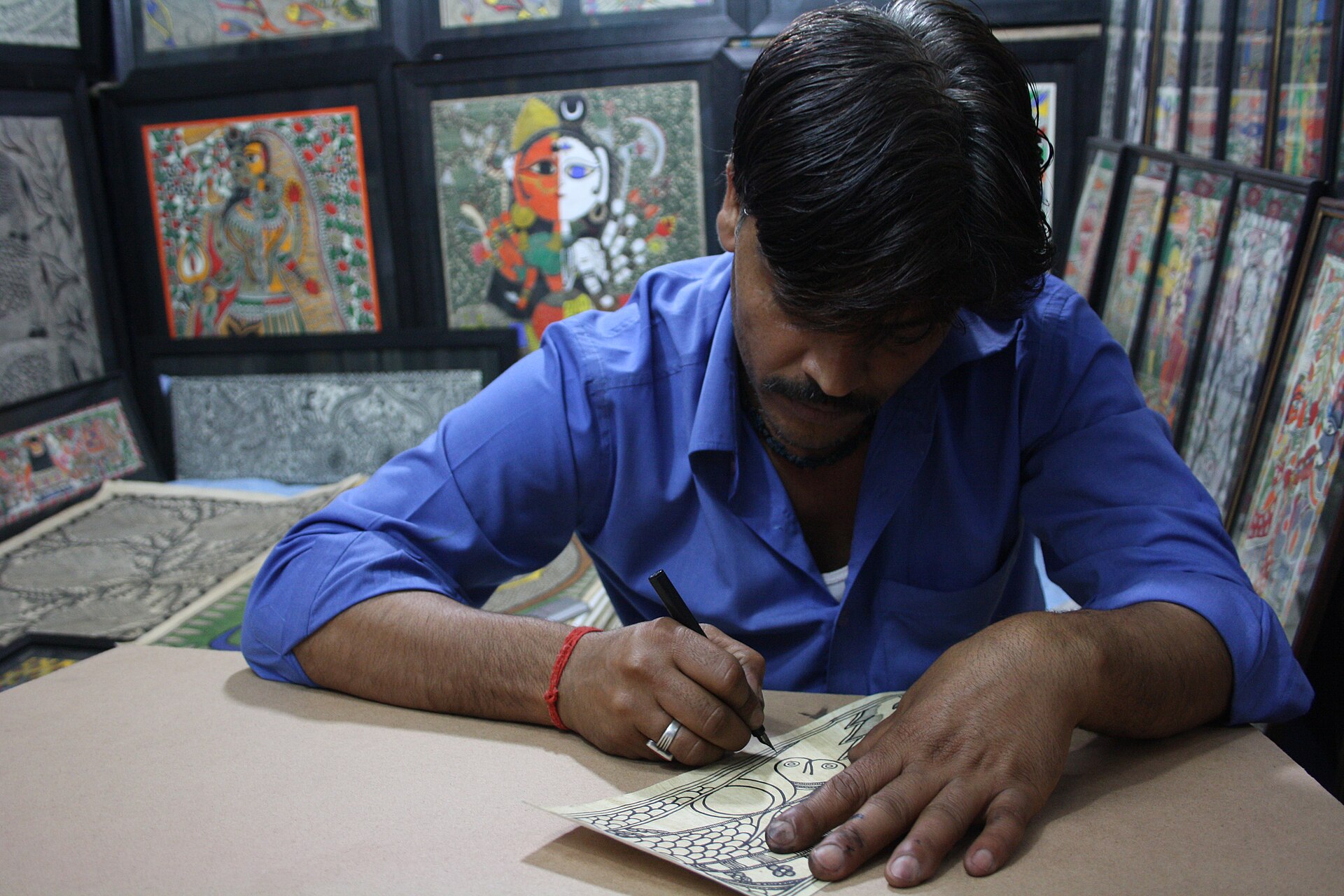

The paintings now sold worldwide as Madhubani began on walls that no longer exist. In the Mithila region, which spans northern Bihar and the Nepali Tarai, women plastered the interior walls of their houses with mud and cow dung and painted on them with brushes made from twigs, cotton wrapped around a stick, or their own fingers. The most important of these surfaces was the kohbar ghar, the nuptial chamber where a newly married couple spent their first nights. Its wall painting was not decoration. It was a ritual object with a job to do, and it was renewed for each marriage and allowed to weather away afterwards.
Two names are used for the same tradition and the difference matters. Mithila is the cultural and linguistic region, associated with the ancient Videha kingdom and with the Maithili language, bounded roughly by the Ganges, the Gandaki, the Mahananda and the Himalayan foothills. Madhubani is a district and a town within it. Scholars and many practitioners prefer Mithila painting because it names the culture; the art market fixed on Madhubani because that is where collectors first bought. Both are defensible, and neither is a translation of the other.
From Wall to Paper
The shift that created the art form as an object of trade happened in the 1960s. Severe drought in Bihar devastated agriculture in the region, and among the responses was an effort to give Mithila women a cash income from a skill they already possessed. Handmade paper was supplied and painters were encouraged to reproduce on it what they had previously painted on plaster. This was not a simple transfer. Wall painting is large, ephemeral, ritually timed and made by groups. Paper painting is small, permanent, commissioned and signed. Once a work could be signed, individual reputations became possible for the first time in a tradition that had been anonymous and collective.
Named artists followed quickly. Jagdamba Devi received the Padma Shri in 1975. Sita Devi received the Padma Shri in 1981 and the Bihar Ratna in 1984. Ganga Devi became known for narrative sequences drawn from her own life and travels, a use of the idiom that had no precedent on a kohbar wall. Karpoori Devi and, in more recent years, Dulari Devi, who received the Padma Shri in 2020, extended the line. The tradition also broke open along caste lines. Painting had been concentrated among Brahmin and Kayastha women, and the entry of Dusadh painters brought the godna style, derived from tattoo patterns, into a repertoire that had previously excluded it.
Styles, Line and Fill
The tradition is usually divided into five approaches, and they are best understood as different answers to the question of how to treat an enclosed shape. Kachni, from the word for line, fills forms with fine monochrome hatching, so the picture is built almost entirely from ruled strokes. Bharni, from the word for filling, uses solid blocks of colour bounded by a heavy black outline, and is the style most people picture when they hear the name Madhubani. Tantrik painting depicts deities and diagrams drawn from tantric ritual texts. Godna reproduces the concentric, repeating geometry of tattoo work. Kohbar keeps the wedding chamber imagery, with its lotus pond, bamboo grove and clustered circular forms.
Certain conventions run through all of them. The picture plane is filled: empty background is avoided, and gaps are packed with fish, birds, flowers, sun and moon discs and repeated geometric filler. There is no linear perspective and no attempt at modelled volume. Figures are shown frontally or in strict profile, and eyes are enlarged and elongated. Colour was historically made on the spot, with lampblack for black, turmeric for yellow, indigo for blue, red from kusum flower or ochre, and green from leaves, bound with gum. Commercial poster paints and acrylics are now normal, and the older mineral and vegetable palette has become a premium selling point rather than a default.
What the Pictures Are Actually About
The recurring subjects reward a second look. Fish, turtles, parrots, bamboo and the lotus are read in the wedding context as symbols of fertility and union, and their density in a kohbar is deliberate rather than decorative. Krishna with the gopis, Rama and Sita, Durga, Kali, Shiva and Ganesha appear constantly, which is unsurprising given the region's association in tradition with Sita's birthplace. But since the move to paper, the same visual language has been used for subjects it was never designed for: village sanitation campaigns, deforestation, dowry, literacy, the Bhopal disaster, and the personal biographies that Ganga Devi painted. That flexibility, not any single motif, is what has kept the form alive.
Mithila painting also has an institutional life that is easy to overlook. Government emporia, the Mithila Museum in Japan, the Ethnic Arts Foundation's teaching work in Madhubani district and a steady flow of exhibitions abroad have all shaped what gets painted, because buyers reward some subjects and sizes more than others. Square paper of a standard size, dense black outlining and instantly readable deities sell; long horizontal narrative scrolls and pale kachni line work sell less easily. Anyone looking at a contemporary Mithila painting is therefore looking at a negotiation between a household idiom and a market, and the more interesting artists in the field are the ones who push back against that pressure rather than settling into a saleable formula.
One popular claim should be treated with caution. It is often stated that the tradition dates to the era of the Ramayana, when King Janaka is said to have commissioned paintings for Sita's wedding. This is a foundation story told within the tradition, not a datable historical record, and the earliest documentation of the wall paintings by outsiders comes only in the twentieth century. The honest position is that the practice is clearly old, that its documented history is short, and that the two facts are not in conflict, because ephemeral art on mud walls leaves no archaeological trace by design.
References
- WikipediaMadhubani art
- WikipediaMithila (region)
- Indira Gandhi National Centre for the ArtsIndira Gandhi National Centre for the Arts
- Victoria and Albert MuseumSouth Asia: Explore the Collections
This is a reference article, written from the sources above. It is background, not news reporting.