The Bold, Busy Flavours of Maharashtrian Street Food
Reference library · 978 words

Maharashtrian street food is engineered around a constraint that most cuisines never face: it has to be eaten standing up, in under five minutes, by someone who is late. Almost every characteristic of it follows from that. The bread is soft and requires no chewing effort. The fillings are pre cooked and reheated to order. Everything is assembled in front of you in seconds. And the seasoning is loud, because a dish eaten quickly and distractedly has to make its point immediately.
The bread deserves the first word, because it is the foundation of the whole Mumbai repertoire and it is not indigenous. Pav is a soft, square, yeast leavened roll baked in a joined tray so the sides tear apart, and the word comes from the Portuguese pao, a legacy of the Portuguese presence on the western coast from the sixteenth century. Wheat bread of this kind entered a rice and millet eating region through colonial and Christian communities, was adopted by Irani and Parsi bakeries, and became the cheap carrier that Bombay's industrial workforce needed.
Vada pav and the mill city
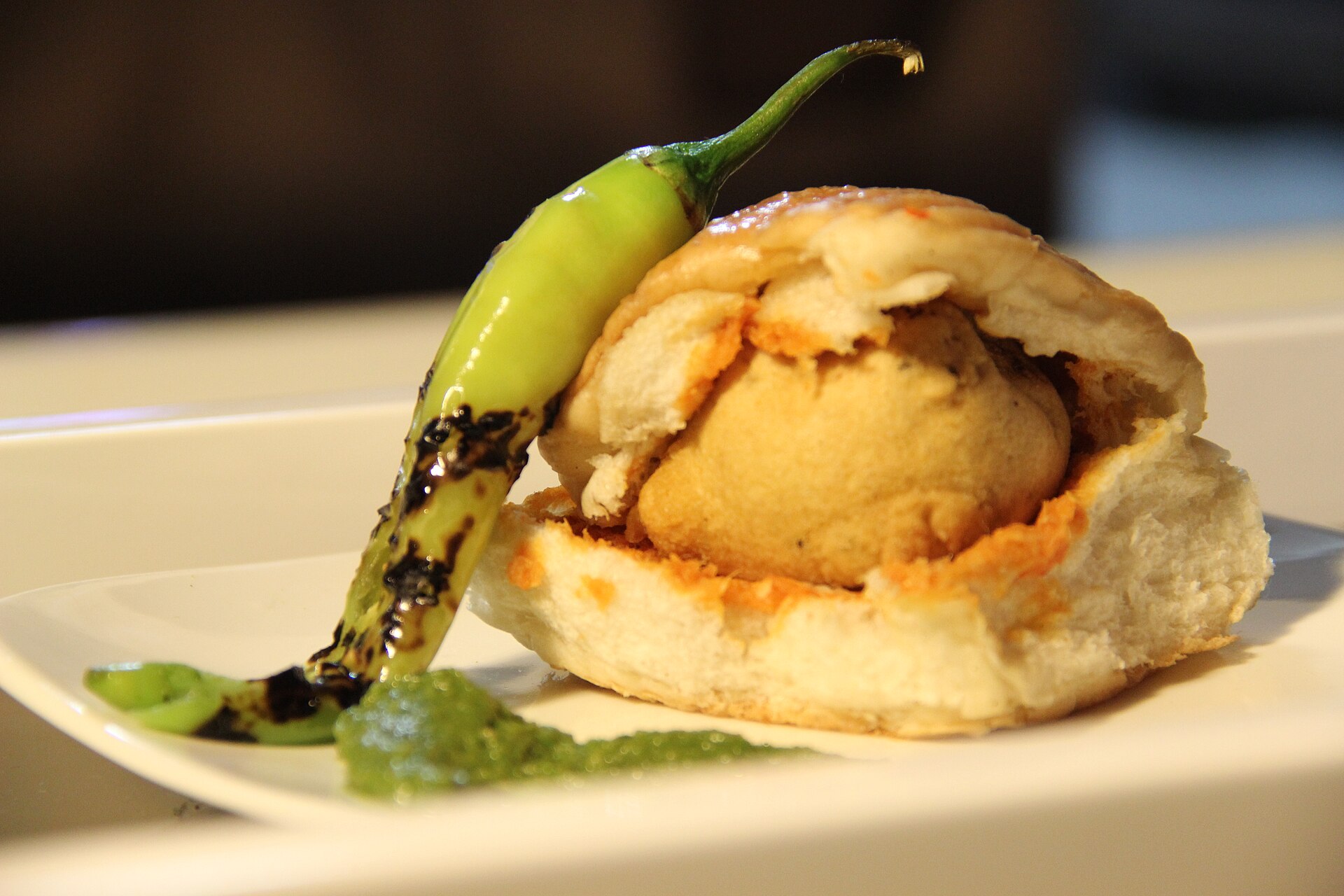
Vada pav is the emblem. A batata vada is spiced mashed potato with turmeric, mustard seed, curry leaf, ginger, garlic and green chilli, rolled into a ball, dipped in gram flour batter and deep fried. It is split into a pav that has been smeared with a coriander and chilli chutney, a sweet tamarind chutney and, essentially, a dry red chutney of garlic, dried coconut and chilli that clings to the bread. A fried green chilli goes alongside, salted. The whole thing costs very little and functions as a complete meal.
Its invention is usually credited to a vendor working outside Dadar railway station in the 1960s or 1970s. That attribution is repeated everywhere but is not firmly documented, and the honest position is that batata vada and pav both already existed and someone, quite possibly several people, put them together. What is better established is the political dimension. Vada pav stalls were promoted from the late 1960s as a source of self employment for Marathi speaking young men in a city where they felt economically displaced, and the snack acquired an identity charge that it has never entirely lost.
Pav bhaji has a comparable origin story and comparable uncertainty. A mash of mixed vegetables, tomato and potato is cooked down on a large flat griddle with a proprietary spice blend and a great deal of butter, then scraped into a portion and served with pav toasted on the same griddle, with raw onion and lemon. It is commonly said to have been devised as a fast midday meal for textile mill workers in the nineteenth century, sometimes tied specifically to the cotton boom of the 1860s. The account is plausible and widely told, but it is a tradition rather than a documented event.
Frying is the shared technology across the whole category, and it is worth understanding why gram flour dominates it. Besan batter contains no gluten, sets fast in hot oil, and forms a shell that stays crisp for a surprisingly long time while trapping steam around a soft interior. That combination is what allows a batata vada to be fried in batches and still be acceptable twenty minutes later on a busy corner, and it is why the same batter carries onion bhaji, chilli fritters and the sliced potato fritters sold alongside them. Rice flour is sometimes added for extra brittleness. The oil is reused across a session, which is part of the flavour and part of the reason street frying is periodically the subject of municipal attention.
Misal, and why Maharashtra is not Mumbai
Misal pav is the dish that reveals the state behind the city. A base of usal, sprouted and cooked moth beans, is topped with farsan or chivda for crunch, raw onion, coriander and lemon, and then flooded with tarri or kat, a fiery red oil floated off the top of the gravy. It is eaten with pav, and the leftover gravy is refilled without charge in most places that take it seriously.
Regional versions differ sharply and their partisans do not agree. Kolhapuri misal is the one with a reputation for genuine heat, built on the local kanda lasun masala of onion, garlic and Lavangi or Sankeshwari chilli. Puneri misal is milder and sweeter. Nashik and Nagpur have their own claims. This is characteristic of the state: Kolhapur and southern Maharashtra cook hot and meat forward, with the paired tambda rassa and pandhra rassa, red and white mutton broths, served together. The Konkan and Malvan coast works with fish, coconut and the sour purple fruit kokum, which yields the pink drink solkadhi. Vidarbha around Nagpur has saoji cooking, ferociously spiced, and its own morning staple of poha with a chilli gravy poured over. Interior Deccan cooking leans on jowar and bajra bhakri, groundnut and goda masala, a distinctive blend that uses dried coconut and the dark lichen called dagad phool.
Mumbai's chaat counter is a separate stream again, assembled by migration. Bhel puri, sev puri and pani puri were carried into the city from Gujarat and the north and reworked locally, which is why the Mumbai versions are sweeter and use a different puri to the ones sold in Delhi or Kolkata. The Bombay frankie, a spiced filling rolled in a griddled flatbread, is generally credited to a Mumbai entrepreneur who launched it in the late 1960s after seeing similar wrapped street food abroad, and unlike most such stories that one is attached to a still trading business. Seasonal habits complete the picture: onion bhaji in the monsoon, and sabudana vada and khichdi made from tapioca pearls and peanuts during fasting periods, which is how a religious dietary rule ended up producing one of the best snacks in the state.
References
- WikipediaVada pav
- WikipediaPav bhaji
- WikipediaMisal
- WikipediaMaharashtrian cuisine
This is a reference article, written from the sources above. It is background, not news reporting.