Rabindranath Tagore's Enduring Literary Legacy
Reference library · 941 words
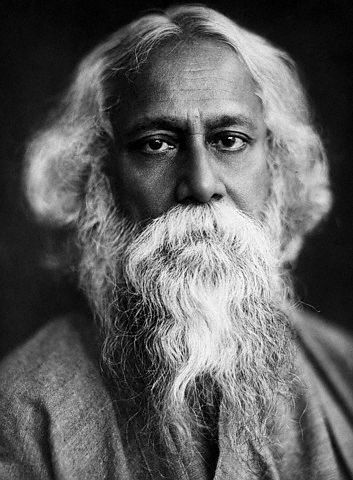
.jpg)
Rabindranath Tagore is the only writer whose words are sung as the national anthem of two countries. India's Jana Gana Mana and Bangladesh's Amar Shonar Bangla are both his, which is a strange distinction for a man who spent much of his later life arguing that nationalism was a European disease India would be foolish to catch. That contradiction, between the poet claimed as a national symbol and the thinker deeply suspicious of nations, runs through everything about his reputation.
The Jorasanko world
He was born in 1861 into the Tagore household at Jorasanko in north Calcutta, a large, wealthy and unusually creative family at the centre of the Bengal Renaissance. His father Debendranath was a leader of the Brahmo Samaj, the reformist movement that rejected image worship and caste in favour of a monotheism drawn from the Upanishads. His brothers and nephews included a philosopher, a novelist, a composer and the painters Abanindranath and Gaganendranath Tagore. He disliked formal schooling intensely, was sent to England as a young man without completing a degree, and returned to manage the family estates in East Bengal, at Shilaidaha on the Padma river. Those years on a houseboat among rural tenants gave him both his intimate knowledge of village Bengal and his exposure to Baul singers, whose songs shaped his own.
His output was enormous and spread across every form. In poetry, collections such as Manasi, Sonar Tari and Balaka gradually loosened Bengali metre and diction. In fiction, Chokher Bali examined a widow's desire with a frankness that scandalised readers, Gora set an orthodox Hindu nationalist against the discovery of his own origins, and Ghare Baire, translated as The Home and the World, put a landowner, his wife and a charismatic agitator into a triangle that is also an argument about political violence. His novella Nastanirh later became Satyajit Ray's Charulata. His short stories, including Kabuliwala and The Postmaster, essentially created the modern Bengali short story. He wrote plays, among them Dakghar, Raktakarabi and the dance dramas Chitrangada and Chandalika, and in his late sixties he began to paint, producing hundreds of dark, instinctive works that have since been exhibited internationally.
The Nobel and the problem of translation
In 1912 Tagore travelled to England carrying his own English prose renderings of poems from his Bengali Gitanjali and other collections. William Butler Yeats read them, wrote an introduction, and the resulting slim volume, Song Offerings, made him famous within months. In 1913 he received the Nobel Prize in Literature, the first non European writer to do so.
The English Gitanjali is not a translation of the Bengali book of the same name. It is a selection from several volumes, rendered into a hushed, biblical prose that Tagore constructed for an English readership and that bears little relation to the tight, musical, metrically alive Bengali originals. Almost every Bengali reader who also reads English says the same thing: the English is a pale shadow. This matters because the West's Tagore, a serene oriental sage, is largely a creation of his own translations, and the sharp, argumentative, often funny writer known in Bengali is a different figure. Amartya Sen and others have written at length about the gap.
He was knighted in 1915 and renounced the honour in 1919, in a letter to the viceroy written in the aftermath of the massacre at Jallianwala Bagh in Amritsar, calling for the right to stand beside his countrymen in their humiliation. That act, more than any poem, secured his standing as a public conscience.
Santiniketan, and the arguments
In 1901 he founded a school at Santiniketan in rural Birbhum, built on his conviction that children learn badly indoors and by rote. Classes were held under trees, arts were treated as central rather than decorative, and the calendar followed the seasons. He expanded it in 1921 into Visva Bharati, a university whose name announces its purpose, the world in India, and added a rural reconstruction wing at nearby Sriniketan to work on agriculture, crafts and cooperative credit in surrounding villages. He funded much of this with his Nobel money and with punishing international lecture tours undertaken into his seventies.
His disagreements with Gandhi were public and courteous. Tagore doubted the non cooperation movement's rejection of Western learning, thought the spinning wheel a poor substitute for education, and objected when Gandhi described the 1934 Bihar earthquake as divine punishment for untouchability, arguing that this kind of reasoning insulted both reason and the victims. Gandhi, for his part, thought the poet too detached from the practical work of freedom. Their correspondence is one of the most instructive exchanges in modern Indian thought precisely because neither man conceded.
His lectures published as Nationalism in 1917, delivered in Japan and the United States during the First World War, argue that the nation as an organised political machine crushes the human being inside it, and that India's real problem was social, not constitutional. The lectures were poorly received at the time, in Japan especially, and read now as unusually prescient.
Above all there is the music. Tagore wrote something in the order of two thousand songs, words and melodies both, drawing on Hindustani classical raga, Bengali folk, Baul tunes and Western melody. Rabindrasangit is a living repertoire in Bengal and Bangladesh in a way that has few parallels anywhere: people sing these songs at weddings, funerals, political rallies and on ordinary evenings, often without thinking of them as literature at all. If you want to understand why Bengalis regard Tagore as something more than a great writer, the songs, rather than the Nobel, are where to look.
References
- The Nobel PrizeRabindranath Tagore, Biographical
- Encyclopaedia BritannicaRabindranath Tagore
- Poetry FoundationRabindranath Tagore
- Visva-Bharati UniversityVisva-Bharati, the university founded by Tagore
This is a reference article, written from the sources above. It is background, not news reporting.