Stitching Sunlight: The Story of Phulkari
Reference library · 926 words
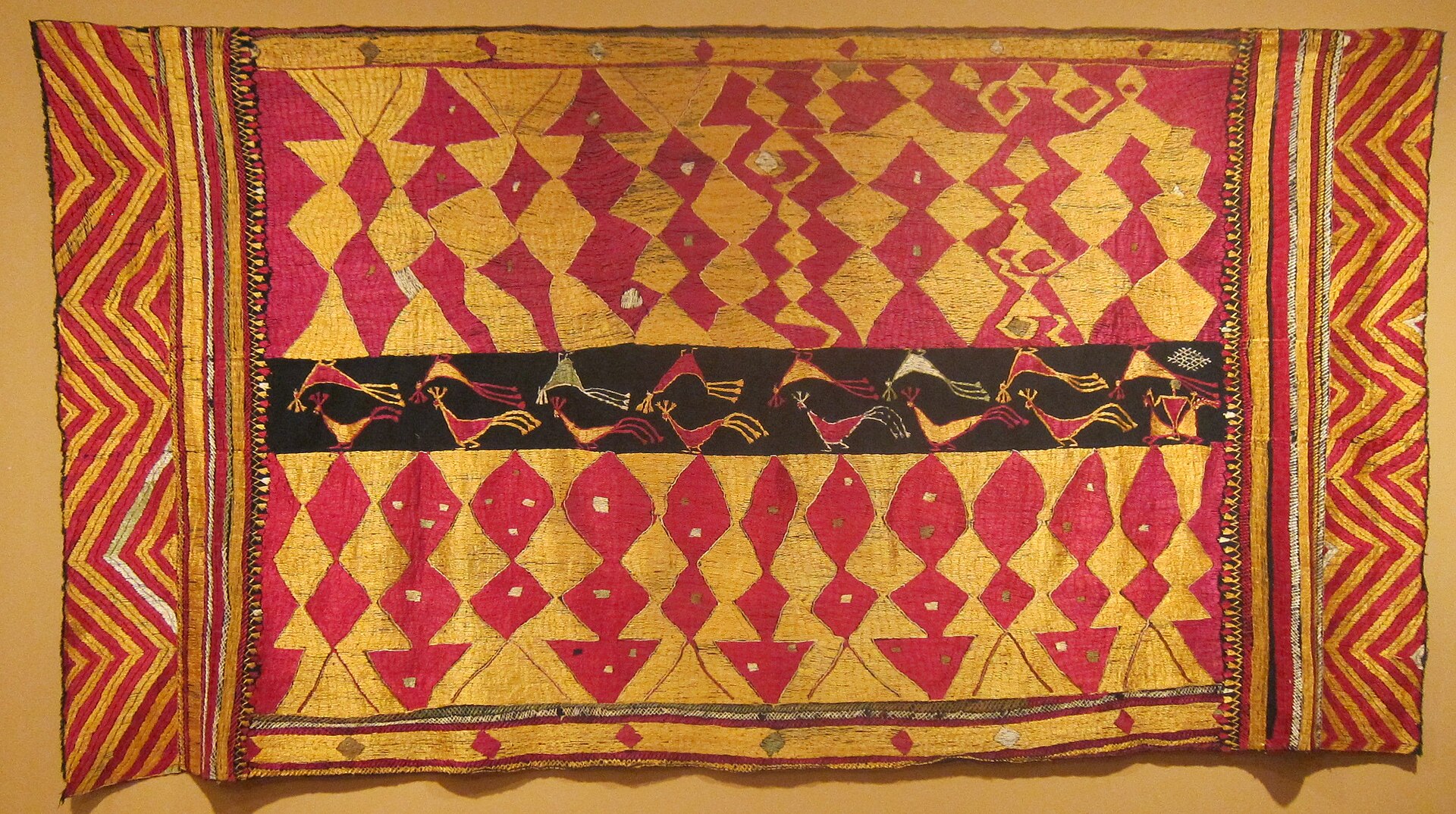
,_Punjab,_early_20th_century,_cotton,_silk_and_embroidery,_Honolulu_Academy_of_Arts.jpg)
Phulkari means flower work, and the name describes an effect rather than a subject. Almost nothing in a classical phulkari is a botanical flower. What the eye reads as blossom is in fact the massed glint of floss silk laid down in long, flat stitches that catch light at different angles, so a surface of geometric lozenges and chevrons behaves like a field in sun. The craft belongs to the whole of undivided Punjab, on both sides of the border drawn in 1947, and it was for centuries a domestic art rather than a market one: cloth made by women for the women of their own household, and given at weddings and births.
The technical foundation is unusual and explains much of the look. Phulkari is worked from the reverse of the fabric using a darning stitch, so the embroiderer sees the back while producing the design on the front. The stitch travels a long distance on the face and only a short one on the reverse, which means very little thread is wasted on the hidden side and the visible float is generous and lustrous. Because the ground is a plain weave and the worker counts threads to place each stitch, the geometry is dictated by the weave itself. There is traditionally no stencil, no printed outline and no drawn cartoon. The pattern lives in the maker's memory and in her ability to count.
Khaddar, Patt and the Logic of the Cloth
The ground is khaddar, a hand spun and hand woven cotton, usually narrow, so a full shawl is made from two or three loom widths seamed together. Khaddar is coarse and open enough for thread counting yet strong enough to survive decades of folding. The embroidery thread is patt, an untwisted silk floss, historically brought in from Kashmir, Afghanistan, Bengal and China. Untwisted floss is fragile and prone to snagging, which is precisely why it shines: with no twist to break up the surface, each filament reflects light along its whole length. Dye ranges were limited and deliberate. Golden yellow, white, crimson and orange dominate, with red treated as the auspicious colour of Punjabi ceremonial life.
Within the tradition there is a firm distinction between phulkari proper and bagh. In a phulkari the embroidery is scattered, leaving the khaddar ground visible between motifs. In a bagh, which means garden, the silk covers the ground completely, so no cotton shows at all on the front. A bagh could take years and represented a serious investment of a household's time and silk. The chope, given by a maternal grandmother and worked in a double running technique that appears the same on both faces, is normally red with yellow and edges the whole cloth rather than filling it. The sainchi is the exception to the geometric rule: it abandons abstraction for narrative, filling the cloth with wrestlers, trains, peacocks, farmers, jewellers and village scenes, and it is associated particularly with the Firozpur and Bathinda areas.
Rupture, Revival and What Gets Called Phulkari Now
Phulkari's institutional history is inseparable from the partition of Punjab. The craft was practised across districts that in 1947 were divided between India and Pakistan, including Hazara, Peshawar, Rawalpindi, Jhelum, Sialkot and Multan on one side and Amritsar, Jalandhar, Ludhiana and Patiala on the other. Displacement broke the transmission chain that mattered most, which was not a workshop or a guild but the household in which a girl learned by working alongside older women on cloth intended for her own marriage. Many surviving pre-partition pieces were carried across the border as portable wealth, which is one reason fine early examples are now scattered through private families and museum collections rather than concentrated in any single region.
By the middle of the twentieth century the domestic tradition had contracted sharply. Revival since then has taken two very different forms. One is genuine continuation, including cooperative and self help group production in Punjab and by Punjabi diaspora communities, where the darn stitch and thread counting survive. The other is commercial substitution: machine embroidered dupattas sold as phulkari across north Indian markets, produced on multi head embroidery machines in a fraction of the time and at a fraction of the price. These are not forgeries in any legal sense, but they have changed what most buyers now picture when they hear the word.
Telling the two apart is not difficult once you know what to look for. Hand phulkari shows a reverse that is comparatively bare, with short connecting stitches rather than the dense backing and trailing jump threads left by a machine. The floss on a hand piece varies subtly in tension and shade because it was dyed and worked in small quantities. Colour transitions in hand work are stepped, following the count of the weave, rather than blended. And the geometry, being counted rather than traced, contains small honest irregularities where a row runs one thread wide or narrow.
What deserves emphasis is that phulkari was never signed, dated or exhibited by its makers. It was ordinary in the way a well made everyday object is ordinary, produced within a gift economy rather than a market, and its value was measured in the labour a family could afford to give a daughter. That context is easy to lose once the cloth is framed on a gallery wall or cut into a cushion cover, and it is worth restoring when looking at any old bagh: someone counted every thread of it, in the intervals between other work, for a person she knew.
References
- WikipediaPhulkari
- WikipediaKhadi
- Victoria and Albert MuseumSouth Asia: Explore the Collections
- Indira Gandhi National Centre for the ArtsIndira Gandhi National Centre for the Arts
This is a reference article, written from the sources above. It is background, not news reporting.