South India's Distinct Cinema Traditions
Reference library · 932 words
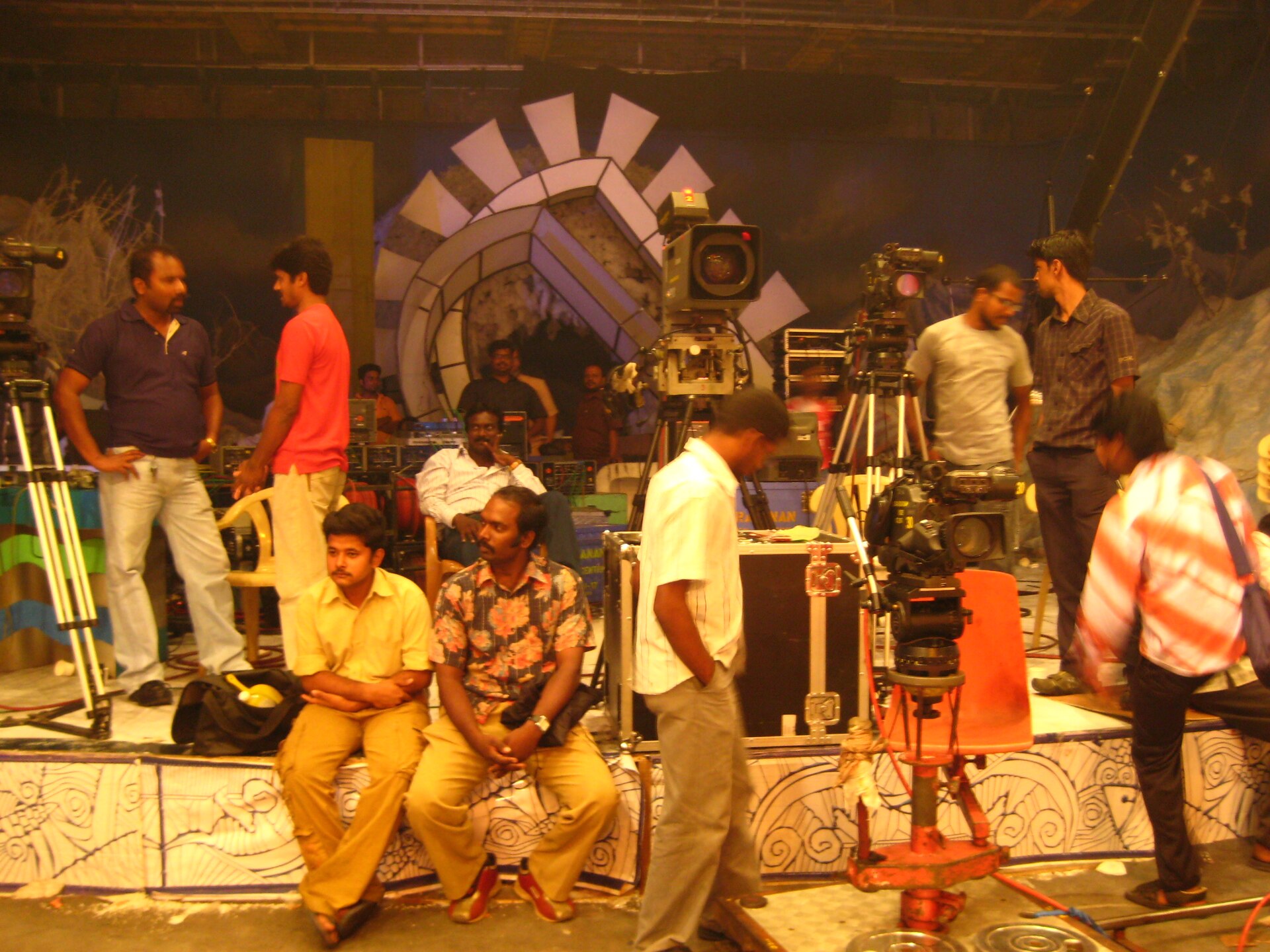

Outsiders often say Bollywood when they mean Indian cinema. The four principal film industries of southern India, working in Tamil, Telugu, Malayalam and Kannada, between them produce a large share of the country's films, sustain their own star systems and, in two cases, have supplied their states with chief ministers. They are not regional variations on a Bombay template. They developed in parallel, from different literary and theatrical roots, and for decades they shared a production base that Bombay had nothing to do with.
Madras as the workshop of the south
Until the 1970s almost everything made in the four southern languages was shot in Madras, now Chennai, in a cluster of studios around the suburb of Kodambakkam. Gemini Studios, run by S.S. Vasan, produced Chandralekha in 1948, a costume spectacle with a drum dance finale that was dubbed into Hindi and became one of the first southern films to conquer the north. AVM Productions, founded by A.V. Meiyappan, is among the oldest surviving studios in India and worked in all four southern languages plus Hindi. Vijaya Vauhini Studios, run by B. Nagi Reddy, was for a time one of the largest studio complexes in Asia and made Mayabazar in 1957, a Telugu and Tamil mythological comedy still regarded as a technical marvel for its trick photography.
Telugu production gradually relocated to Hyderabad from the 1970s onwards as Andhra Pradesh built its own infrastructure, a shift completed with the opening of the vast Ramoji Film City complex in the 1990s. That separation is why Telugu cinema today feels institutionally distinct from Tamil, though the two shared crews, composers and even negatives for decades. The pioneers reach back further: Raghupathi Venkaiah Naidu built exhibition and production in the Telugu country from the silent era, the first Tamil talkie Kalidas appeared in 1931, the first Kannada talkie Sati Sulochana in 1934, and Malayalam cinema traces its origin to J.C. Daniel's silent Vigathakumaran in the late 1920s.
Politics on the Tamil screen
Tamil cinema's defining peculiarity is its entanglement with the Dravidian movement. From the late 1940s, writers associated with the Dravida Munnetra Kazhagam used film scripts as political platforms. C.N. Annadurai and M. Karunanidhi both wrote screenplays; Karunanidhi's Parasakthi in 1952, which introduced Sivaji Ganesan, contained long rhetorical speeches attacking priestly authority and social hypocrisy that functioned as party argument in dramatic form. Both men later became chief minister of Tamil Nadu. So did the actor M.G. Ramachandran, whose screen persona as the incorruptible protector of the poor translated with startling directness into electoral support, and later the actress Jayalalithaa. In Telugu, N.T. Rama Rao, famous for playing Rama and Krishna in mythological films, founded the Telugu Desam Party and won power within months of launching it. No other cinema in the world has converted stardom into government so consistently, and Tamil and Telugu political commentary still treats film as a wing of politics rather than a diversion from it.
Artistically, Tamil cinema turned in the 1970s. Bharathiraja shot 16 Vayathinile in 1977 largely on location in a village, breaking the studio bound convention; K. Balachander built a body of work around uncomfortable social situations and gave early roles to Kamal Haasan and Rajinikanth. Mani Ratnam brought a glossy, tightly edited urban style with Nayakan in 1987 and Roja in 1992, the latter introducing the composer A.R. Rahman, whose arrival ended the long dominance of Ilaiyaraaja and reshaped film music across India.
Kerala, Karnataka, and the art of restraint
Malayalam cinema took a different road, powered by Kerala's dense network of film societies and its unusually high literacy. Adoor Gopalakrishnan, a graduate of the film institute at Pune, co founded the Chitralekha Film Cooperative and made Swayamvaram in 1972, a spare account of a couple who elope and slowly run out of money; Elippathayam in 1981 used a rat trap as an image for a feudal household unable to leave its own house. G. Aravindan, a cartoonist by training, worked in a looser, more lyrical register in films such as Thampu and Kummatty. John Abraham took the anti industrial position to its limit, funding Amma Ariyan in 1986 through public collections by a film society movement he helped organise.
Kerala also produced something rarer: a durable middle cinema, neither avant garde nor formula, associated with Padmarajan, Bharathan and K.G. George, whose films were commercially viable while remaining psychologically serious. That tradition underlies the widely admired Malayalam work of the past fifteen years, which has travelled internationally through streaming platforms.
Kannada cinema's parallel wave arrived with Samskara in 1970, adapted from U.R. Ananthamurthy's novel about a Brahmin community paralysed by the question of who will cremate a heretic, with Girish Karnad in a leading role. Girish Kasaravalli's Ghatashraddha in 1977 and the work of B.V. Karanth extended it, while the actor Rajkumar anchored the popular industry for decades.
The relationship between the southern industries and Bombay has reversed in recent years. For most of the twentieth century, southern hits were remade in Hindi. Since the success of S.S. Rajamouli's two part Baahubali, released in 2015 and 2017, and of RRR in 2022, whose song Naatu Naatu won the Academy Award for best original song, the traffic has run the other way, with Telugu and Tamil films released nationally in dubbed versions and outgrossing Hindi productions. Commentators now use the term pan Indian film, which is a marketing category rather than an aesthetic one. Whether it represents a genuine merging of traditions or simply the export of one industry's scale is a matter on which critics in Chennai, Hyderabad and Mumbai disagree, often sharply.
References
- Encyclopaedia BritannicaAdoor Gopalakrishnan
- Encyclopaedia BritannicaM.G. Ramachandran
- British Film InstituteBFI, film history and criticism
- Encyclopaedia BritannicaA.R. Rahman
This is a reference article, written from the sources above. It is background, not news reporting.