Sindh's Sour Kitchen: Curry Traditions After Partition
Reference library · 934 words
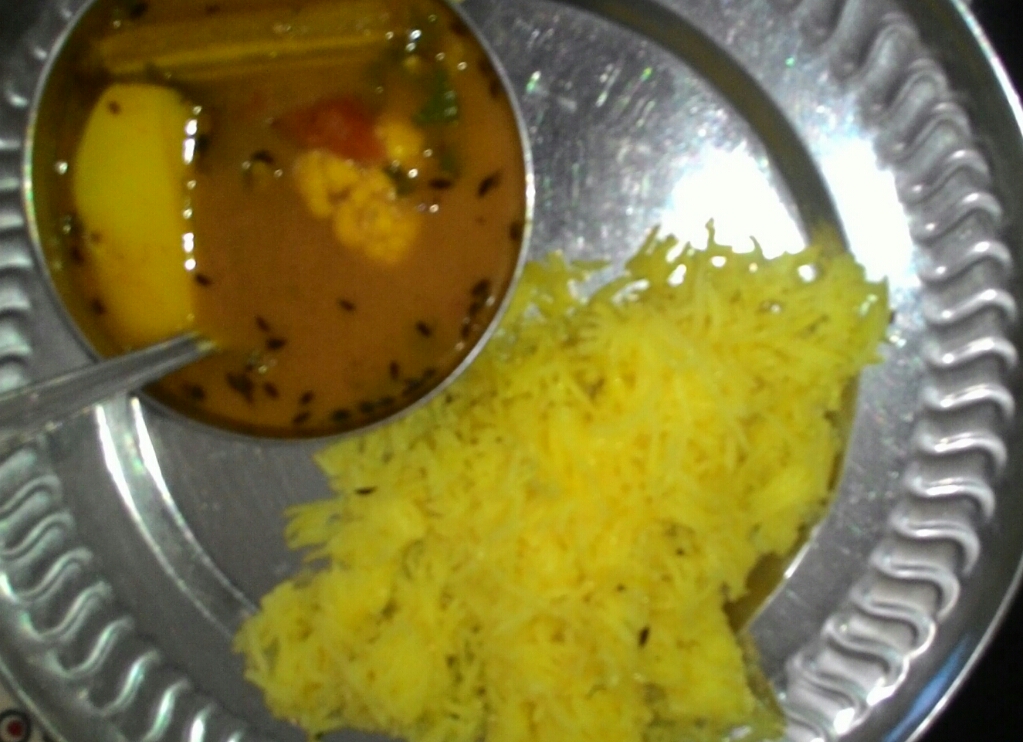

The first thing to understand about Sindhi kadhi is that it is not a kadhi at all, at least not in the sense the word carries elsewhere in India. There is no yoghurt in it. The base is gram flour roasted in oil until it turns nutty and deep gold, then let down with water and soured with tamarind, tomato or both. Into that goes a parade of vegetables chosen for texture as much as flavour: drumsticks, cluster beans, okra, potato, carrot, and above all lotus stem, sliced into rounds that stay crisp. It is served with plain rice and, in most households, with tuk, potatoes fried twice until the edges shatter. Anyone expecting the pale, tangy, yoghurt based kadhi of Gujarat or Punjab will be surprised, and the surprise is the point.
Sindhi cooking grew in a place defined by the Indus. Sindh is arid, and almost everything about its agriculture depends on the river and its inundation. Wheat and rice were both staples, fish came from the river rather than only the sea, and vegetables were seasonal and heavily supplemented by pulses. Sourness runs through the repertoire as a structural element rather than a finishing touch, supplied by tamarind, dried mango, tomato and lime. In a hot climate with a fat forward, gram flour heavy diet, acid is what keeps food edible in quantity.
What Happened in 1947
Partition dealt Sindhi Hindus an unusual hand. Punjab and Bengal were divided down the middle, leaving displaced communities with a home province that still existed on their side of the line. Sindh was not divided. The whole province went to Pakistan. When roughly a million Sindhi Hindus crossed into India during 1947 and 1948, they arrived without a regional homeland to migrate into, and were dispersed instead into refugee settlements scattered across the country: Ulhasnagar in Maharashtra, Gandhidham and Adipur in Kutch, camps at Ahmedabad, Jaipur, Ajmer and Bangalore. Ulhasnagar became the largest concentration and is still spoken of as a miniature Sindh.
The culinary consequence was direct. A cuisine that loses its territory has only one remaining vessel, which is the household. Sindhi food in India became domestic, calendrical and unusually conservative, because the family kitchen was carrying an identity that no map was carrying any more. Particular dishes attached themselves to particular days. Sindhi kadhi with rice became a fixture of certain weekly and ritual meals. Dal pakwan, chana dal eaten with large crisp fried discs of dough, settled into the role of Sunday breakfast in a way it may never have held in Sindh itself. This is one reason published Sindhi recipes vary so widely and so confidently: community cookbooks compiled after 1947 tended to freeze one family's practice as the authentic version, and there is no older authority to appeal to.
The split also sent the cuisine down two paths. Sindhi Muslim cooking continued in place in Pakistan, staying closer to meat and to river fish, with dishes such as Sindhi biryani and preparations of palla, the Indus hilsa. Sindhi Hindu cooking in India tilted further towards vegetables and absorbed influences from wherever it landed, Maharashtrian, Gujarati, Rajasthani. Palla is the clearest casualty. The fish is specific to the Indus, and no substitute in Indian waters carries the same flavour, so a dish that was once seasonal and celebrated simply dropped out of the Indian Sindhi repertoire.
The Working Repertoire
Beyond kadhi, the everyday dishes are worth knowing by name. Sai bhaji is a thick, savoury mash of spinach and other greens cooked with chana dal, tomato, and sometimes potato and aubergine, eaten with rice. Koki is the household flatbread, made from wheat dough studded with onion, coriander and ajwain, rolled once, part cooked, crumbled or re rolled and cooked again to give a dense, biscuit like texture that keeps for travel. Seyun patata is fried vermicelli with potato, savoury and often eaten at breakfast, while sweet seyun appears at festivals such as Thadri and Cheti Chand. Bhee, lotus stem, is cooked on its own with spices as well as in kadhi. Sanna pakora, besan ju tikyun and a range of gram flour fried snacks fill out the rest.
Cheti Chand is the community's new year, falling on the first day of the bright half of Chaitra, the same lunar day as Gudi Padwa in Maharashtra and Ugadi in the Deccan. It honours Jhulelal, the river saint associated with the Indus, and its food is deliberately sweet: seyun and other milk and jaggery dishes. A community that lost a river kept a festival addressed to it.
Why You Rarely Eat It in a Restaurant
Sindhi food is among the least commercially visible of India's major regional cuisines, and the reason is structural rather than culinary. Restaurant traditions grow where a cuisine is tied to a place with travellers, pilgrims and a hospitality trade. Sindhi cooking in India has no such place. It survives in homes, at community functions, in sweet and snack businesses run by Sindhi families, and in a handful of restaurants in Ulhasnagar, Mumbai and Ahmedabad. Diaspora communities in Dubai, Hong Kong, Lagos, London and Australian cities keep it going by the same domestic means.
The result is a cuisine that is simultaneously well preserved and hard to find. Its methods are distinctive enough to resist absorption, the roasted gram flour base, the reliance on tamarind, the twice cooked textures of koki and tuk, but its transmission depends entirely on people cooking at home for each other. That is a fragile arrangement, and it is also the reason Sindhi kadhi still tastes like nothing else on the subcontinent.
References
- WikipediaSindhi cuisine
- WikipediaSindhi Hindus
- WikipediaPartition of India
- WikipediaGudi Padwa
This is a reference article, written from the sources above. It is background, not news reporting.