Rajasthan's Thali: A Desert Table of Many Flavours
Reference library · 1084 words
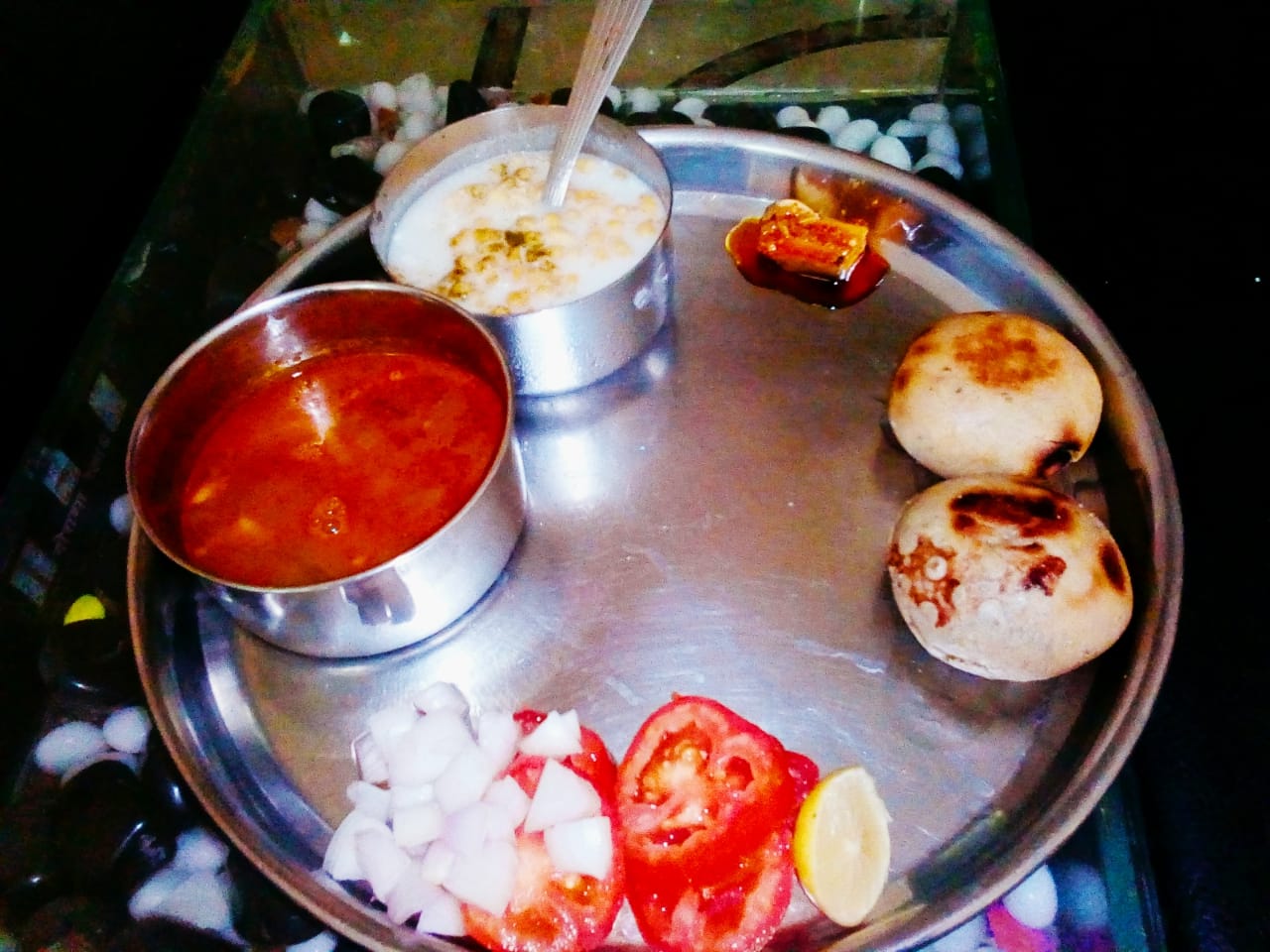

Rajasthan is India's largest state by area and one of its driest. The Thar desert covers much of its western half, rainfall is unreliable, and for most of recorded history fresh green vegetables were a seasonal luxury rather than a daily assumption. Rajasthani cooking is the direct answer to those constraints, and almost every characteristic feature of the state's thali can be traced to a specific scarcity: of water, of fresh produce, of fuel, or of refrigeration.
A thali is not a dish but a format: a round metal platter carrying small bowls (katori) of several preparations, with bread and rice placed directly on the plate. The logic is a balanced meal in one service, offering contrasts of texture, temperature and taste rather than a single main course. In Rajasthan the thali typically arrives with more items than a diner can finish, and in many traditional dining houses it is served unlimited, with attendants circulating to refill bowls.
Cooking without water, cooking without greens
The most distinctive Rajasthani techniques are workarounds. Where other regions simmer in water, Rajasthani cooks often use milk, buttermilk or ghee as the cooking liquid. Kadhi, a gravy of sour buttermilk thickened with gram flour and seasoned with chilli and whole spices, is a staple partly because it turns souring milk into a virtue. Ghee is used lavishly, not from indulgence but because clarified fat keeps without refrigeration for long periods in heat, carries flavour, and provides dense calories in a place where food was not always plentiful.
Where fresh vegetables were unavailable, the desert supplied its own. Ker is the small berry of a hardy desert shrub. Sangri is the long slender bean pod of the khejri tree, the state tree, which survives extraordinary drought. Dried and stored, then soaked and cooked with yogurt and spices, they become ker sangri, a dish with a sour, chewy, slightly astringent character that has no real equivalent elsewhere in India. Dried mango powder (amchur), dried pomegranate seed (anardana), tamarind and yogurt all supply the sourness that fresh tomatoes supply elsewhere. Lentils and gram flour (besan) do enormous work in place of vegetables: gatte ki sabzi is made by steaming or boiling seasoned gram flour dumplings and then simmering them in a yogurt gravy, producing something with the substance of a vegetable dish from a shelf stable powder.
Preservation logic also explains the state's most famous dish. Dal baati churma combines three elements. Baati are hard, dense wheat dough balls, traditionally baked in embers or buried in hot sand, which keeps them edible for days and requires no elaborate oven. They are cracked open and drowned in ghee. Dal is a spiced mixture of lentils, commonly five sorts (panchmel), providing protein and moisture. Churma is baati crushed and mixed with ghee and jaggery or sugar, a sweet made from the same base. It is a complete meal engineered for a place where fuel is scarce, water is scarce and food must survive travel.
The meat traditions, and who ate them
Rajasthan has a large and devout vegetarian population, particularly among Jain and Vaishnava communities, and a good deal of the state's food is not merely vegetarian but avoids onion and garlic as well. Marwari cooking in particular has developed a substantial repertoire without either. At the same time, the Rajput warrior and princely tradition produced one of the most notable meat cuisines in India, built around game and around cooking in the field.
Laal maas is the emblem: mutton cooked with a large quantity of dried red chilli, particularly the Mathania chilli of Jodhpur district, in yogurt and ghee. The Mathania chilli gives colour and aroma without the punishing heat that the quantity of chilli would suggest from a hotter variety, though laal maas is genuinely fiery by most standards. Safed maas is its opposite number, white rather than red, made with a pale ground paste of cashew, almond, poppy seed, yogurt and cream, with white pepper rather than chilli, and reflects the more courtly Mughal influenced end of the tradition. Junglee maas, the hunting camp dish, is the most stripped down of all: meat, ghee, salt, whole red chilli and little else, because that was what could be carried.
Chilli, of course, is not indigenous. It arrived in India through Portuguese trade after contact with the Americas, and became dominant in Indian cooking over a period of a few centuries, displacing long pepper and black pepper as the primary source of heat in many regional cuisines. Any account that treats fiery Rajasthani food as timelessly ancient is compressing that history.
Breads, snacks and the sweet end
Rajasthani breads reflect the grains that grow in dry conditions. Wheat is used, but so are pearl millet (bajra) and maize, which tolerate poor soils and low rainfall. Bajre ki roti, coarse and greyish, eaten with garlic chutney and white butter, is a genuine everyday village food rather than a restaurant novelty. Missi roti mixes wheat with gram flour.
The state's snack culture is significant enough to have travelled worldwide. Bikaner is the acknowledged centre of bhujia, the fine spiced gram flour noodle snack, whose commercial manufacture built one of India's larger food companies. Jodhpur is associated with the mirchi bada, a whole green chilli stuffed with spiced potato, coated in gram flour batter and fried, and with pyaaz kachori, a flaky pastry filled with spiced onion. Mawa kachori is the sweet counterpart, filled with reduced milk solids and soaked in syrup.
The sweets lean heavily on ghee, reduced milk and gram flour, again for keeping qualities. Ghevar, a disc shaped lattice sweet made by pouring thin batter into hot ghee, is associated particularly with the monsoon festivals of Teej and Raksha Bandhan, and requires real skill: the batter must be cold, the ghee must be hot, and the pouring must be done from height in a steady stream so the lattice forms. Malpua, balushahi and the ghee soaked semolina halwa of the state round out a dessert tradition that is unapologetically rich.
The modern tourist thali in Jaipur or Udaipur presents all of this at once, which is a slightly artificial compression: no household ever ate fifteen preparations at a sitting. But as an introduction to a cuisine built on shortage rather than plenty, it is an unusually honest one, because every item on it is a solution to a problem the desert set.
References
- Encyclopaedia BritannicaRajasthan
- Encyclopaedia BritannicaThar Desert
- Government of Rajasthan, Department of TourismRajasthan Tourism official site
- BBCBBC Food: Indian cuisines
This is a reference article, written from the sources above. It is background, not news reporting.