The Rajasthani Haveli: Courtyard Living in Stone
Reference library · 946 words
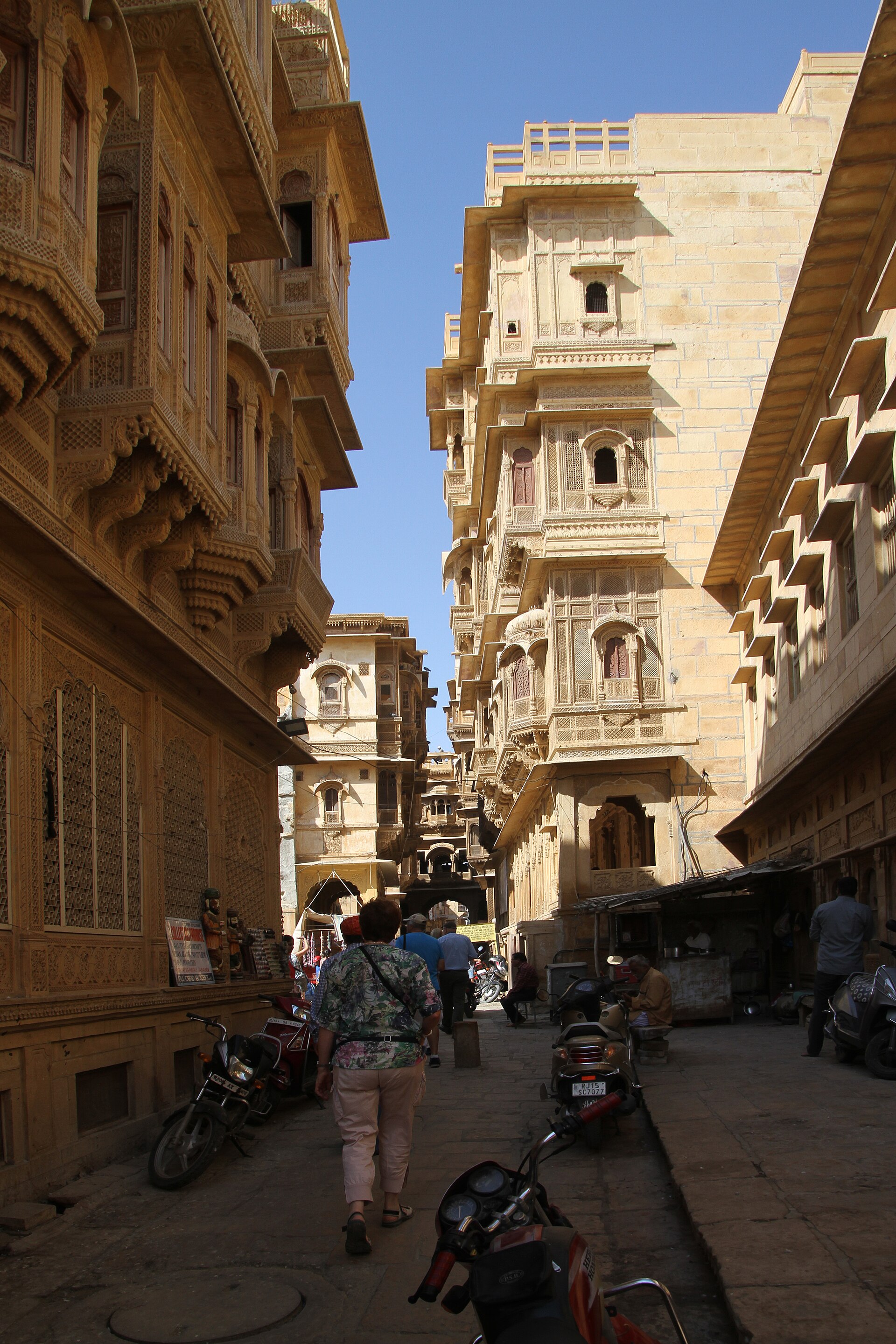

A haveli turns its back on the street. From outside you get a high blank wall, a heavy door, some carved brackets and a row of projecting balconies. Everything that matters happens inward, around a courtyard open to the sky. That single decision, to organise a large house around a void rather than a facade, explains most of what follows: the climate performance, the social zoning, the decoration, and eventually the abandonment.
The word itself is a borrowing, from a Persian and Arabic root meaning an enclosed or surrounding space, and havelis are not a Rajasthani monopoly. Courtyard mansions of the same family stand in Delhi, in the Punjab on both sides of the border, in Gujarat and across the Gangetic plain. What Rajasthan contributed was a set of extremely distinctive local variants, driven by desert climate, by locally available stone, and by the extraordinary wealth of nineteenth century trading families.
How the plan works
The classic arrangement uses two courtyards in sequence. The outer mardana court is the public and male zone, entered through a gate wide enough for animals, with a raised baithak or reception room where business was conducted and guests received. Behind it, reached through a controlled passage, lies the zenana, the inner court around which the women of the household lived. Larger havelis add further courts for kitchens, stores and staff. Rooms open onto the courts through columned verandahs, often a tibari of three arched bays, so that circulation happens in shaded semi outdoor space rather than through corridors.
The climatic reasoning is genuinely sophisticated. Thick masonry walls of sandstone or lime bonded rubble give high thermal mass, absorbing heat through the day and releasing it after dark. External openings are small and set high. The courtyard acts as a thermal chimney, drawing hot air up and out during the day, and at night the open sky lets the court and the surrounding surfaces radiate heat away, so cool dense air pools at floor level. Deep projecting eaves, the chhajja, throw shade onto walls. Pierced stone screens, jali, cut glare and accelerate air moving through the aperture while preserving privacy. The projecting oriel window, the jharokha, does the same job vertically and lets people see the street without being seen from it. Roof terraces are living space for much of the year, and many havelis include basements used through the worst of the summer.
Four cities, four kinds of haveli
Jaisalmer built in a soft golden limestone that carves like wood, worked by hereditary silawat stone carvers. The Patwon ki Haveli, a cluster of houses raised by a Jain trading family in the first half of the nineteenth century, and the Nathmal and Salim Singh havelis, are essentially exercises in lace made from stone, with screens and brackets cut to a fineness that has no structural excuse at all.
Shekhawati, the semi arid tract north of Jaipur containing towns such as Nawalgarh, Mandawa, Fatehpur and Ramgarh, went the other way and painted everything. Marwari merchant families who had made fortunes in trade covered interior and exterior walls with murals, worked partly in true fresco on wet lime plaster, a technique often called arayish or ala gila, and partly in dry work applied over a set surface. The subject matter is the best social document in the region: Krishna and Rama alongside steam locomotives, motor cars, gramophones, aeroplanes, hot air balloons and Europeans in hats, painted by artists who had frequently never seen the machines they were depicting. Bikaner produced the Rampuria havelis in deep red Dulmera sandstone. Jaipur, inscribed by UNESCO in 2019 for its planned grid, integrated haveli frontages into a coordinated streetscape, and the Hawa Mahal of 1799 is essentially a jharokha screen inflated into a whole building.
The carving itself followed a division of labour that is easy to miss. Structural masonry, bracket work, screen cutting and figural sculpture were separate skills, often held by different hereditary groups, and a large haveli was assembled by a contractor coordinating them much as a Mughal imperial workshop did at larger scale. Painted decoration was another trade again, with mural painters travelling between towns and taking commissions from competing families, which is why neighbouring havelis in Shekhawati can share motifs and even whole compositions. Ownership rivalry drove much of the expenditure. A merchant returning from a successful season in a distant port demonstrated the fact on his own wall, and the escalation of frontages along a single lane can be read as a ledger.
Emptied houses
The decline has an economic cause rather than an aesthetic one. The same Marwari families whose trade paid for the Shekhawati murals moved their operations to Calcutta, Bombay and other colonial ports through the nineteenth and early twentieth centuries, following rail and industry. Many havelis were left with caretakers, then with nobody. Lime plaster fails when roofs leak, and painted surfaces go first. Some houses have been restored as heritage hotels or museums, which keeps roofs on but changes the plan, since a courtyard designed for a joint family reads differently as a hotel lobby. Others have been repainted with modern synthetic paint that traps moisture behind the plaster and accelerates the damage it was meant to prevent.
Two caveats are worth carrying. The tourism description of Shekhawati as the world's largest open air art gallery is a marketing phrase, not a measured claim, and no serious survey supports it. And the dating of individual murals is often unreliable, because havelis were repainted repeatedly, sometimes over earlier schemes, so a confident date on a guide's board frequently refers to the house rather than to the paint you are looking at.
References
- WikipediaHaveli
- WikipediaShekhawati
- WikipediaJharokha
- UNESCO World Heritage CentreJaipur City, Rajasthan
- WikipediaHawa Mahal
This is a reference article, written from the sources above. It is background, not news reporting.