Rajasthan's Desert Circuit: Forts, Sand and Sky
Reference library · 1065 words
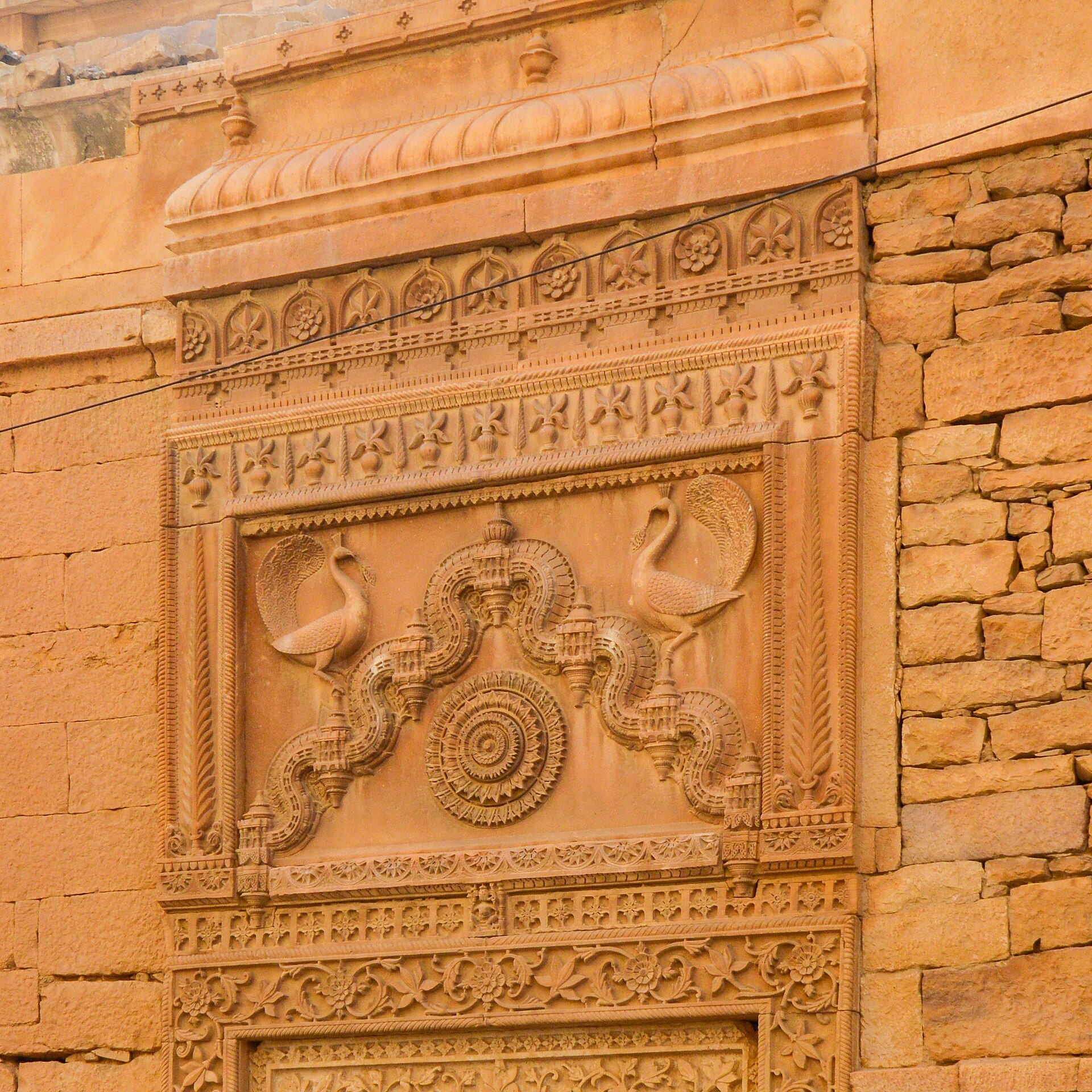

Rajasthan's western half is the Thar, the Great Indian Desert, a belt of dune fields, scrub and stony plain running up to the frontier with Pakistan. It is among the most densely populated deserts on earth, which is the first thing that surprises visitors: this is not empty country but a landscape of villages, herds, wells and walled towns. The reason lies in the Aravalli range, one of the oldest fold mountain systems in the world, worn down to low ridges that run diagonally across the state. The Aravallis divide the wetter southeast, historically Mewar, from the arid northwest, historically Marwar, and they blocked neither trade nor armies. The desert circuit follows that trade.
The caravan cities
Jaisalmer is the westernmost of the great desert towns and the one that looks most like the idea of one. Its fort, founded in the twelfth century by the Bhati ruler Rawal Jaisal, rises out of a low ridge in yellow sandstone that turns honey-coloured at sunset, and it is one of the very few forts anywhere still inhabited: several thousand people live inside the walls, in houses, shops and guesthouses along lanes barely wide enough for a motorcycle. That habitation is also its main threat. The fort's medieval drainage was never designed for piped water and modern sanitation, and seepage has undermined bastions and caused collapses, prompting long-running conservation campaigns and pleas to limit water use inside the walls.
Jaisalmer's wealth came from the caravan routes to Sindh and Central Asia, and the merchants who profited built the town's havelis: Patwon ki Haveli, actually a cluster of five mansions raised by a family of brocade and opium traders in the nineteenth century; Nathmal ki Haveli, whose two halves were reportedly carved by two brothers working from opposite ends, producing a facade that is nearly but not quite symmetrical; and Salim Singh ki Haveli, with its flared upper storey. When the port of Karachi and then the railways redirected trade in the nineteenth century, Jaisalmer's commerce collapsed, which is precisely why so much of it survives unmodernised.
Jodhpur, the Marwar capital, is dominated by Mehrangarh, begun in the mid-fifteenth century by Rao Jodha and expanded for centuries afterwards, a fort whose walls seem to grow directly out of the rock. Below it the old city is painted blue, a practice variously explained as a Brahmin caste marker, as a lime-and-copper-sulphate wash that deterred termites, or simply as fashion; all three explanations circulate and none is conclusively established. Nearby stand Jaswant Thada, a white marble cenotaph of the late nineteenth century, and Umaid Bhawan Palace, an enormous Art Deco palace built through the 1930s and early 1940s, commissioned in part as famine relief employment during a prolonged drought.
Bikaner, founded in the late fifteenth century by a son of Rao Jodha, holds Junagarh Fort, unusual in Rajasthan for standing on the plain rather than a hill and for never having been substantially taken. Outside town, the temple of Karni Mata at Deshnok is famous for the rats that live in and are protected within it, and a government camel research station continues work begun under colonial administration.
Water, and the architecture of not having it
Nothing explains Rajasthan's building culture better than water scarcity. The region developed step wells, called baori, bawdi or jhalra, in which flights of stairs descend in geometric tiers to a water table that falls through the dry season. Chand Baori at Abhaneri, east of Jaipur, is the most photographed: a deep square shaft lined on three sides with thousands of steps in a repeating chevron pattern. Toorji ka Jhalra in Jodhpur, an eighteenth-century step well commissioned by a queen consort, was excavated from decades of debris in the 2010s and is now a public square. Artificial lakes such as Gadisar at Jaisalmer and Pushkar's sacred tank served the same purpose. Traditional khadin earth bunds and rooftop tanka cisterns did the work at village and household scale. The Indira Gandhi Canal, carrying Himalayan water from Punjab deep into the northwestern desert, transformed agriculture from the 1960s onwards and brought its own problems of waterlogging and salinity.
Planning a route, and what to eat on it
A conventional circuit runs Jaipur to Jodhpur to Jaisalmer to Bikaner, with detours as time allows. Jaipur itself is not a desert town but the usual gateway, and it is a remarkable object in its own right: laid out from 1727 by Sawai Jai Singh II on a grid of wide streets and rectangular chowkri blocks, planned with the architect Vidyadhar Bhattacharya on principles drawn from Indian treatises on building, and inscribed by UNESCO in 2019. Its Jantar Mantar, a set of monumental masonry astronomical instruments, is separately listed, and the Hawa Mahal, the honeycombed screen facade of 1799, was designed so that women of the court could watch street processions unseen. Six of Rajasthan's hill forts, including Chittorgarh, Kumbhalgarh with its immense perimeter wall, and Amber near Jaipur, were inscribed together in 2013. The Jain temple complex at Ranakpur, of the fifteenth century, is worth the diversion into the Aravallis for its forest of individually carved marble pillars.
The desert circuit is a cold-season activity. October to March is comfortable; April to June routinely pushes past 45 degrees Celsius. Pushkar's camel fair falls around Kartik Purnima, the full moon of the lunar month of Kartik, usually in November, and Jaisalmer's desert festival in the winter. Sam and Khuri offer dune camps outside Jaisalmer, now heavily commercialised. The Desert National Park nearby protects the last significant population of the great Indian bustard, or godawan, a heavy grassland bird now critically endangered, with power lines across its habitat identified as a major cause of death.
Marwari food answers the same constraints as the architecture. Ker sangri is a dry curry of desert berries and bean pods that keep without refrigeration. Dal baati churma pairs lentils with hard wheat balls traditionally baked in embers or hot sand, and a sweetened crumble of the same dough. Laal maas, a fiercely red mutton curry built on Mathania chillies, is associated with hunting kitchens; gatte ki sabzi uses gram flour dumplings where vegetables are scarce. Jodhpur claims the mawa kachori, Bikaner the bhujia named after it, and Jaipur is loudest about ghewar. As with most regional food claims in India, these origin stories are asserted with more certainty than the record supports.
References
- UNESCO World Heritage CentreJaipur City, Rajasthan
- UNESCO World Heritage CentreHill Forts of Rajasthan
- Encyclopaedia BritannicaThar Desert
- IUCN Red List of Threatened SpeciesArdeotis nigriceps (Great Indian Bustard)
This is a reference article, written from the sources above. It is background, not news reporting.