Block Printing: Rajasthan's Stamped Cloth Tradition
Reference library · 1040 words
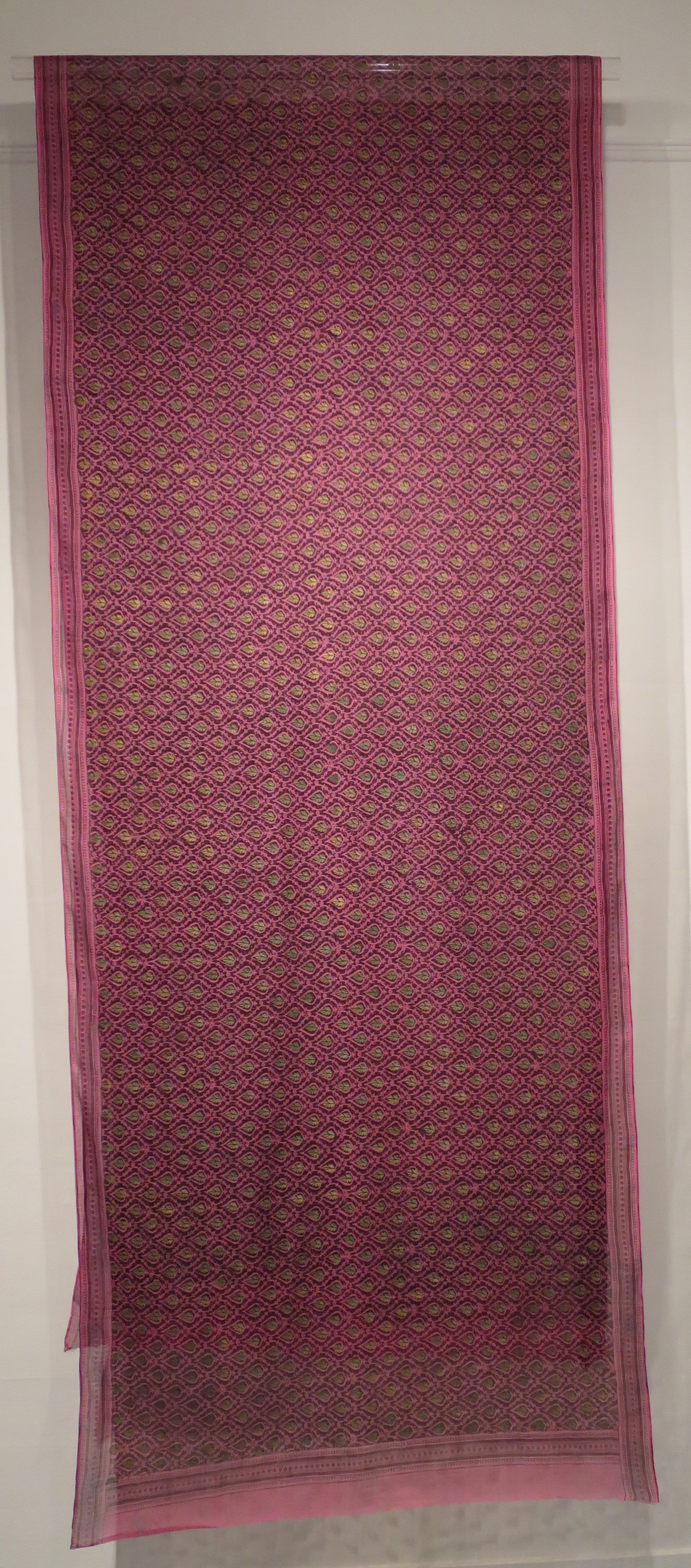

Hand block printing is a deceptively simple idea: carve a pattern in relief on a wooden block, charge it with dye or a chemical that will fix dye, and stamp it onto cloth, repeating across the length. Everything difficult about it lies in the repetition. A printer working a sari length must place several thousand impressions so that the pattern registers exactly, with no gap and no overlap, working by eye along a padded table, moving fast enough that the paste does not dry unevenly. Small pins carved into the corners of the block, the mirdang or register marks, are the only guide. The evidence of the hand, slight variations in density and the occasional broken join, is the mark of the real thing rather than a defect.
India's block printing traditions are old and widely distributed, but Rajasthan holds the densest concentration of working printers, in the towns of Sanganer and Bagru near Jaipur, in Barmer and Balotra in the west, and in Akola in the south of the state. The printing communities are known generically as Chhipa, from the verb meaning to print or stamp, and in many towns they occupy a distinct quarter with access to water, since printing consumes and pollutes a great deal of it.
Blocks, and the people who cut them
Blocks are cut from close-grained hardwood, most often sheesham (Indian rosewood) or teak, seasoned for months and sometimes years so they will not warp. A printer does not use one block per design but a set. The rekh block carries the outline; datta or gad blocks carry the filling colours, one block per colour, each cut to sit exactly inside the outline. A complex floral repeat may require four or five blocks in sequence, and any error in cutting one of them ruins the whole. Blocks are drilled with small air holes to release suction and are soaked in oil between uses. Block carving is a separate craft with its own centres, notably Pethapur in Gujarat and Farrukhabad in Uttar Pradesh alongside Jaipur, and carvers work from paper drawings, cutting mirror images freehand with chisels.
Bagru and Sanganer: mud, iron and white ground
The two most cited Rajasthani styles sit about thirty kilometres apart and are not variants of one another but different chemistries.
Bagru is a resist and mordant tradition working in an earthy palette. Its signature technique is dabu, in which a paste of clay, gum, wheat chaff and slaked lime is printed onto the cloth wherever the printer wants it to stay pale. The pasted areas are dusted with sawdust and dried, then the whole cloth is dyed. Where the mud sat, the dye cannot reach; when the paste is washed off, the pattern appears in reserve. Colour comes from mordants and natural dyestuffs: iron liquor made by fermenting scrap iron with jaggery gives blacks and greys; alum with madder or alizarin, boiled with dhavdi flowers, gives the characteristic dull reds; indigo vats give blue. Multiple rounds of resist and dyeing build up several colours, and the cloth is repeatedly washed, which historically was done in the river and is now increasingly done in effluent-controlled facilities.
Sanganer, closer to Jaipur and long favoured by the court, developed in the opposite direction: fine, delicate floral butis and trailing borders printed directly in bright colour on a bleached white or cream ground. The reputation of Sanganeri printing rests on the crispness of its line and the clarity of its white, both of which depended on the quality of the local water. Sanganer's printing industry now uses pigment and azo-free chemical dyes extensively alongside natural ones, and has been the subject of long-running regulatory pressure over groundwater extraction and dye effluent. Both Sanganeri and Bagru printing have been given geographical indication protection.
Ajrakh, and the neighbours often confused with Rajasthan
The most technically demanding block printing on the subcontinent is not Rajasthani at all but ajrakh, made by Khatri printers in Kutch in Gujarat and across the border in Sindh in Pakistan. Ajrakh cloth is printed on both sides in perfect register, with a long sequence of preparation, resist, mordant and dye stages, most versions of the process counting somewhere between fourteen and twenty steps, and it is dyed principally in indigo and madder to produce the deep blue and red geometry the cloth is known for. After the 2001 Bhuj earthquake damaged the printing village of Dhamadka and its water supply, printers established a new settlement named Ajrakhpur, a rare case of a craft village being deliberately rebuilt around its water needs.
Kalamkari is also frequently confused with block printing and is a different thing again: in its Srikalahasti form it is drawn freehand with a bamboo pen, and in its Machilipatnam form block printing and hand painting are combined. Bagh printing from Madhya Pradesh is a close relative of Bagru's resist and mordant approach.
The threat, and how to recognise the real thing
The commercial enemy of hand block printing is not powerlooms but screen printing and, increasingly, digital textile printing, both of which can reproduce a hand-blocked look convincingly at a tiny fraction of the cost and are widely sold as block print without qualification. The tells are consistent. Screen and digital prints are mechanically perfect: the repeat never shifts, colour density never varies, and joins never overlap. Block printed cloth shows slight misregistration at repeat joins, small variations in ink load, and, if it is dyed with mordants rather than pigments, colour that has penetrated the fibre rather than sitting on the surface, so the reverse is nearly as strong as the front. Claims of vegetable dye are made loosely; genuinely naturally dyed cloth is limited in palette and its colours are characteristically softer.
The craft is unusually visible to visitors. Printers work with open doors in both Bagru and Sanganer, and the Anokhi Museum of Hand Printing at Amber, housed in a restored haveli and recognised by UNESCO for its conservation work, demonstrates the whole sequence from block carving to finished cloth. Buying directly from a printing workshop, rather than from a shop that stocks whatever prints cheapest, remains the most reliable way to ensure that the money reaches the hands that did the stamping.
References
- Victoria and Albert MuseumCollections
- Encyclopaedia BritannicaBlock printing
- Encyclopaedia BritannicaDyeing
- Encyclopaedia BritannicaRajasthan
This is a reference article, written from the sources above. It is background, not news reporting.