Pongal: Marking the Harvest in Tamil Nadu
Reference library · 1010 words

Pongal is the Tamil harvest festival, and it is unusual among major Indian festivals in being fixed to the solar rather than the lunar calendar. It falls at the start of the Tamil month of Thai, which corresponds to the middle of January, and coincides with the sun's transit into Capricorn, Makara Sankranti. That is why it lands on essentially the same Gregorian dates every year while Diwali and Holi move around. The same solar moment is marked across India under other names: Makar Sankranti in much of the north and west, Lohri the night before in Punjab, Magh Bihu in Assam, Uttarayan and its kite flying in Gujarat.
The Tamil saying Thai pirandhal vazhi pirakkum, when Thai is born a way is born, expresses the mood: the month is regarded as auspicious, the harvest is in, and new undertakings begin. Weddings are commonly scheduled in Thai for this reason.
Four days, four different things
Pongal runs across four days, and each has a distinct object.
Bhogi comes first, on the last day of the preceding month, Margazhi. Old and unwanted household goods are discarded and burned in a bonfire, houses are cleaned and often whitewashed, and the year's accumulated clutter goes. It is a straightforward renewal rite, and in modern cities it has become a genuine air quality problem, with authorities regularly appealing against the burning of tyres and plastics.
Thai Pongal, the main day, is the one the festival is named after. The word pongal means boiling over or overflowing, and it names both the act and the dish. Newly harvested rice is cooked with milk and jaggery in a clay pot, usually outdoors, over a wood fire, with the pot decorated by tying fresh turmeric plant with its root and leaves around the neck. The dish is deliberately allowed to boil over the rim, and the moment it does, those present call out Pongalo Pongal. The overflow is the point: an enacted image of abundance exceeding its container. The sweet version, sakkarai pongal, is flavoured with cardamom, cashew and raisins fried in ghee. A savoury version, ven pongal, made with moong dal, black pepper, cumin, ginger and curry leaf, is eaten year round as breakfast across Tamil Nadu. The first offering is made to the sun, Surya, whose role in ripening the crop is the explicit subject of the day.
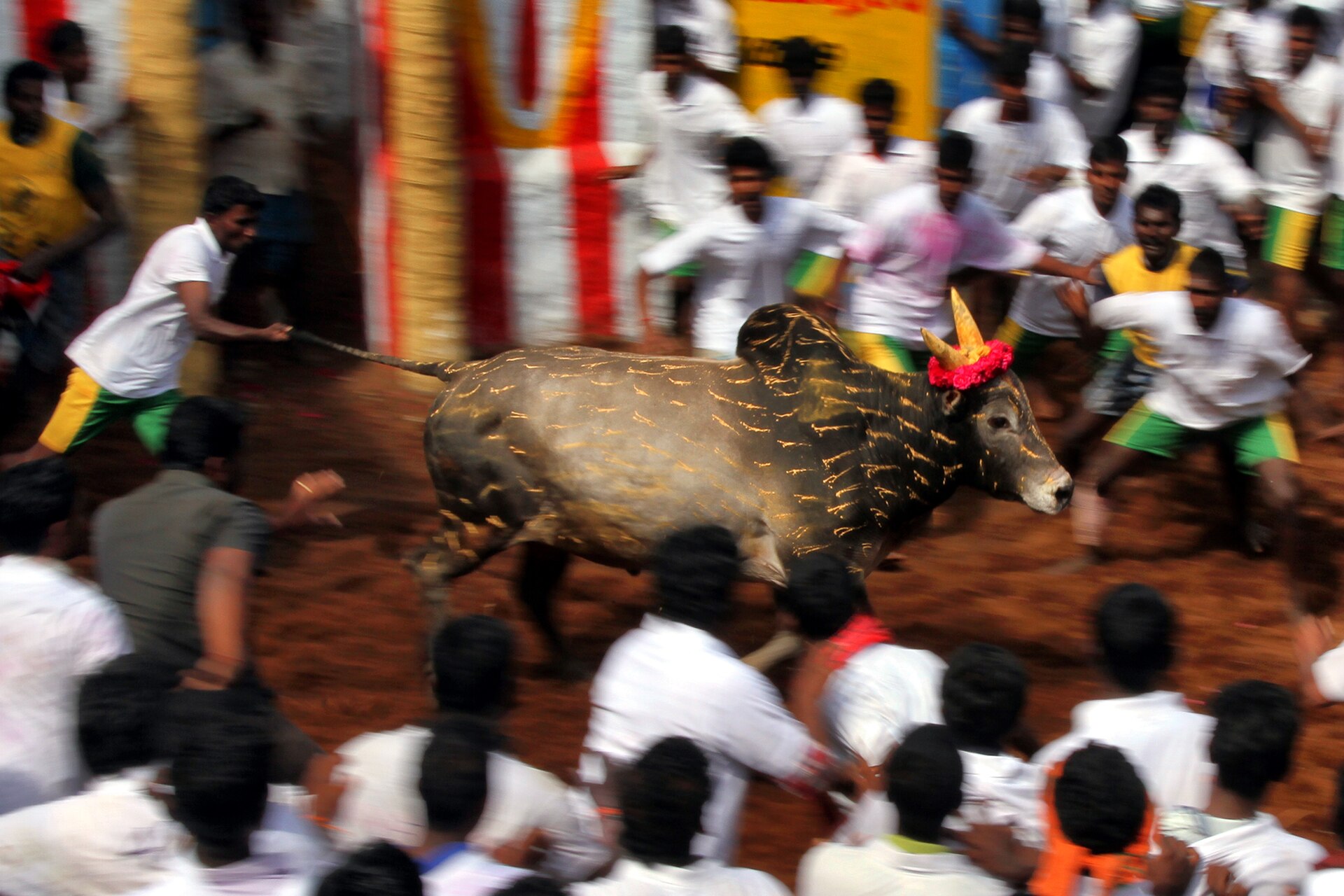
Mattu Pongal, the third day, honours cattle. Bulls and cows are washed, their horns painted and sometimes capped with metal, garlands and bells are hung on them, and they are fed pongal. In an agrarian economy in which draught animals did the ploughing and the water lifting, a formal day of thanks to the animals is entirely logical, and the practice survives the mechanisation that has made it economically obsolete. Kaanum Pongal, the fourth day, is for visiting: families travel to relatives, siblings meet, and outings to beaches, parks and temples are traditional. In many households women perform a small rite wishing wellbeing for their brothers.
Jallikattu, and a genuine controversy
Mattu Pongal is also associated with jallikattu, the bull taming event held in parts of southern Tamil Nadu, particularly in the Madurai region, at villages such as Alanganallur, Avaniyapuram and Palamedu. A bull is released into a crowd and participants attempt to hold onto its hump for a distance or a duration. Bulls are not killed, which distinguishes it from Spanish bullfighting, but injuries to participants and to animals occur.
The practice is old: bull grappling scenes appear in ancient Tamil iconography and the sport is referenced in classical Tamil Sangam era literature, which is one reason its defenders regard it as inseparable from Tamil identity. It has also been the subject of one of India's more heated legal and political disputes. Animal welfare organisations, including the Animal Welfare Board of India and PETA, argued that the event caused suffering, and the Supreme Court of India banned it in 2014. Very large protests followed in Tamil Nadu in early 2017, notably an extended occupation of Marina Beach in Chennai by tens of thousands of people, and the state government passed legislation permitting the event to resume under regulation. Litigation continued for years afterward.
The arguments on each side are worth stating fairly. Opponents point to documented injuries, to the use of fear inducing handling before release, and to deaths among spectators and participants. Supporters argue that the event sustains the breeding of indigenous cattle breeds such as the Kangayam and Pulikulam, which have little commercial value as dairy animals and would otherwise disappear, and that a ban imposed from Delhi on a regional practice was experienced as a cultural intrusion. Both claims contain real substance, and the dispute is not resolved by declaring one side obviously right.
Kolam, sugarcane and the wider calendar
Two visual markers define Pongal streetscapes. The first is kolam, the geometric floor drawing made in rice flour at the threshold each morning, which reaches its most elaborate during Margazhi and Pongal. Drawn freehand around a grid of dots, kolam is traditionally made with rice flour partly so that ants and birds may eat it, a small daily act of feeding. The second is sugarcane, sold in whole stalks in enormous quantities before the festival and stood at doorways, chewed as a sweet and used in offerings; the cane harvest coincides with the festival.
Pongal is also a marker of Tamil identity beyond religion and beyond India. It is a public holiday in Tamil Nadu and in Puducherry, is observed in Sri Lanka, Malaysia, Singapore and Mauritius, and is celebrated by Tamil communities in Australia, Canada and Britain. Because its object is the sun, the harvest and the cattle rather than a particular deity's story, it accommodates a wide range of participants comfortably. Of all the Indian festivals, it is perhaps the one whose logic a farmer from anywhere would recognise immediately: the crop is in, the pot boils over, and the animals that pulled the plough get a day of their own.
References
- Encyclopaedia BritannicaPongal
- Encyclopaedia BritannicaMakar Sankranti
- BBCBBC News: India coverage
- Encyclopaedia BritannicaTamil Nadu
This is a reference article, written from the sources above. It is background, not news reporting.