Pashmina: The Himalayan Wool with a Global Name
Reference library · 1043 words
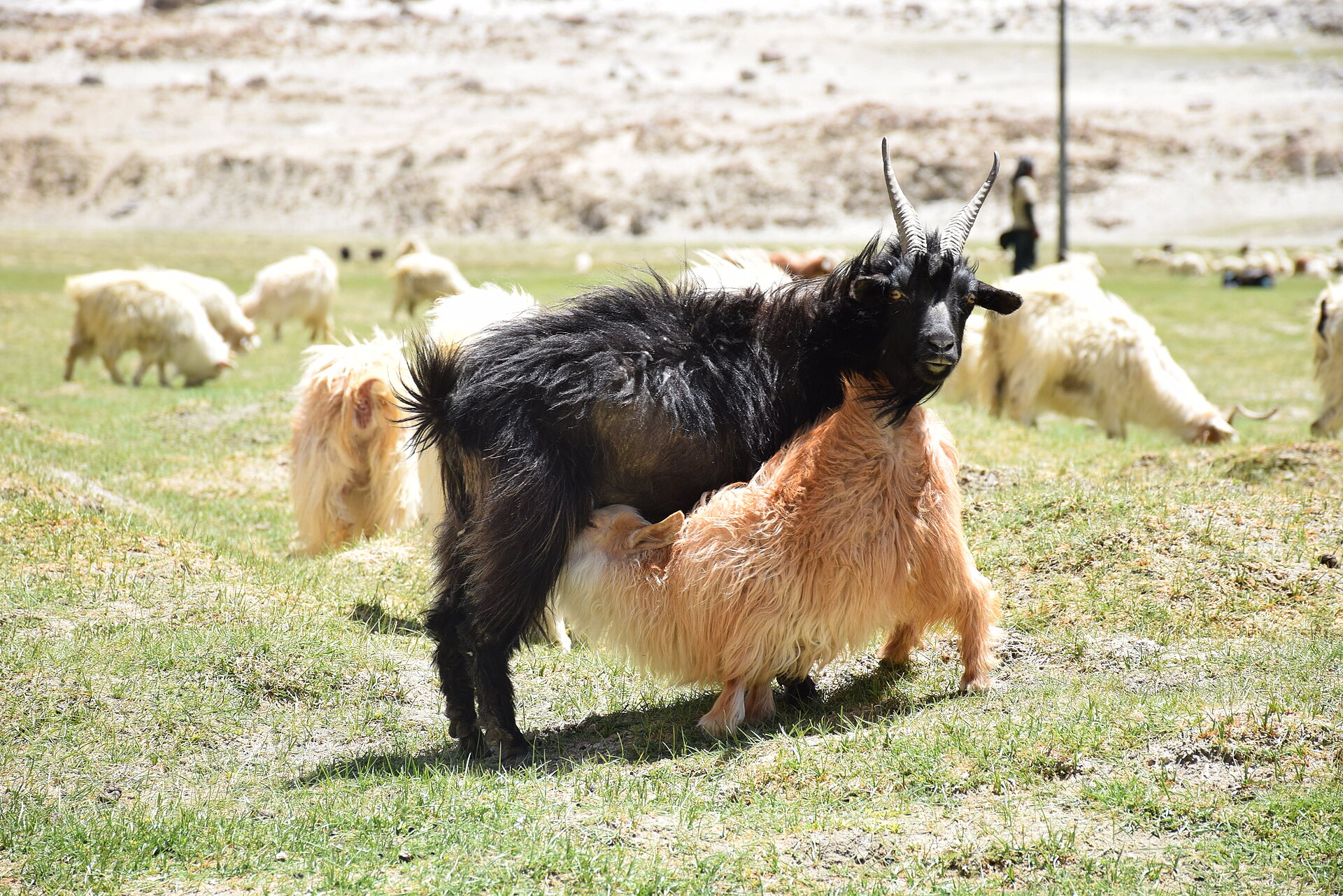

Pashmina begins as an animal's answer to cold. On the Changthang plateau of eastern Ladakh, at altitudes above four thousand metres where winter temperatures fall far below freezing, the Changthangi goat grows a fine insulating undercoat beneath its coarse outer hair. In spring the animal sheds this down, and the herders of the plateau, the Changpa, comb it out. The fibre is extremely fine, typically in the range of about twelve to sixteen microns in diameter, against roughly twenty-five microns or more for ordinary sheep wool. Fineness is what produces the softness and the extraordinary warmth-to-weight ratio, and it is also what makes the fibre difficult to process: it is short, weak under tension and easily broken.
The Persian word pashm simply means wool. The English word cashmere comes from Kashmir, because Europe first encountered the fibre in the form of Kashmiri shawls, not as a raw material. That accident of naming is the root of most of the confusion around the product today.
From fleece to cloth in Srinagar
Historically the raw down travelled from Ladakh, and from Tibet and Central Asia, to Kashmir, where the entire manufacturing tradition sat. The first task is dehairing: separating the fine down from coarse guard hairs, traditionally done by hand, a slow job overwhelmingly performed by women, and now largely mechanised, with some hand dehairing retained for the highest grades. The cleaned down is then spun, classically on a simple hand wheel called a yinder, into a yarn so fine that a single spinner might take many days to produce enough for one shawl. Handspun yarn cannot take the tension of a power loom, which is why genuinely handspun pashmina is necessarily handwoven, and why the two claims travel together.
Weaving is done on handlooms in twill. The plain woven shawl is then finished, and it is at the finishing and decorating stage that Kashmir developed its two celebrated ornamental traditions.
The first is kani weaving, a tapestry twill in which the pattern is not embroidered but built into the cloth. Instead of a shuttle carrying weft across the full width, the weaver uses dozens or hundreds of small wooden bobbins called tojis, each loaded with one colour, and inserts each colour only where the design requires it, interlocking the joins. The design is not drawn on the loom. It is encoded in a coded script called talim, prepared by a specialist, which records the colour and number of warp threads for every row; a reader calls the instructions aloud while the weaver works. A finely detailed kani shawl advances by a few centimetres a day and can take one to three years or more to complete.
The second tradition is amli, the needle-embroidered shawl, worked in fine sozni stitch on a plain woven ground. Embroidery is far faster than kani and was developed in part as a commercially competitive alternative, capable of imitating woven designs at lower cost. Whole-field embroidered shawls known as jamawar represent months of work by a single embroiderer. The best sozni is worked so that the design reads almost identically on both faces of the cloth.
The boteh, Europe, and a market destroyed by a loom
Kashmiri shawl weaving is often traced to the fifteenth-century sultan Zain-ul-Abidin, credited in local histories with bringing weavers from Central Asia. Mughal patronage from the sixteenth century made the shawl a court item of the highest prestige, given as robes of honour and hoarded in treasuries.
Europe discovered the shawl in the late eighteenth century, and by the early nineteenth it was a fashion necessity for wealthy women in Britain and France. The demand transformed Kashmir's economy and distorted its craft, pushing weavers toward the elongated, densely packed designs the export market wanted. It also produced the single most consequential act of design piracy in textile history: the curved teardrop motif known as boteh, endlessly repeated on shawl borders, was copied by weavers in the Scottish town of Paisley, which lent the pattern its English name. Once the Jacquard loom allowed European mills to mass-produce convincing imitations in wool and cotton at a fraction of the price, the Kashmiri export trade collapsed. Changing fashion and the disruption of European markets in the 1870s finished it. The craft survived, but as a shadow of what it had been, and Kashmiri weavers suffered severe distress in the aftermath.
What the word means now, and what it does not
Today the word pashmina is used loosely and often dishonestly. Large quantities of viscose, acrylic, silk-blend and ordinary wool scarves are sold worldwide as pashmina, and even within genuine cashmere there is enormous variation between fine handspun Changthangi down and coarse machine-processed fibre from elsewhere. Two widely repeated authenticity tests are unreliable: the ring test, in which a shawl is passed through a finger ring, can be passed by fine silk and by thin synthetics, and the burn test is crude and destroys the goods. The dependable checks are documentary and structural: a geographical indication label for Kashmir pashmina, laboratory certification of fibre and of handspun and handwoven status of the kind issued in Srinagar, slight irregularity in a handspun yarn, and a price that reflects hundreds of hours of labour.
One distinction must be made absolutely clearly, because it involves a crime rather than a matter of taste. Shahtoosh is not pashmina. It is made from the down of the Tibetan antelope, or chiru, a wild animal that cannot be combed and is killed to obtain it. The species is protected under the Convention on International Trade in Endangered Species and under Indian wildlife law, trade in shahtoosh is illegal in India and in most of the world, and possession can carry serious penalties. Any vendor offering a shahtoosh shawl is offering contraband.
The contemporary craft faces slower problems too. Changthang's herding communities contend with harsh winters that kill livestock, pasture pressure and competition from imported cashmere, while Srinagar's spinners, weavers and embroiderers work in a piece-rate system in which most of the retail value accrues elsewhere. Cooperative dehairing and spinning initiatives, the geographical indication regime and direct-to-buyer selling are all attempts to redistribute some of that value back up the chain to the people whose hands the fibre actually passes through.
References
- Victoria and Albert MuseumSouth Asia collection
- Encyclopaedia BritannicaCashmere
- CITES (Convention on International Trade in Endangered Species)CITES
- OneRen (Paisley Museum)Paisley Museum
This is a reference article, written from the sources above. It is background, not news reporting.