Onam: Kerala's Golden Harvest Celebration
Reference library · 1010 words
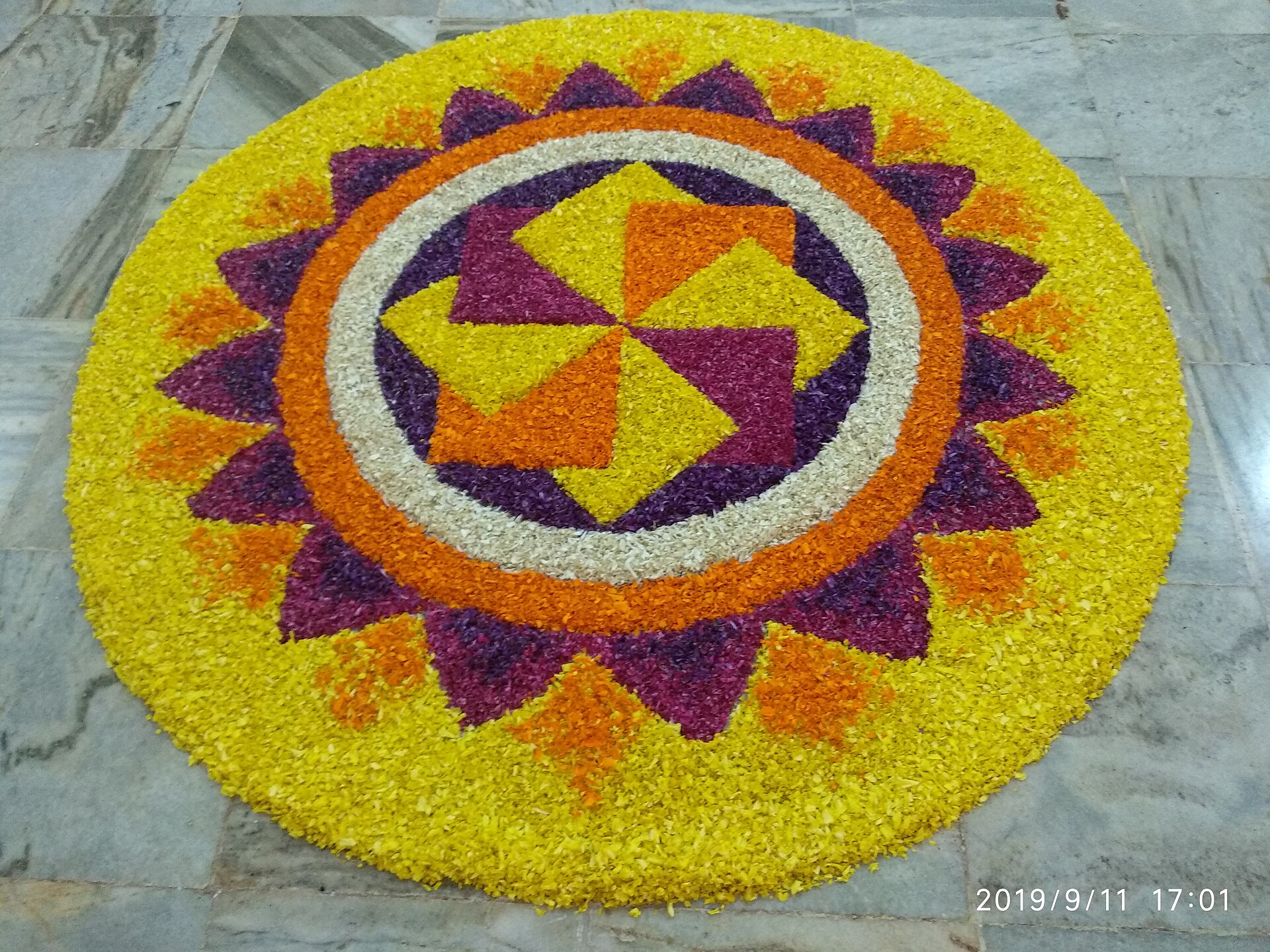

Onam is Kerala's principal festival and one of the few major Indian festivals whose central figure is not a god being worshipped but a king being welcomed. It runs for ten days in the Malayalam month of Chingam, which corresponds to August or September, and is timed by the Malayalam calendar rather than by the lunar months used further north. The festival marks the end of the monsoon, the beginning of the harvest season and, by the story, the annual homecoming of Mahabali.
Mahabali, and a story that reads two ways
Mahabali, or Maveli, was an asura king who ruled Kerala so well that his reign became the standard by which all others fell short. The classic Malayalam verse describing his rule speaks of a time when everyone was equal, there was no deceit, no theft and no falsehood. His virtue and power grew until the gods became uneasy. Vishnu appeared in the form of Vamana, a dwarf brahmin, and asked the king for as much land as he could cover in three steps. Mahabali, generous and warned against it by his own advisor, agreed. Vamana grew to cosmic size, covered the earth with one step and the heavens with the second, and asked where to place the third. Mahabali offered his own head. He was pressed down into the underworld, but was granted the right to return once a year to visit his people.
The story is genuinely double edged, and Malayalis are aware of it. Read one way it is a lesson in humility and in keeping one's word. Read another way it is a story in which a good and popular ruler is dispossessed by a trick, and that reading has been taken up in Kerala's political and social reform discourse, where Mahabali has at times been claimed as a figure of an egalitarian order displaced by a hierarchical one. The festival's emotional core, in any reading, is not triumph but welcome: Kerala prepares its houses and food so that a returning king should find his people prospering and happy, which is why an unhappy or poorly kept household at Onam carries a particular sting.
Ten days, and the flower carpet
The festival opens on Atham and builds to Thiruvonam, the tenth and principal day. Each morning from Atham, a pookkalam, a circular carpet of flower petals, is laid in the courtyard or at the entrance of the house. It begins small, often with a single ring, and grows a ring each day, so that by Thiruvonam it is a large concentric design. Traditionally the flowers were gathered locally: thumba, a small white flower particularly associated with Onam, along with marigold, chrysanthemum, hibiscus and the petals of the flame tree. The scale of modern demand means much of the flower supply now comes in by truck from Tamil Nadu and Karnataka, which is a quiet indicator of how the festival's economics have changed.
Small conical clay or wooden figures representing Mahabali and Vamana, called onathappan, are placed at the centre of the pookkalam. The house is cleaned, new clothes (onakkodi) are given, and the sadya, the vegetarian banquet served on a plantain leaf, is prepared for Thiruvonam. The sadya at Onam is the year's most elaborate, running to twenty or more preparations, and it is the single item most people outside Kerala associate with the festival.
Boats, tigers and games
Onam's public spectacles are distinctive. Vallam kali, the snake boat races, are held on the backwaters of central Kerala during the season. The chundan vallam is an extraordinary vessel, a long, narrow, high sterned racing boat crewed by a hundred rowers or more, propelled to the rhythm of vanchipattu boat songs. The Nehru Trophy Boat Race on Punnamada Lake at Alappuzha is the best known event and draws very large crowds; other races are held on the Pamba and elsewhere. The boats belong to villages and boat clubs, are maintained collectively, and carry serious local prestige.
Pulikali, the tiger dance, is associated particularly with Thrissur, where performers paint their bodies as tigers and hunters and parade through the town to percussion on the fourth day of Onam. It is loud, comic and physically demanding, and the body painting takes many hours. Other traditional Onam activities include thiruvathira kali, a circular women's dance performed around a lamp, kummattikali masked dances in the Thrissur and Palakkad region, tug of war, and various games grouped as onakalikal.
A festival that crosses religious lines
One of the more notable things about Onam is how thoroughly it functions as a regional rather than a strictly religious festival. Kerala has among the most religiously mixed populations of any Indian state, with very substantial Muslim and Christian communities alongside Hindus, and Onam is widely celebrated across all of them as a Malayali cultural occasion. The Kerala government designates it the state festival and runs an official Onam Week with cultural programmes, and Malayali associations from the Gulf to Australia hold Onam sadyas that function as the main annual gathering of the diaspora.
That said, there is an ongoing and sometimes sharp argument about the festival's framing. Some Hindu organisations have promoted the name Vamana Jayanti and an emphasis on Vishnu's avatar rather than on Mahabali, which many Malayalis have resisted as an attempt to reinterpret a story whose local meaning has always centred on the king. The dispute surfaces most years around the festival. It is a live disagreement rather than a settled question, and it is worth knowing about, because it explains why the choice of name in a greeting can carry weight.
What has not changed is the shape of the day itself: flowers at the doorstep, a leaf laid out, a large number of small dishes in a fixed order, and a payasam at the end. Onam is a harvest festival that has kept its harvest logic. It arrives when the rains have finished and the rice is in, and its entire vocabulary is about abundance being shown rather than hoarded.
References
- Encyclopaedia BritannicaOnam
- Kerala Tourism, Government of KeralaOnam
- Encyclopaedia BritannicaVamana
- Encyclopaedia BritannicaKerala
This is a reference article, written from the sources above. It is background, not news reporting.