Nine Nights, Countless Forms: Understanding Navratri
Reference library · 992 words

Navratri means simply nine nights, from the Sanskrit nava and ratri, and that plainness hides an unusual fact: the name describes a container rather than a single observance. What fills the nine nights differs so sharply between Kolkata, Ahmedabad, Chennai and Varanasi that a traveller moving between them in the same week could reasonably conclude they had attended four separate festivals. They would be partly right. The shared element is the worship of the goddess in her many aspects across nine consecutive nights, closing on a tenth day of victory. Almost everything else is regional.
The calendar is lunisolar. Navratri begins on Pratipada, the first lunar day of the bright fortnight, and runs to the ninth, with Vijayadashami or Dussehra on the tenth. Traditional reckoning recognises four Navratris in a year, two of them primarily observed by ascetics and ritual specialists. The two that fill public streets are Chaitra Navratri, in March or April, which culminates in Rama Navami in much of north India, and Sharad Navratri in the month of Ashvin, falling in September or October. Because lunar months drift against the solar year and an intercalary month is inserted roughly every three years, the Gregorian dates move considerably. A common confusion concerns Mahalaya, the new moon that ends the fortnight of ancestral offerings called Pitru Paksha. Mahalaya precedes Navratri rather than beginning it, and in some years a full extra month separates the two, which is why Durga Puja occasionally falls unusually late.
Nine Nights, Nine Forms, Several Lists
The nine nights are commonly mapped onto the Navadurga: Shailaputri, Brahmacharini, Chandraghanta, Kushmanda, Skandamata, Katyayani, Kalaratri, Mahagauri and Siddhidatri. This list is widely printed on calendars and treated as fixed, but it is not uniform across texts or regions, and older sources order and name the forms differently. The scriptural spine of the festival is more stable. The Devi Mahatmya, a section of the Markandeya Purana also known as the Durga Saptashati or Chandi Path, is recited through the nine nights. It narrates the goddess assembling herself from the pooled energies of the gods and destroying the buffalo demon Mahishasura, an image that dominates the iconography: Durga with ten arms, lion beneath her, trident driven into the demon emerging from a severed buffalo body.
Fasting practices are equally varied. Where a vrat is observed, grains, onion and garlic are set aside, and cooks turn to buckwheat flour (kuttu), water chestnut flour (singhara), amaranth, sago and rock salt. Whole communities in Bengal do not fast at all in this way, while for many Gujarati families the fast is central and the evening dance is what breaks the day's tension.
Clay in Bengal, Circles in Gujarat
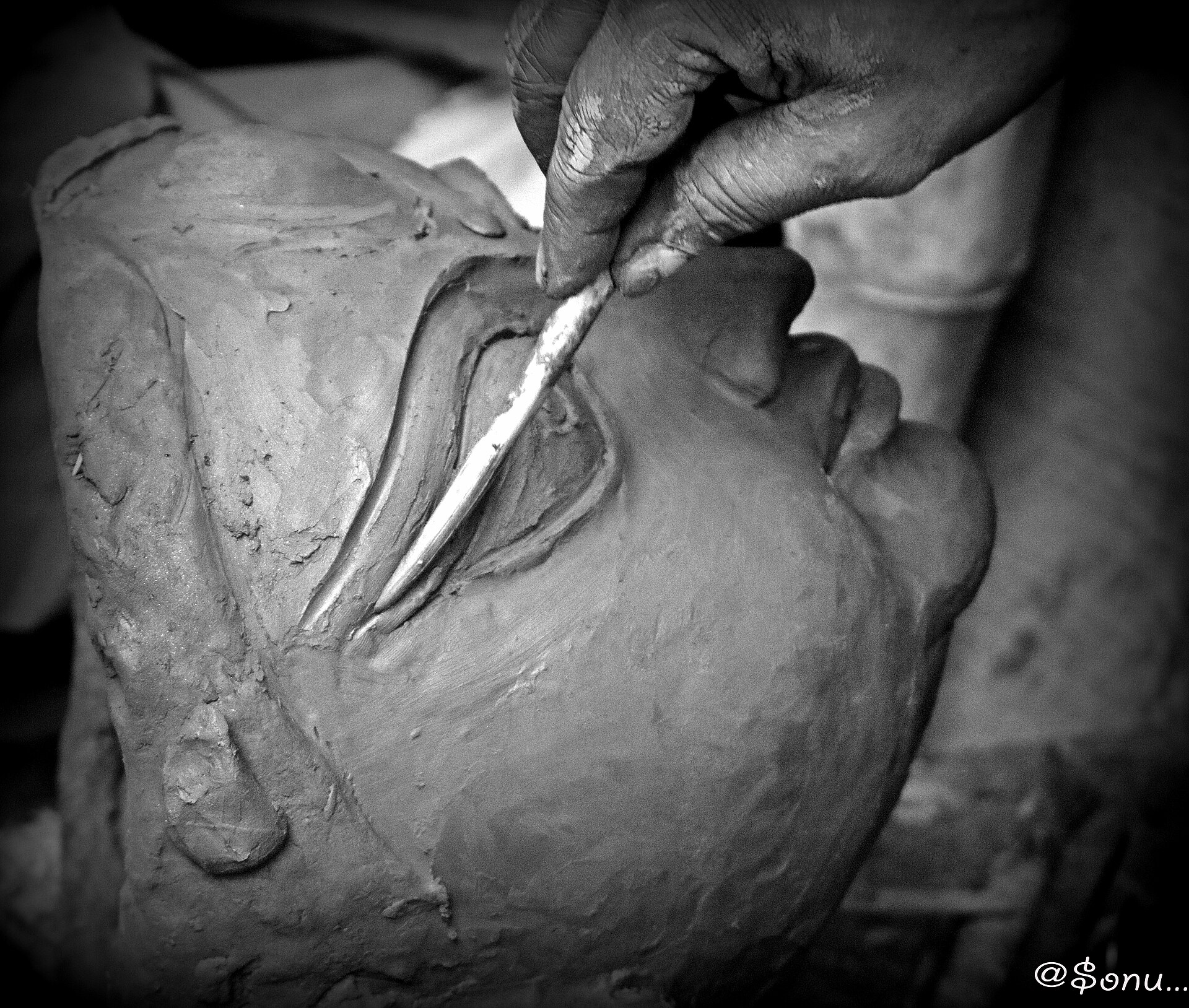
In Bengal the last five days matter most, from Shashthi through Dashami, and the festival is Durga Puja. The images are built in Kumartuli, the potters' quarter of north Kolkata, on straw and bamboo armatures packed with unfired clay drawn from the river. The final act of making is chokkhu daan, the giving of eyes, painted on to bring the figure to life. On the tenth day the images are returned to the water and dissolve. The pandals that house them have become an enormous public art economy, with themed structures, commissioned artists and sponsorship, and Durga Puja in Kolkata was inscribed on the UNESCO Representative List of the Intangible Cultural Heritage of Humanity in 2021. Community or sarbojanin pujas, open to all rather than confined to a landowning family's courtyard, are a later development than the older zamindari household pujas, and the shift is central to how the festival became a civic event.
Gujarat's Navratri belongs to the garba and the dandiya raas. Dancers circle an earthen pot pierced with holes and lit from within, the garbo, moving anticlockwise in expanding rings with a clap-based step that speeds through the night. The connection commonly drawn between the word garba and garbha, meaning womb, and thus to the lamp as life within the body, is old and widely repeated, though like most etymological folk explanations it should be treated as interpretation rather than established derivation. Garba of Gujarat was itself inscribed on the UNESCO Representative List in 2023. The commercial ticketed garba, held in stadium grounds with amplified orchestras, is a late twentieth century development layered over neighbourhood dancing that continues in lanes and housing society compounds.
Dolls, Processions and Effigies
In Tamil Nadu, Karnataka and Andhra Pradesh the nine nights are marked by Golu, also called Bommai Kolu or Bommala Koluvu: a tiered display of figurines arranged on steps, usually an odd number of them, mixing deities, saints, wooden marapachi dolls, and increasingly whole miniature scenes of village life or public affairs. Households visit one another, women and girls are given thamboolam of betel leaf, coconut and small gifts, and songs are sung before each display. Karnataka's Mysuru Dasara is a different register again, a state procession with the Jamboo Savari carrying the image of Chamundeshwari in a golden howdah on an elephant. The Wadiyar rulers developed it, but the practice reaches back to the Mahanavami festivities of the Vijayanagara court, whose stepped ceremonial platform still stands at Hampi and was described by foreign visitors in the sixteenth century.
Across much of the Hindi belt the same nights are given to Rama rather than to Durga in the public eye. Ramlila cycles are staged nightly, the Ramlila of Ramnagar near Varanasi running for weeks across a landscape of purpose built sites rather than a single stage, and Dussehra ends with the burning of towering effigies of Ravana, Meghnad and Kumbhakarna. The traditional Ramlila was inscribed by UNESCO in 2008. That two such different emphases share one calendar slot is not a contradiction to be resolved. It is the most accurate thing anyone can say about Navratri: the nine nights are a frame, and each region has filled it with the goddess, the epic, the harvest or the household that mattered most to it.
References
- UNESCO Intangible Cultural HeritageDurga Puja in Kolkata
- Indian Culture Portal, Ministry of CultureDurga Puja
- SahapediaDurga Puja
- Incredible India, Ministry of TourismGujarat
This is a reference article, written from the sources above. It is background, not news reporting.