Sadya: Kerala's Feast Served on a Banana Leaf
Reference library · 1091 words
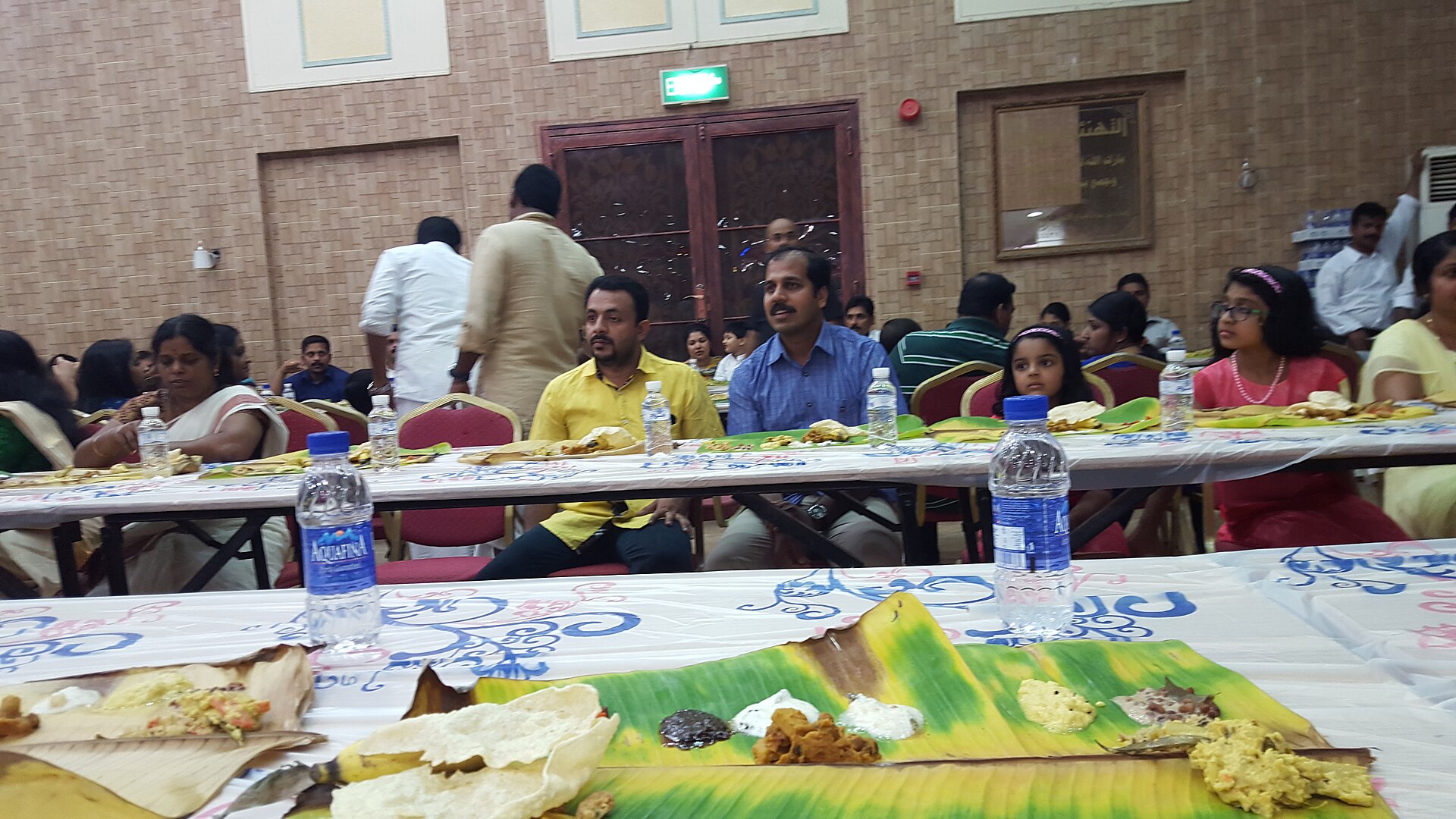

A sadya is a vegetarian banquet served on a fresh plantain leaf, eaten with the right hand, and governed by rules of sequence and placement that are far more precise than a visitor might guess. It is the ceremonial meal of Kerala, served at weddings, temple functions and, most spectacularly, at Onam. Two dozen or more separate preparations may appear on a single leaf, and the order in which they arrive, the corner they occupy and the order in which the diner mixes them with rice are all conventional rather than arbitrary.
The leaf itself sets the geometry. It is laid with the narrow end pointing left, in front of the diner, and the tapering tip is the side from which the meal is read. The upper half of the leaf receives the small items: pickles, the salt, the crisp things, the various vegetable preparations. The lower half receives rice, and the liquid courses are ladled over it. Nothing is served on the wrong half, and a diner who has eaten sadyas since childhood can tell at a glance whether a server knows the form. At the end of the meal the leaf is folded, and in most parts of Kerala folding it toward yourself signals satisfaction with the food, while the opposite fold carries a very different meaning, traditionally associated with funeral meals. Practice varies locally, which is one reason guests are wise to watch their neighbours.
What goes on the leaf, and why
The sequence is designed as a progression from sharp and pungent through savoury and rich to sweet, and it works nutritionally as much as ceremonially. Pickles come first at the top left: naranga curry made from lime, inji puli or puli inji, a dark sweet, sour and hot preparation of ginger, tamarind and jaggery that is arguably the signature taste of the meal. Next come the salted and preserved items, then thoran, vegetables finely chopped and stir fried with grated coconut, mustard seed and curry leaf. Avial follows, a thick mixture of many vegetables in coconut and yogurt or sour buttermilk with raw coconut oil poured over at the end. Olan is its gentle opposite: ash gourd and cowpeas in thin coconut milk, barely spiced, deliberately quiet. Kalan is sourer and thicker, made with yogurt and yam or plantain. Erissery combines pumpkin and beans with roasted coconut.
Crisp elements matter for contrast: upperi, plantain chips fried in coconut oil, and sharkara varatti, plantain pieces coated in jaggery. Pappadam, the thin lentil wafer, is crushed over rice. Then come the rice courses in order, each poured over a fresh mound of rice which is eaten before the next arrives. Parippu, a simple lentil preparation with ghee, comes first. Sambar follows, the tamarind soured lentil and vegetable stew. Rasam, thinner, peppery and intensely sour, comes later and is understood as a digestive. Pulissery or moru, a light yogurt curry, often closes the savoury run.
The rice deserves a note. Kerala favours matta rice, a parboiled red rice with a distinctly nutty flavour, a rough texture and considerably more character than polished white rice. Parboiling before milling drives some nutrients from the bran into the grain and hardens it, so matta rice holds its shape under the gravies rather than collapsing.
Payasam, and the sweet finish
The meal ends with payasam, and often with two or three of them. Palada payasam uses milk and thin rice flakes, cooked slowly until the milk reduces and takes on a pale pink cast. Ada pradhaman uses coconut milk and jaggery with the same rice ada, giving a darker, deeper, more caramel result. Parippu payasam uses moong dal, coconut milk and jaggery. Payasam is served on the leaf and eaten from it, sometimes with a small banana, sometimes with pappadam crumbled in, a combination that surprises newcomers and is defended fiercely by those who grew up with it.
Coconut is the thread running through the entire meal, and its three forms are used deliberately. Grated fresh coconut goes into thoran and into ground pastes. Coconut milk, extracted in successive pressings so that the first thick milk and the later thin milk are used at different stages, provides body without dairy. Coconut oil is the cooking fat and is also poured raw over avial at the end, where its aroma is a flavour in its own right. Kerala's name is popularly linked to the coconut palm, and whether or not that etymology is secure, the crop's dominance in the state's agriculture and cooking is not in dispute.
Temple kitchens, caste and the modern sadya
The sadya's structure comes largely out of temple and Brahmin household practice, where strict vegetarianism, the avoidance of certain ingredients and the ritual ordering of a meal were religiously significant. That inheritance carries a social history that is worth stating plainly rather than glossing: access to temple feeding halls in Kerala was historically restricted along caste lines, and the twentieth century movements that opened temples, including the campaigns around temple entry in the 1920s and 1930s, changed who could sit down to eat. The sadya as a public, secular, everybody's feast, served in community halls and hotels and by caterers, is substantially a modern phenomenon layered on an older ritual form.
Kerala's wider food culture is of course not vegetarian. The state has large Muslim, Syrian Christian and Latin Catholic populations with rich meat and seafood traditions: Malabar biryani, pathiri rice breads, Syrian Christian duck roast and beef preparations, Kuttanad style fish. The sadya's vegetarianism is a specific ceremonial choice, not a description of how Kerala eats every day. At an Onam sadya in a Christian or Muslim household, the vegetarian core is usually kept intact precisely because it is the ceremonial form, whatever is served on other days.
Practical advice for a first sadya: eat with the right hand only, mix each course thoroughly into the rice with the fingertips rather than scooping it dry, do not rush, and do not attempt to finish every item early. Servers will return. Refusing more is done by a small gesture over the leaf rather than by speech. The meal is meant to take an hour or more, and its pleasures are cumulative: the sourness of the inji puli against the sweetness of the payasam, the crunch of the upperi against the softness of the avial, all of it eaten from a leaf that is thrown away afterwards. It is, among other things, one of the most environmentally sensible banqueting systems ever devised.
References
- Encyclopaedia BritannicaKerala
- Kerala Tourism, Government of KeralaKerala Tourism official site
- Encyclopaedia BritannicaOnam
- BBCBBC Food: Indian cuisines
This is a reference article, written from the sources above. It is background, not news reporting.