Karva Chauth and the Ritual of the Rising Moon
Reference library · 971 words
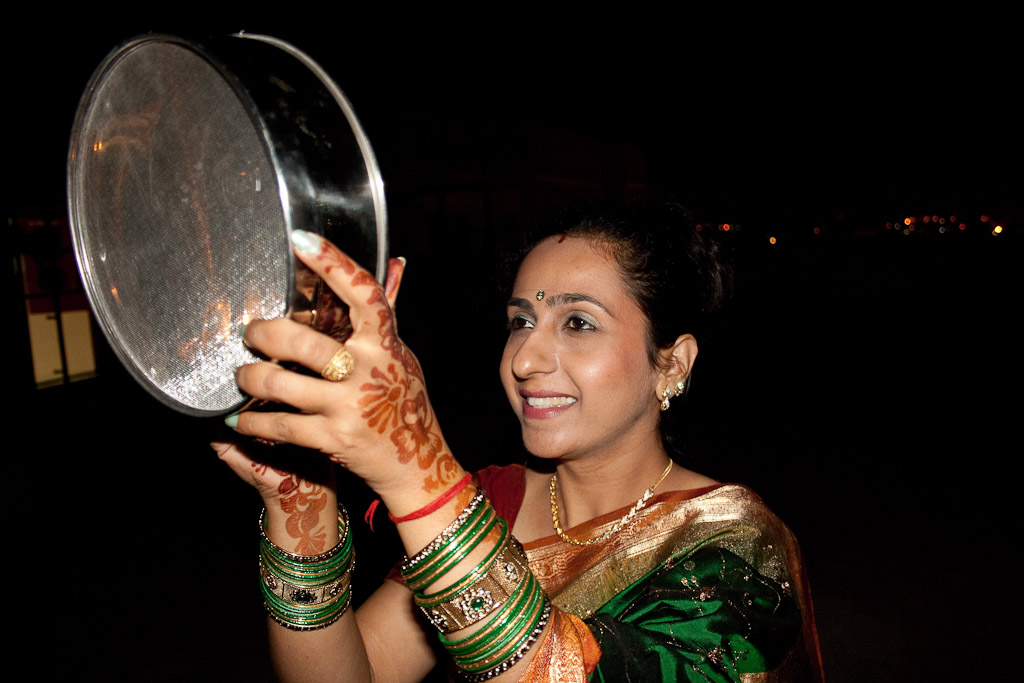

On one evening each autumn, in a broad belt of northern and western India, women who have not eaten since before dawn stand on terraces and in courtyards watching an empty sky. They are waiting for the moon. When it appears, each looks at it through the mesh of a sieve or the weave of a dupatta, offers water towards it, then turns and looks at her husband through the same screen. He hands her the first sip of water and the first mouthful of food. The fast of Karva Chauth ends there, and the whole architecture of the day, the pre dawn meal, the ornaments, the songs, the storytelling, exists to arrive at that moment.
Fixing the Date
Karva Chauth falls on the fourth day of the waning fortnight in the month of Kartika, which in the Gregorian calendar places it in October or most years the first days of November. The Hindu calendar is lunisolar, so the date moves against the Western year by roughly eleven days, with an intercalary month inserted every thirty two or thirty three months to stop the festivals drifting out of their seasons.
There is a wrinkle worth knowing, because it causes genuine confusion. Northern India counts lunar months from full moon to full moon, the purnimanta reckoning, while much of the south and west counts from new moon to new moon, the amanta reckoning. The same lunar day therefore sits in Kartika in the north and in Ashvina under the southern count. Since Karva Chauth is a northern observance, the northern name has stuck. The festival lands less than a fortnight before Diwali, in the same crowded stretch of the autumn calendar, which is one reason it has become entangled with the general festive season.
The name is descriptive rather than mysterious. Chauth is the fourth lunar day. A karva is a small earthen pot with a spout, of the kind used to store grain and to pour water. The pot is not incidental decoration: it is passed, filled, gifted and used to offer water to the moon, and it gives the day its name.
How the Day Runs
In Punjab and Haryana the day begins before sunrise with sargi, a meal traditionally prepared and sent by the mother in law to the fasting daughter in law. It usually contains fenia, a fine sweet vermicelli, along with fruit, dry fruit and sweets, chosen to release energy slowly. After sargi the fast begins. In its strictest form it is nirjala, without even water, though practice varies considerably by family, region and health, and no single standard is enforced.
The daylight hours are social rather than austere. Hands are decorated with mehendi, often days in advance. Women wear red, ochre or other auspicious colours, frequently a wedding sari or its equivalent, along with full bridal ornaments. Gifts arrive from the woman's parental family, a practice known in some areas as baya, which keeps the natal household visibly present in a ritual otherwise centred on the marital one.
In the late afternoon women gather in a circle. Filled karvas and decorated thalis are passed hand to hand while a katha, the festival's traditional story, is recited by an older woman, punctuated by songs. This gathering is the social core of the festival and is what many participants describe as the part they actually look forward to. The fast then continues until moonrise, which in October may be well after dark, and can be delayed by cloud for an anxious hour.
The Stories, and How Much to Trust Them
Several narratives are told as the katha and they do not agree with each other. One concerns Veeravati, a woman tricked by her brothers into breaking her fast when they simulate a moon, with disastrous consequences later reversed. Another involves a woman named Karva who saves her husband from a crocodile through the force of her devotion. Others attach the observance to Savitri, who argued Satyavan back from death, or to Draupadi, said to have fasted on Krishna's advice.
These should be read as devotional narratives rather than history. They are of uncertain age, several are clearly attached to the festival later, and the Draupadi episode does not appear in the Mahabharata as the text has come down to us. Two further origin theories circulate widely: that the fast began as an agrarian observance tied to the wheat sowing season, when karva pots were used for grain storage, and that it began with women praying for husbands away at war. Both are plausible sounding and neither has documentary support. It is more honest to say that the festival's early history is not recoverable, and that what can be traced is its recent spread.
Expansion and Argument
That spread has been rapid. Karva Chauth was for a long time a regional practice of Punjab, Haryana, Rajasthan, Delhi, Uttar Pradesh and Madhya Pradesh. From the 1990s onward, Hindi cinema and television made it a recurring set piece, filmed as an occasion of romance rather than duty, and the festival began appearing in Mumbai, Gujarat and among diaspora communities in Britain, Canada, the United States and Australia with little prior local history of observing it. Markets, jewellers and salons have followed the demand.
The festival also draws sustained criticism. The objection is one of asymmetry: a woman fasts for her husband's long life, and no equivalent obligation runs the other way, which critics read as ritualising a wife's responsibility for her husband's welfare. Defenders reply that the day is voluntary, that it functions as a rare women's gathering with real social value, and that participants understand it as celebration rather than submission. A visible minority of couples now fast together, which changes the symbolism without abandoning the practice. Both readings are held sincerely, and the argument is not close to settled.
References
- WikipediaKarva Chauth
- WikipediaHindu calendar
- WikipediaKartika (month)
This is a reference article, written from the sources above. It is background, not news reporting.