Kanjeevaram: The Silk Sari of Temple Towns
Reference library · 1006 words
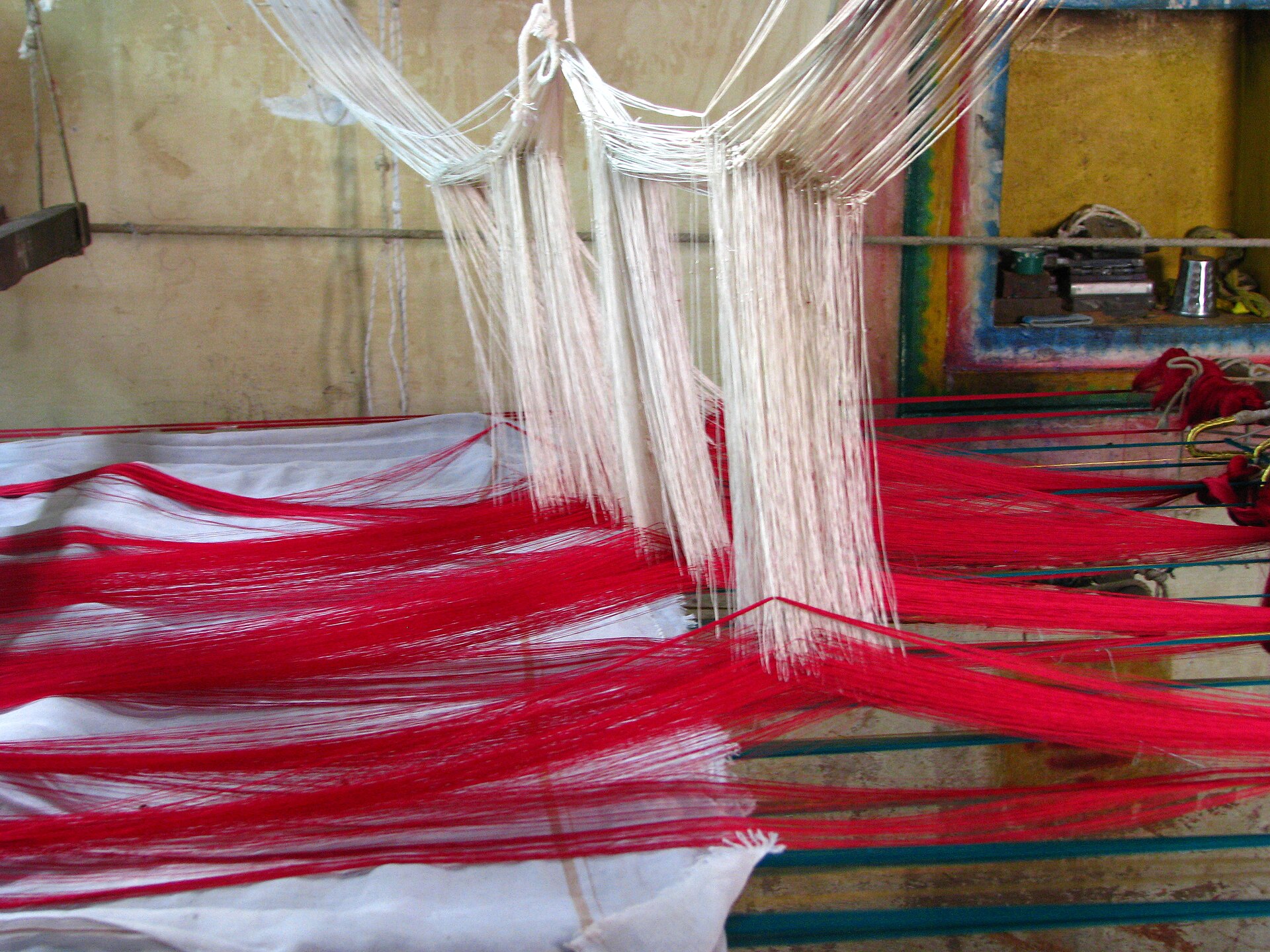

Kanchipuram, about seventy kilometres inland from Chennai, was a capital of the Pallava dynasty and remains one of the oldest continuously important temple towns in southern India. The Kailasanathar temple, built in sandstone in the Pallava period around the early eighth century, the vast Ekambareswarar complex and the Varadaraja Perumal temple all stand within a few kilometres of the looms that make the town's other famous product. The proximity is not incidental. The Kanjeevaram sari, also written Kanchipuram, takes much of its ornamental vocabulary directly from temple architecture and sculpture, and its market has always been anchored in temple ritual, marriage and the giving of cloth as a religious act.
Weaving families in Kanchipuram trace descent principally from the Devanga and Saligar communities, and from Saurashtrian weavers who migrated south from Gujarat over several centuries. A local origin story holds that the sage Markandeya wove cloth from lotus fibre for the gods and that the town's weavers descend from him. It is a devotional claim rather than a historical one, and worth reporting as such.
Korvai, petni and why the sari is heavy
What distinguishes a Kanjeevaram technically is that its contrasting parts are separate structures joined together, not patterns laid over a single ground. In the korvai method the border and the body of the sari are woven in different colours with different warps, and the two are locked together at the join by interlocking the wefts, a process that on a traditional loom requires three shuttles and, for the finest work, two people working in coordination. Pull at a korvai join and the cloth resists; the border does not peel away because it is genuinely woven into the body. This is the origin of the frequently repeated claim that a Kanjeevaram sari can be torn but its border will not detach, an exaggeration that nonetheless describes something real.
The petni technique performs the equivalent operation at the other end, joining a contrasting pallu, the decorated end panel that falls over the shoulder, to the body. In the most laborious version the two sets of warp threads are individually knotted together, thousands of joins made by hand, so that the pallu appears in a different colour with no seam. Cheaper saris achieve a similar look by weaving the whole length in one warp and simply changing the weft, or by stitching a separately woven pallu on. Turning the pallu join inside out and looking for a stitched seam is the quickest way to tell.
The silk itself is thicker than that used in northern brocades. Weavers commonly use multiple filaments twisted together, producing a dense, slightly stiff cloth that holds a sculptural fold, and a wedding sari can weigh from around half a kilogram to well over a kilogram once the zari is counted. The mulberry silk is generally reeled in Karnataka, around Ramanagara and Bangalore, and the zari has traditionally come from Surat in Gujarat: silver wire flattened and wound over a silk core, then gilded. Pure zari carries a hallmark of sorts in the trade and is priced by metal content; tested zari and copper-based imitation zari are far cheaper and are used in most saris sold today. The geographical indication for Kanchipuram silk was registered in the mid 2000s and is administered with the state handloom weavers' cooperative sector, which also runs the silk mark and zari testing that serious buyers look for.
The motifs and where they come from
The design repertoire is unusually literal about its architectural debt. The yali, a composite leonine temple beast carved on the pillars of southern temples, marches along borders. Rudraksham borders repeat the bead form associated with Shiva worship. Gopuram borders reproduce the stepped silhouette of a temple gateway tower. The mayil (peacock), annam (the mythical swan), the mango butta, and the thousand-eye or ayiram kann pattern of tiny repeated checks are all standard. Plain geometry is equally traditional: kattam checks, veldhari stripes running the length of the sari, and broad unpatterned fields in a single saturated colour whose only ornament is the border.
Colour is the other signature. Kanjeevaram dyeing favours strong, sometimes deliberately clashing pairings: mustard with parrot green, magenta with orange, deep maroon with turquoise. The convention of shot colour, where warp and weft are different hues so the cloth changes tone as it moves, is used heavily and gives the silk its characteristic depth.
Banarasi and Kanjeevaram compared
Because both are described as gold-worked silk wedding saris, the two are often confused. The difference is structural. A Banarasi sari from Varanasi is fundamentally a brocade: relatively fine silk carrying supplementary weft figuring that floats over the surface, with the pattern applied as ornament to a continuous ground. A Kanjeevaram is a heavier, denser plain or twill silk in which the drama comes from solid blocks of contrasting colour joined by interlocking, with the zari often confined to borders, pallu and discrete motifs rather than covering the field. Northern brocade tends toward Persianate florals and hunting scenes; southern silk tends toward temple geometry and mythical animals. A Banarasi drapes softly, a Kanjeevaram stands up.
The pressures on the two industries are similar. Powerloom saris marketed under the Kanchipuram name, silk from outside the designated area, imitation zari sold as pure and machine-made borders attached to plain bodies all compete on price with the handwoven article, and weaver cooperatives have struggled with debt and with the fluctuating cost of raw silk and silver. Younger weavers leave for Chennai. At the same time the wedding market remains robust, the top end has held its value, and designers working with Kanchipuram looms have widened the vocabulary with new colour ranges and lighter weights.
For a visitor, the town rewards a day that mixes both of its industries: the Pallava temples in the morning, when the light in the Kailasanathar courtyard is best, and a cooperative society showroom or a weaver's home loom in the afternoon, where the three-shuttle korvai join can be watched being made a few centimetres at a time.
References
- Victoria and Albert MuseumSouth Asia collection
- Encyclopaedia BritannicaKanchipuram
- Encyclopaedia BritannicaPallava dynasty
- Intellectual Property India (Government of India)Geographical Indications Registry
This is a reference article, written from the sources above. It is background, not news reporting.