How India Celebrates Eid, Region by Region
Reference library · 953 words
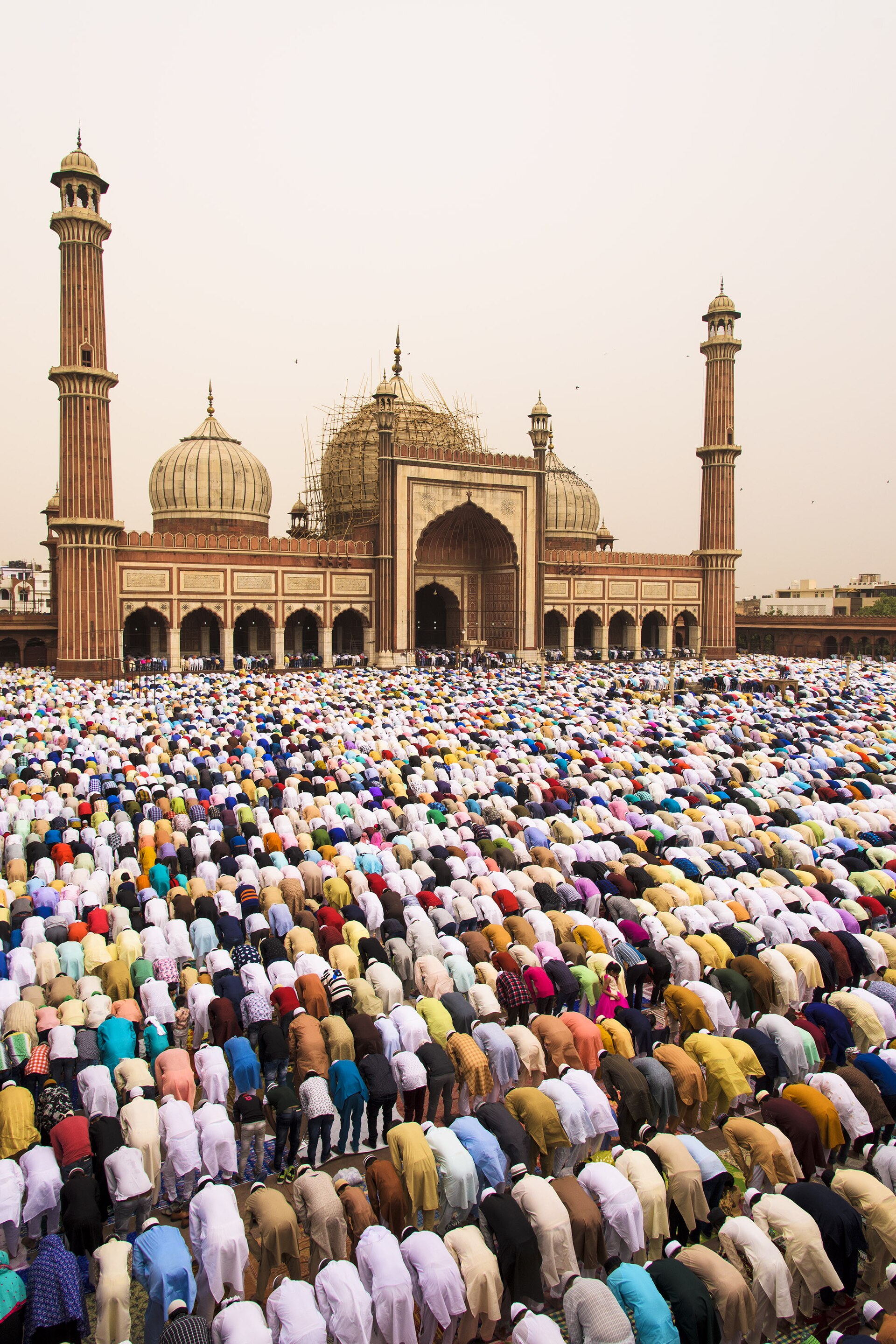

There are two Eids, and conflating them is the most common error outsiders make. Eid al-Fitr falls on the first of Shawwal and marks the end of the Ramadan fast. Eid al-Adha, known across most of India as Bakrid or Bakra Eid, falls on the tenth of Dhu al-Hijjah, coincides with the Hajj, and commemorates Ibrahim's willingness to sacrifice his son. The first is a festival of sweets and new clothes. The second is a festival of meat, distribution and obligation, with the sacrificed animal traditionally divided into three parts for the household, for relatives and for the poor.
Both move. The Islamic calendar has twelve lunar months totalling roughly 354 days, so each Eid arrives about ten or eleven days earlier in the Gregorian year than it did the year before, and over a lifetime a person will have kept Ramadan in every season. The date is not settled by arithmetic in most Indian communities but by the sighting of the new crescent, reported to local and regional moon sighting committees. Because sighting depends on weather, latitude and the authority a community recognises, India frequently celebrates Eid on two different days. Kerala often marks it a day ahead of much of the north. The Dawoodi Bohra community, concentrated in Gujarat and Mumbai, uses a calculated calendar rather than observation, so its dates are fixed years in advance and may not match either. None of this is a malfunction. It is how a sighting based calendar behaves in a country of this size.
Where the Prayer Happens
The Eid prayer is congregational and, by strong preference, held outdoors on an open ground called an Eidgah rather than inside a mosque, which is why Indian cities keep large maidans and school grounds in reserve for two mornings a year. The great exceptions are the historic congregational mosques. Delhi's Jama Masjid, commissioned by Shah Jahan and completed in the mid seventeenth century, fills its vast red sandstone courtyard. In Hyderabad the Mecca Masjid, begun under the Qutb Shahi sultans and finished during Mughal rule, draws similar crowds. In Srinagar the Jamia Masjid in the old city, with its deodar pillars, and the Hazratbal shrine on the Dal shore are the focal points. Before the prayer, heads of household are expected to pay zakat al-fitr, a small per person charitable payment usually reckoned in staple grain, and the timing matters: it is meant to be given before the congregation gathers so that the poorest can also mark the day.
The Kitchen Map
Food is where regional difference becomes vivid. Across Delhi, Uttar Pradesh, Bihar and much of the Deccan, Eid al-Fitr begins with sheer khurma, a vermicelli pudding cooked in milk with dates, almonds, pistachios and often saffron. The name is Persian, sheer for milk and khurma for dates, and its arrival with Persianate court culture is plausible, though the frequently repeated claim that a particular Mughal ruler introduced it is not supported by any contemporary record. Simpler sewaiyan, roasted vermicelli in thickened milk, is the everyday version. In Lucknow and Old Delhi the later part of the day belongs to kebabs, nihari and biryani, with Matia Mahal behind the Jama Masjid becoming a single long kitchen.
Hyderabad's signature Ramadan dish is haleem, a long simmered pounded mixture of wheat, lentils and meat, served with fried onion, mint and lime. It is worth being precise: haleem belongs to the fasting month, eaten at iftar, more than to Eid morning. Its ancestor is the Arabian harees, brought south by Hadhrami Arab soldiers who settled in Hyderabad, and Hyderabadi haleem carries a registered geographical indication. Eid itself in Hyderabad turns to double ka meetha, a bread pudding of fried bread in sweetened milk and khoya, and to qubani ka meetha made from dried apricots.
Kerala's Malabar coast eats differently again, reflecting centuries of direct trade with Yemen and the Gulf rather than overland Persianate influence. Mappila households make pathiri, a soft flatbread of ground rice, to eat with chicken or mutton curry, along with mutta mala, threads of sweetened egg yolk drawn through hot syrup, and its companion pinjanathappam. Thari kanji, a semolina and coconut milk porridge, breaks the fast. Malabar biryani uses the short grained kaima or jeerakasala rice rather than basmati, and is layered and sealed differently from Hyderabadi versions. Along the Tamil Nadu coast at Kayalpattinam and in the Bengal delta the sweets shift again, to Bengali shemai and payesh in Murshidabad and Kolkata.
Claims Worth Treating Carefully
Muslim communities in India are not a single culinary or cultural bloc, and much popular writing flattens them. Several origin stories in wide circulation deserve scepticism. The idea that biryani was invented by a Mughal queen for undernourished soldiers is folklore with no documentary basis, and layered rice and meat dishes existed across Persia and the Arab world long before. The tradition that the Cheraman Juma Masjid at Kodungallur in Kerala was founded in the seventh century, which would make it among the oldest mosques anywhere outside Arabia, is a community tradition rather than an archaeologically established date, although Kerala's Muslim presence through Arabian Sea trade is genuinely very early and predates the Delhi Sultanate by centuries.
What holds the regional versions together is not a menu but a sequence: the sighting, the early prayer, the embrace exchanged three times, the eidi of cash or gifts pressed into the hands of children, the visiting that carries on into the afternoon, and the obligation to have given something away before sitting down to eat. In the diaspora, including in Australian cities with large Indian populations, that sequence survives intact even when the crescent is sighted somewhere else entirely and the sheer khurma is made with supermarket vermicelli.
References
- Pew Research CenterReligion in India: Tolerance and Segregation
- Incredible India, Ministry of TourismHyderabad
- Incredible India, Ministry of TourismKerala
- Incredible India, Ministry of TourismDelhi
This is a reference article, written from the sources above. It is background, not news reporting.