Holi: How India Welcomes Spring in Colour
Reference library · 1038 words
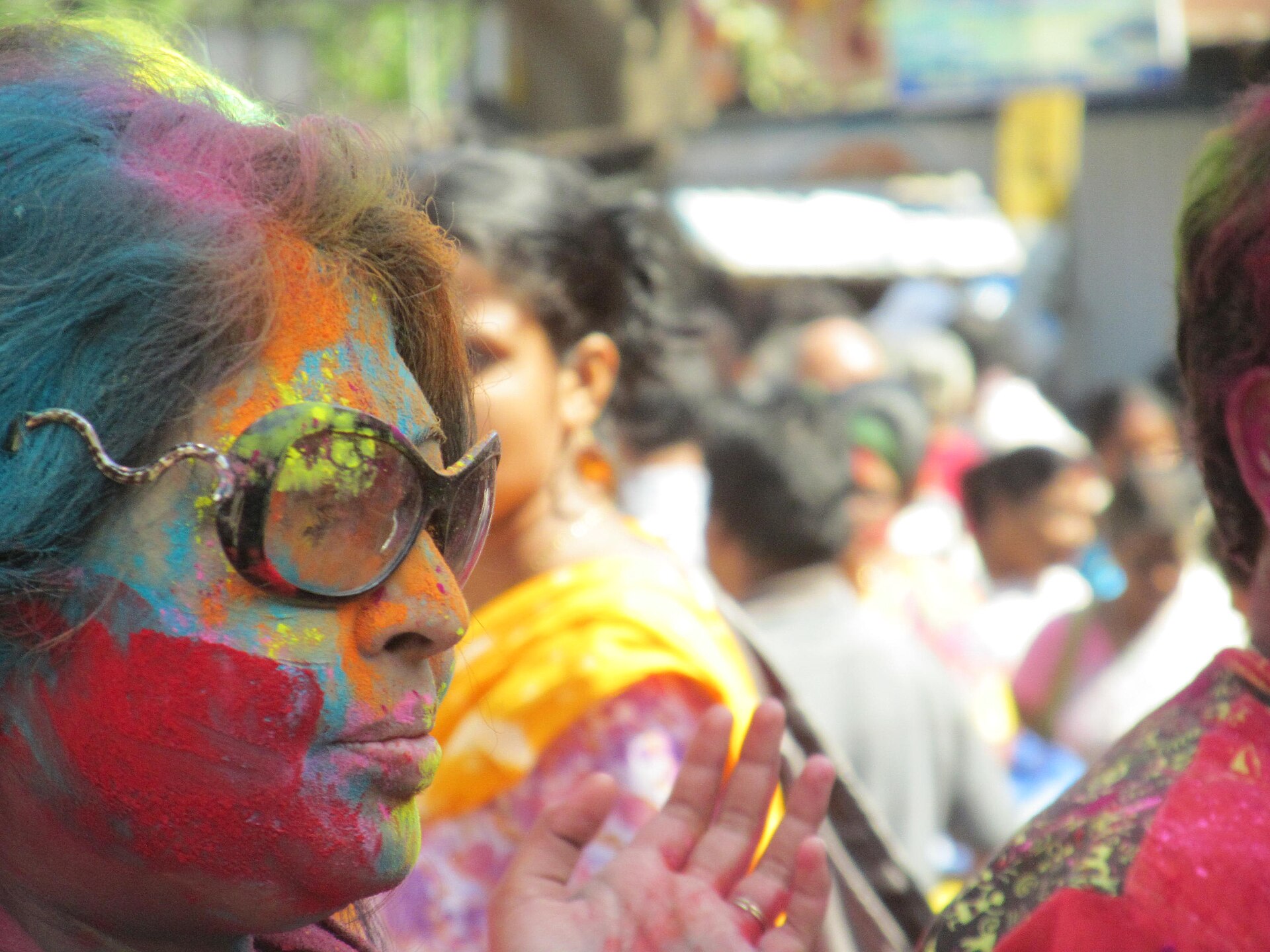

Holi is the best travelled of Indian festivals, reproduced now as colour runs and music festivals on several continents, usually stripped of everything except the throwing of powder. The original is stranger and more interesting than the export. It is a festival of the spring full moon that combines a bonfire, an agricultural marker, a devotional story about Krishna, a legend about a fire that would not burn, and, crucially, a licensed suspension of ordinary social rules.
The date is set by the Hindu lunisolar calendar: Holi falls on the full moon (purnima) of the month of Phalguna, which places it in late February or March. The bonfire, Holika Dahan, is lit on the night of the full moon; the colour throwing, variously called Rangwali Holi, Dhulandi or Dhuleti, happens the following morning. Two nights, two entirely different moods.
The fire, and the story behind it
The bonfire commemorates the destruction of Holika. In the story, the king Hiranyakashipu had obtained protection that made him nearly impossible to kill and demanded worship as a god. His son Prahlada refused and remained devoted to Vishnu. Hiranyakashipu's sister Holika possessed a boon or garment that protected her from fire, and she sat in a pyre holding the boy, intending that he burn while she survived. The protection failed her and saved him. The narrative is part of the Prahlada cycle, which continues with Vishnu's appearance as Narasimha, the man lion, to kill the king in a way that circumvented every condition of his protection.
The bonfire is thus a burning of arrogance and of the destructive impulse, and in practice it is also an old agricultural fire rite. Holi falls at the end of winter, around the time the rabi crop is ready in northern India, and grain, chickpeas and stalks are traditionally roasted in the fire and eaten. Wheat ears held to the flames and the eating of the parched grain, holaka, connect the festival to harvest in a way that predates or runs alongside the Puranic story. In many places the fire is circumambulated and the ash is applied to the forehead.
Krishna, Braj, and why the colours
The colour throwing has a separate origin story, set in the Braj region around Mathura and Vrindavan in western Uttar Pradesh, where Krishna is held to have spent his youth. In the story, the young Krishna, dark skinned, complained to his mother Yashoda that Radha and the other gopis were fair while he was not, and was told, half in jest, to colour Radha's face whatever shade he liked. He did, and the game became a festival.
Braj holds the most elaborate and prolonged Holi observances in India, running well over a week rather than a day. At Barsana, said to be Radha's village, and Nandgaon, said to be Krishna's, the tradition of Lathmar Holi has women of one village drive off men from the other with long sticks while the men shield themselves with leather bucklers, a ritual reversal of ordinary power performed with a great deal of noise and considerable good humour. At Vrindavan's Banke Bihari temple, Phoolon wali Holi is played with flower petals rather than powder. Elsewhere in the region Holi is played with coloured water pumped from tanks and with dry powder, and the crowds are among the largest and least manageable in India.
The suspension of ordinary hierarchy is genuinely central rather than incidental. On Holi, distinctions of age, caste, wealth and, to a degree, gender are ritually set aside. Employees can colour employers, the young can colour the old, strangers can approach strangers. The Hindi phrase bura na mano, Holi hai, do not take offence, it is Holi, is the standard licence. Anthropologists have long treated Holi as a classic example of a ritual of reversal, a temporary and bounded inversion that lets social tension discharge without threatening the order it briefly suspends.
That licence has a documented downside, and any honest account should say so. The cover of the festival has been used for harassment, particularly of women, and the problem is discussed openly in Indian media and campaigned against by Indian women's organisations. Many people now choose to play Holi only in known company, in gated communities or at organised events, precisely for this reason.
Colours, bhang and the regional variants
The powders, gulal, were historically made from plant sources: the orange red of the flame of the forest tree (palash or tesu), turmeric yellow, indigo blue, henna and beetroot. From the twentieth century, cheap synthetic pigments displaced these, and some of the cheapest have contained industrial dyes and heavy metal compounds capable of causing skin and eye damage. There has been a substantial and reasonably successful push in recent years toward herbal and food grade colours, and buying from a known source is worth doing.
Food and drink are their own tradition. Gujiya, a fried crescent pastry filled with reduced milk solids and dried fruit, is the emblematic Holi sweet in the north. Thandai is a cold milk drink flavoured with almond, fennel, poppy seed, rose and pepper. It is frequently, though by no means always, prepared with bhang, an edible preparation of cannabis, which occupies an unusual legal and cultural position in India: associated with Shiva, tolerated in specific festival contexts and sold from licensed shops in some states, while cannabis is otherwise restricted. Visitors are routinely caught out by being handed a thandai without being told what is in it, and asking directly is entirely reasonable.
Regional variants multiply. In Punjab, the Sikh festival of Hola Mohalla falls immediately after Holi at Anandpur Sahib and features martial arts displays and processions by Nihang Sikhs, a tradition attributed to Guru Gobind Singh. Bengal and Odisha observe Dol Jatra or Dol Purnima, in which images of Krishna and Radha are carried in swings and processions, with a strong association to the poet saint Chaitanya. Manipur combines Holi with the six day Yaosang festival and its thabal chongba dances. Maharashtra and Gujarat mark Rangapanchami a few days later, and Gujarat adds the pot breaking contest associated with Krishna and stolen butter. The powder is the same everywhere; almost nothing else is.
References
- Encyclopaedia BritannicaHoli
- BBCBBC Religions: Hinduism, Holi
- Victoria and Albert MuseumSouth Asia collections
- Encyclopaedia BritannicaKrishna
This is a reference article, written from the sources above. It is background, not news reporting.