Hindustani Classical Music: Foundations of a Tradition
Reference library · 979 words

Hindustani classical music is the art music of northern India, Pakistan, Bangladesh and Nepal. It shares its theoretical foundations with the Carnatic music of the south, both descending from a common body of Sanskrit musical theory, but the two diverged over several centuries as the north absorbed Persian and Central Asian influence through the Delhi Sultanate and the Mughal empire. The result is a tradition that is simultaneously a temple art, a court art and, since the twentieth century, a concert-hall art.
Its central proposition is unusual. There is very little repertoire in the Western sense. A performance is built in real time from two fixed frameworks, one melodic and one rhythmic, and the composition itself may occupy only a small fraction of the performance.
Raga and tala
A raga is often loosely translated as a scale or mode, and the translation is inadequate. A raga specifies which notes are used, but also which notes are approached from above or below, which are stressed and which merely touched in passing, which characteristic phrases identify it, and which movements are forbidden. Two ragas can use exactly the same set of notes and remain entirely distinct because their grammar of movement differs. Within a raga, particular notes carry weight: the vadi is the most prominent, the samvadi its consonant partner, and a short signature phrase called the pakad lets a listener identify the raga within seconds.
The note system uses seven named degrees, sa re ga ma pa dha ni, corresponding roughly to a diatonic scale, with five of them having flat or sharp variants to make twelve semitones in the octave. Older theory also describes shruti, microtonal intervals finer than the semitone, and performers do routinely place notes slightly higher or lower than equal temperament would suggest, which is one reason the harmonium, with its fixed tuning, remains a contested accompaniment; All India Radio at one point restricted its use on precisely these grounds.
Ragas are traditionally associated with times of day and, in some cases, with seasons. Bhairav belongs to dawn, Todi to mid-morning, Bhimpalasi to the afternoon, Yaman to early evening, and Bhairavi conventionally closes a concert whatever the hour. Megh and the Malhar family are monsoon ragas, Basant belongs to spring. The system is a performance convention rather than a law of nature, and it is honoured selectively at festivals and on recordings.
The rhythmic framework is the tala, a cycle of a fixed number of beats divided into unequal sections and marked by a drum pattern called the theka. Teental has sixteen beats in four groups of four; jhaptal has ten; ektal twelve; rupak seven. The first beat of the cycle, the sam, is the point of gravity: soloist and drummer may diverge for many cycles, and the pleasure for an informed audience lies in hearing them arrive together on the sam at the end of an elaborate excursion. Audiences keep the cycle with hand claps and waves, and the moment of arrival often draws an audible response.
Forms and gharanas
The oldest surviving concert form is dhrupad, austere, slow to unfold, accompanied by the barrel drum pakhawaj, and given over largely to an unmetred exploration called alap that moves through jor and jhala as pulse and speed enter. The Dagar family sustained dhrupad through a long period when it was commercially eclipsed.
Khayal, whose name comes from a word meaning imagination, displaced dhrupad as the dominant vocal form and remains so. A khayal performance typically pairs a slow composition, the bada khayal, with a fast one, and the short fixed composition or bandish serves mainly as a springboard for improvisation. Lighter classical forms include thumri, romantic and text-driven, associated with Banaras and Lucknow, and tappa, tarana and dadra.
Transmission happens through the gharana, a lineage of style rather than a school in the institutional sense, historically maintained through long apprenticeship in a teacher's household under the guru shishya relationship. The Gwalior gharana is generally regarded as the oldest khayal lineage; Kirana is known for slow, note-centred elaboration, Agra for rhythmic force, Jaipur-Atrauli for complex compound ragas, Patiala for ornament and speed. Instrumental lineages, notably the Maihar tradition built by Allauddin Khan, shaped the sitar and sarod playing that reached the world through musicians such as Ravi Shankar and Ali Akbar Khan.
Instruments, and the twentieth-century reinvention
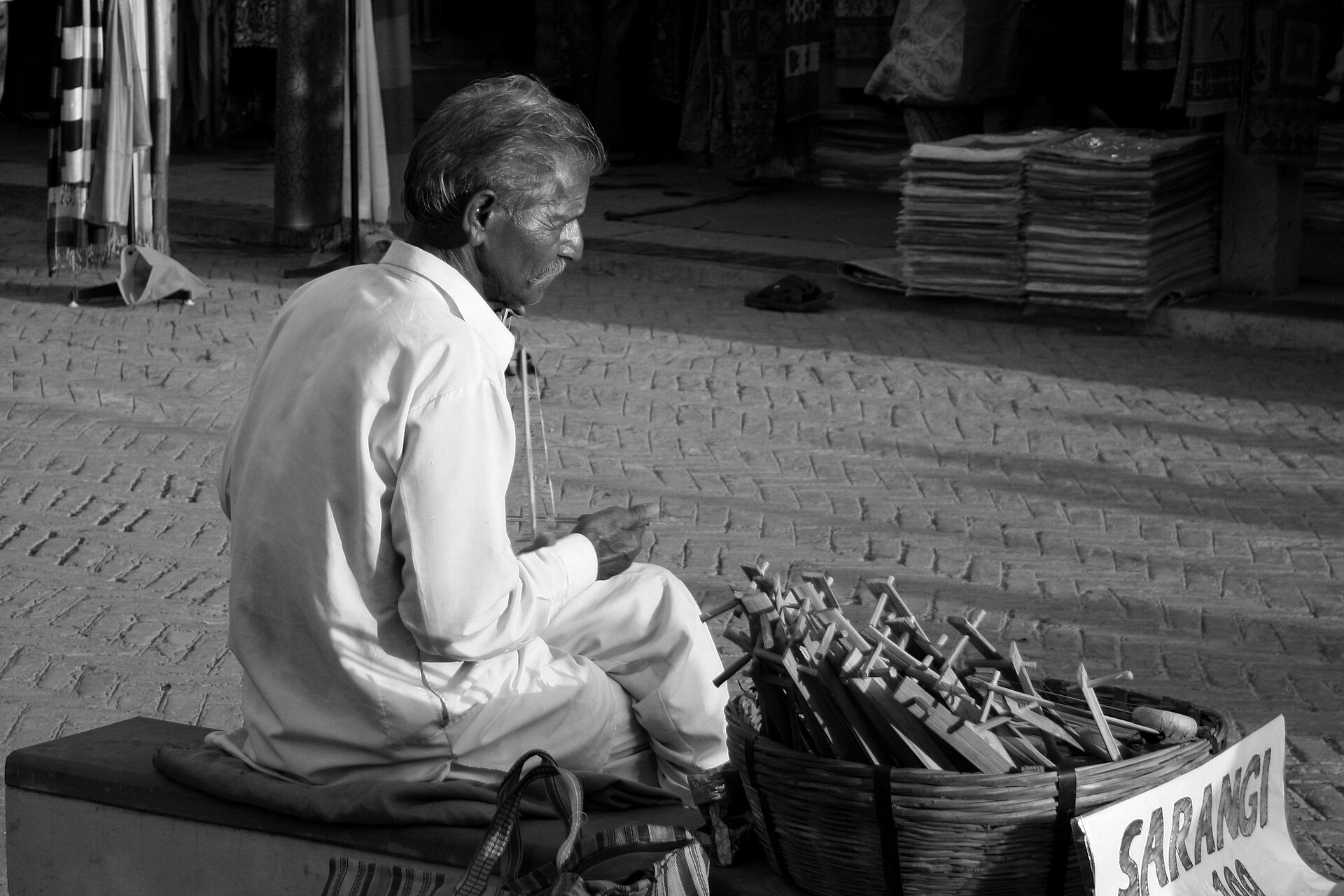
The tanpura underpins everything: a long-necked lute, played by no one in particular, sounding four strings in a continuous drone that establishes the tonic against which every note takes its meaning. Melody instruments include the sitar and the sarod, the bowed sarangi with its sympathetic strings, the hammered santoor of Kashmir, the bansuri bamboo flute and the shehnai, an oboe-like reed instrument long associated with weddings and temple gateways and raised to concert status by Bismillah Khan. The tabla, a pair of tuned hand drums with a black tuning paste on the heads, is the standard percussion and has a highly developed solo repertoire of its own, spoken in mnemonic syllables before it is played.
Much of what audiences take to be immemorial is in fact about a century old. As Mughal and princely patronage collapsed, two reformers reshaped the tradition for a modern public. Vishnu Narayan Bhatkhande developed a classification of ragas into ten parent scales, the thaats, and produced a written notation and a huge collection of compositions. Vishnu Digambar Paluskar established music schools and public concerts and campaigned to give the profession social respectability, which it had lacked partly because performance had been associated with hereditary courtesan and Muslim musician communities. The reform brought classical music to middle-class households and to the radio; it also displaced some of the people who had carried it, and that displacement is now a recognised part of the tradition's history rather than a footnote to it.
References
- Encyclopaedia BritannicaSouth Asian arts: Music
- Encyclopaedia BritannicaRaga
- Sangeet Natak Akademi (Government of India)Sangeet Natak Akademi
- Smithsonian Folkways RecordingsSmithsonian Folkways Recordings
This is a reference article, written from the sources above. It is background, not news reporting.