The Golden Triangle: India's Classic First Journey
Reference library · 1101 words
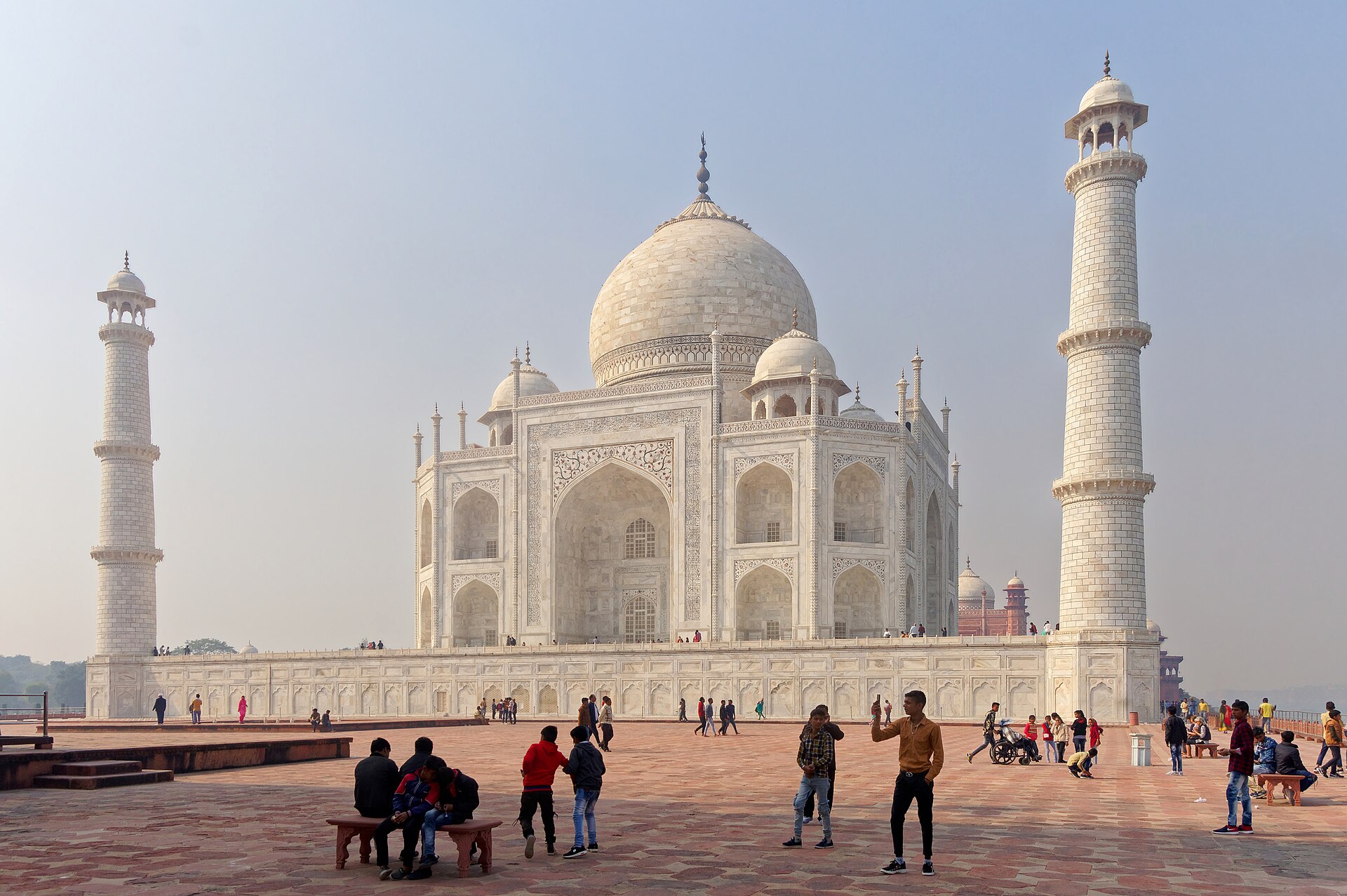

The Golden Triangle is the circuit joining Delhi, Agra and Jaipur, three cities that sit roughly at the corners of a triangle in India's northwest, a few hours apart by road or rail. It is by a wide margin the most travelled tourist route in India, and the marketing has real logic behind it: within a compact area it covers the seat of the Delhi Sultanate and the Mughal empire, the single most famous building in Asia, and the courtly Rajput culture of Rajasthan, spanning something like eight centuries of architecture and politics.
The route's popularity is also its main drawback. Every part of it is heavily geared to visitors, touts and commission driven shopping stops are a constant, and a traveller who follows the standard three or four night itinerary will see a great deal of monument and very little of ordinary India. Both things are true at once, and the honest way to approach the circuit is to accept it as an excellent introduction rather than a representative sample.
Delhi: seven cities on one site
Delhi is not a single historical city but a sequence of them, built and abandoned across the same stretch of the Yamuna plain. The conventional count is seven, though the number depends on who is counting. The earliest surviving major complex is at Mehrauli, where the Qutb Minar, begun at the end of the twelfth century under Qutb ud din Aibak and completed under his successor Iltutmish, rises in tapering fluted storeys of red sandstone and marble. Alongside it stands the Quwwat ul Islam mosque, built partly from the columns of demolished earlier temples, a fact visible in the carving and one that is politically charged in India today. The Qutb complex is a UNESCO World Heritage Site.
Humayun's Tomb, completed in the 1570s, is the other essential Delhi monument and is more important architecturally than its lower profile suggests. Commissioned by the emperor Humayun's widow Hamida Banu Begum and generally attributed to the Persian architect Mirak Mirza Ghiyas, it introduced to India the combination of a high red sandstone and marble mass, a double dome, and a formal charbagh, a garden quartered by water channels representing paradise. Nearly every later Mughal tomb, including the Taj Mahal, descends from it. It too is a World Heritage Site, and its restoration over the past two decades is regarded as one of the more successful conservation projects in India.
The third Delhi site of the same rank is the Red Fort, Shah Jahan's fortified palace complex of the 1640s at Shahjahanabad, the walled city now known as Old Delhi. Nearby, the Jama Masjid, also Shah Jahan's, remains one of the largest mosques in India. The lanes of Chandni Chowk around them are the best food walking in the circuit, and Delhi's other layers, from the colonial New Delhi of Edwin Lutyens and Herbert Baker to the Lodi era tombs scattered through the parks, reward anyone who stays longer than a night.
Agra: the Taj, and what else is there
Agra is about three to four hours from Delhi on the Yamuna Expressway, and considerably less by the fastest trains. The Taj Mahal was built by Shah Jahan as a mausoleum for Mumtaz Mahal, who died in 1631; construction of the main structure occupied most of the following decade with the wider complex taking longer. Ustad Ahmad Lahauri is the name most often associated with its design, though Mughal building was a collective enterprise and attribution is not certain. Its power comes less from ornament than from proportion and from material: white Makrana marble inlaid with semiprecious stone in the technique called parchin kari or pietra dura, set on a raised plinth with the minarets tilted very slightly outward, and reflected in a long watercourse. The marble reads differently at different hours, pinkish at dawn and warm at sunset, which is why the early opening is worth the discomfort.
Two practical points. The Taj is closed to general visitors on Fridays. And the persistent guide story that Shah Jahan mutilated the craftsmen so the building could not be repeated is a legend with no reliable historical basis.
Agra Fort, a short distance away and also a World Heritage Site, is the better building for understanding how the Mughals actually lived, with Akbar's red sandstone construction and Shah Jahan's later marble apartments in the same walls. Thirty five to forty kilometres out lies Fatehpur Sikri, Akbar's purpose built capital of the 1570s, abandoned within a couple of decades, its usual explanation being water supply. It is remarkably intact, and its Buland Darwaza and Panch Mahal are among the most original structures the Mughals built. The smaller tomb of Itimad ud Daulah, sometimes called the baby Taj, predates the Taj Mahal and shows the inlay technique at an earlier stage.
Jaipur: a planned city
Jaipur is roughly four to five hours from Agra. It was founded in 1727 by Sawai Jai Singh II, ruler of Amber, who moved his capital down from the hills and built a new city on a grid. The planning, associated with the scholar Vidyadhar Bhattacharya, follows principles from Indian architectural treatises, with wide straight streets dividing the walled city into rectangular blocks. That is genuinely unusual: most historic Indian cities grew organically. Jaipur's walled city was inscribed as a UNESCO World Heritage Site in 2019. The pink wash that gives it the nickname the Pink City was applied in the nineteenth century and has been maintained by regulation since.
Jai Singh was also an astronomer, and the Jantar Mantar he built in Jaipur is the largest and best preserved of the five observatories he constructed. Its instruments are architectural in scale, built in masonry rather than metal to improve precision, and the enormous Samrat Yantra sundial is accurate to a remarkable degree. It is a separate World Heritage Site. The Hawa Mahal, built in the 1790s under Sawai Pratap Singh, is a five storey screen of small latticed windows designed to let women of the household watch street processions unseen while catching the breeze. Amer Fort, on the ridge outside the city, is the older seat of the dynasty and combines Rajput fortification with Mughal influenced palace interiors, including the mirrored Sheesh Mahal.
A note on the elephant rides at Amer: they are widely criticised on welfare grounds, and jeeps or the walk up are alternatives. The circuit is best between roughly October and March, since May and June here are extremely hot. Four days covers it thinly, a week comfortably, and adding Ranthambore or Shekhawati turns a checklist into a journey.
References
- UNESCO World Heritage CentreTaj Mahal
- UNESCO World Heritage CentreHumayun's Tomb, Delhi
- UNESCO World Heritage CentreJaipur City, Rajasthan
- UNESCO World Heritage CentreThe Jantar Mantar, Jaipur
- Archaeological Survey of IndiaArchaeological Survey of India
This is a reference article, written from the sources above. It is background, not news reporting.