Mirza Ghalib: A Poetic Legacy That Still Speaks
Reference library · 923 words

Mirza Asadullah Beg Khan, who signed his verse first as Asad and then as Ghalib, was born in Agra in 1797 and died in Delhi in 1869. Those seventy two years spanned the collapse of an order. He was born into a world where the Mughal emperor still sat in the Red Fort and Persian was the language of administration and prestige. He died in a city that the British had shelled, sacked and emptied after 1857, with the last emperor exiled to Rangoon and English installed as the language of the courts. Almost everything that makes Ghalib unusual as a poet follows from standing at that hinge. He is the most quoted poet in Urdu, and also one of the most misquoted.
His family were soldiers of Central Asian Turkic descent who had come to India and taken service with regional powers. His father died when he was a small child and he was raised largely by an uncle, whose death left the household dependent on a pension administered by the English East India Company. The dispute over that pension consumed years of Ghalib's life, took him on a long journey to Calcutta between 1828 and 1829, and never resolved to his satisfaction. He married Umrao Begum as a teenager and moved to Delhi, settling eventually in the lane of Ballimaran, where the house now maintained as Ghalib ki Haveli stands. None of the children born to the couple survived infancy, a fact that sits behind a great deal of the verse without ever being announced in it.
Persian pride, Urdu fame
Ghalib considered himself principally a Persian poet. He said so repeatedly and dismissively about his own Urdu work, and his Persian output, including the collection Panj Ahang, is far larger than the slim Urdu Divan on which his popular reputation rests. Posterity has simply overruled him. The Persian is read today mainly by specialists, while the Urdu ghazals are sung in concert halls from Lahore to Melbourne. This is a genuine tension rather than a settled question, and readers who encounter Ghalib only through film songs are meeting a fraction of what he wrote.
His early Urdu manner was deliberately difficult, dense with abstraction and Persianate compounds, and contemporaries complained about it. The critical term for the tendency is mushkil pasandi, a fondness for difficulty. Ghalib himself pruned hard when assembling his published Divan, discarding a large body of early ghazals that survive in manuscript collections and are still argued over by editors. The later verse is plainer on the surface and stranger underneath. A Ghalib couplet typically works by setting up a conventional image from the ghazal stock, the beloved, the wine cup, the desert, the rival, and then twisting it into a proposition about knowledge, desire or the limits of belief. He was a devout but unorthodox Muslim who drank, gambled and joked about both, and the theological unease in his verse is real rather than decorative.
The letters, and the year everything broke
Ghalib's second and arguably greater achievement is prose. Urdu letter writing before him was a formal art of elaborate salutations and borrowed Persian formulae. Ghalib wrote to his friends as though speaking to them, addressing them directly, breaking off, complaining about money, asking after mangoes. The collections published as Ud e Hindi and Urdu e Muallah effectively invented a conversational Urdu prose that later essayists and novelists built on. If you want the man rather than the mask, the letters are where he is.
He was in Delhi through the revolt of 1857 and its ferocious suppression. His diary of those months, Dastanbuy, was written in a Persian carefully purged of Arabic vocabulary, and it is a cautious document, written by a pensioner who needed to survive the British return and who knew it would be read. Friends were hanged, the neighbourhood was cleared, his patron the emperor Bahadur Shah Zafar was tried and deported. Ghalib had by then received court titles and served as a chronicler for the Mughal household, having spent years in professional rivalry with Sheikh Ibrahim Zauq, the emperor's own poetic tutor. After 1857 the court that had given his work a social frame no longer existed.
Afterlives, and things wrongly credited to him
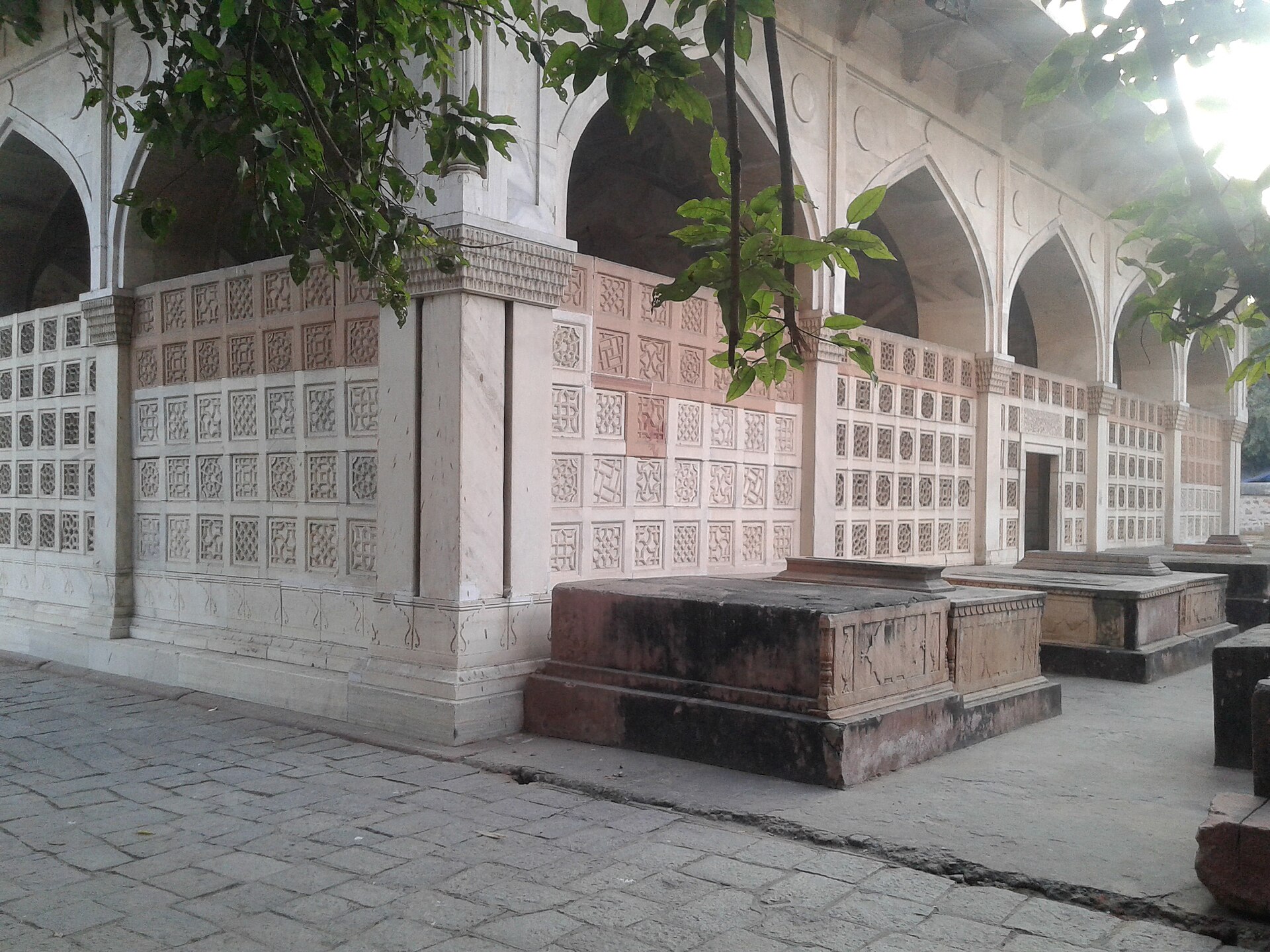
Ghalib survives today largely through music and screen. Sohrab Modi's film Mirza Ghalib was released in 1954, with a score by Ghulam Mohammed and singing by Suraiya, and it fixed a romantic image of the poet for a mass audience. Gulzar's television serial Mirza Ghalib, broadcast in 1988, cast Naseeruddin Shah in the role and used compositions and vocals by Jagjit Singh, and for a whole generation of Indian and diaspora listeners that series is where Ghalib begins. Begum Akhtar, Mehdi Hassan and Abida Parveen have each recorded him. His tomb near the Nizamuddin Basti in Delhi is a small walled enclosure, easy to miss.
One caution is worth stating plainly. A very large quantity of Urdu and Hindi verse circulating on social media under Ghalib's name is not by him. Some of it belongs to other poets, some is modern and anonymous, and some is invented outright. The same applies to the many colourful anecdotes about his drinking and his debts, which are entertaining but come from a later biographical tradition rather than from documents. The reliable route in is the edited Divan and the letters, both freely available in digitised form, and the sensible test for any couplet attributed to him is whether an editor has ever printed it.
References
- Poetry FoundationMirza Asadullah Khan Ghalib
- RekhtaMirza Ghalib: all writings
- WikipediaGhalib
- WikipediaMirza Ghalib (1954 film)
- WikipediaUrdu poetry
This is a reference article, written from the sources above. It is background, not news reporting.