Durga Puja: Kolkata's Season of Pandals and Art
Reference library · 1051 words
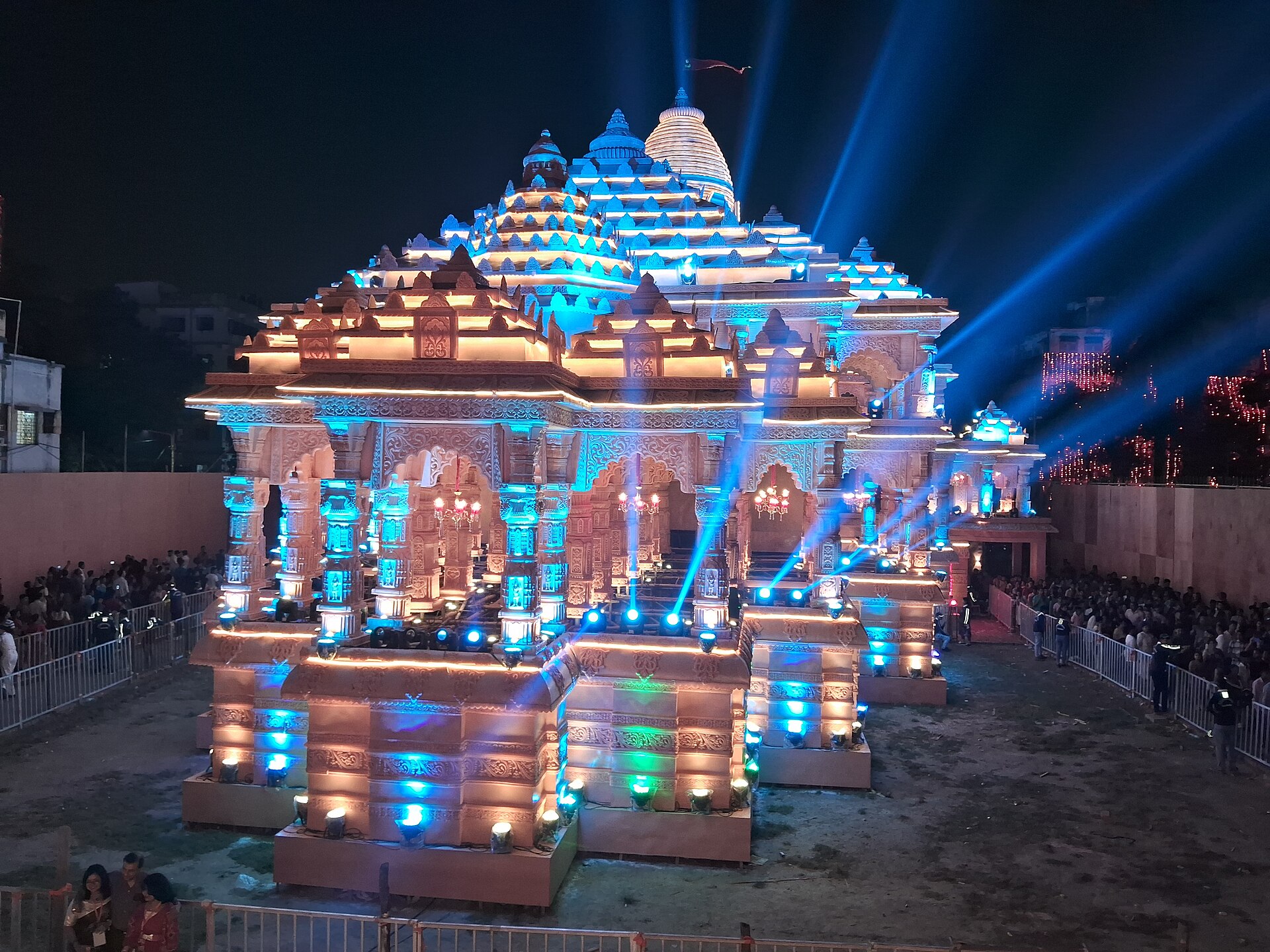

For a few days in autumn, Kolkata turns itself into an open air exhibition. Several thousand temporary structures go up across the city, each housing an image of the goddess Durga, each commissioned from artists and designers, each competing for the attention of crowds who walk from one to the next through the night. Durga Puja is a religious festival, a civic institution, an art competition and an enormous informal economy all at once, and in 2021 UNESCO inscribed Durga Puja in Kolkata on its Representative List of the Intangible Cultural Heritage of Humanity.
The festival falls in the lunar month of Ashwin, in September or October, during the nine night period known elsewhere in India as Navratri. In Bengal the main observance runs across the last four days: Saptami, Ashtami, Navami and Dashami. The mythological subject is Durga's defeat of the buffalo demon Mahishasura, a being who could not be killed by any man or god and was therefore killed by a goddess assembled from the combined energies of the gods, armed by each of them with a weapon. The image shows the moment of the kill: Durga with ten arms, riding a lion, trident driven into the demon as he emerges from the body of a buffalo.
The Bengali arrangement of the image is specific and differs from Durga imagery elsewhere. Durga stands at the centre with four figures grouped around her, conventionally identified as her children: Lakshmi and Ganesha on one side, Saraswati and Kartikeya on the other. Bengalis speak of the goddess coming home to her father's house for a visit, which frames the whole festival as a family homecoming and makes the final day, when the image is taken to the river, a farewell rather than a triumph.
Kumartuli, and how the images are made
Almost all of the images come from one district. Kumartuli, in north Kolkata, is a quarter of narrow lanes occupied by kumors, image makers, whose workshops have supplied the city for generations. The process begins months ahead with a bamboo and straw armature bound into shape. Over this goes ekmete, a first coat of clay mixed with rice husk, then a finer clay layer, then a smooth finish. The clay is traditionally taken from the banks of the Hooghly, and one persistent custom holds that a portion of soil should be obtained from outside a brothel, a practice usually explained as an assertion that no one is excluded from the goddess, and one that sex workers' organisations in Kolkata have at times contested as hollow given their treatment the rest of the year.
The features are modelled last. Chokkhu daan, the giving of the eyes, is performed on an auspicious day and is treated as the moment the image becomes capable of being worshipped. Decoration ranges from traditional daker saj, ornamentation using thin beaten metal foil, to shola, white pith carved into delicate crowns and garlands, to contemporary treatments in fibreglass, metal, jute or found material. The idiom of the face varies too, from the wide eyed classical Bengali style to naturalistic modern faces that provoke argument every year.
The pandal as art commission
A pandal is a temporary pavilion, historically a bamboo frame draped in cloth, now frequently an elaborate constructed environment. From the 1990s onward the leading Kolkata pujas began commissioning practising artists and designers rather than traditional decorators, and the results have included pandals built as replicas of famous buildings, as installations exploring migration or climate or mental health, as recreations of village crafts using terracotta, cane, clay pots, bicycle parts, ceramic tiles or fabric. Prizes sponsored by companies and media houses drive the competition, and the resulting spending is very large. It is worth noting the criticism as well as the spectacle: environmental groups raise concerns about waste and about the effect of immersion on the river, and there is a running debate about corporate sponsorship overwhelming the religious content.
The organisational form behind all this is the barowari or community puja, funded by neighbourhood subscription rather than by a wealthy family. The shift from aristocratic household pujas (the bonedi bari tradition, still maintained by some old Kolkata families) to community pujas is one of the more consequential developments in the festival's history, because it turned a private rite into a public one and made the pandal something a whole locality had a stake in.
Ritual, food and the immersion
The days have their own texture. Mahalaya, about a week before, marks the beginning of the fortnight and is associated in Bengal with a radio programme of devotional chanting broadcast before dawn, a broadcast tradition that has itself become an object of nostalgia. Bodhon awakens the goddess. On Ashtami, anjali is offered with flowers, and the junction between Ashtami and Navami, sandhi puja, is treated as the most charged moment of the festival. Dhunuchi naach is danced holding an earthen censer of burning coconut husk and incense, accompanied by the dhak, a large barrel drum played with thin sticks by drummers who travel into the city for the season.
Eating out is close to obligatory. Street food stalls, bhog served free at pandals, khichuri with fried vegetables and labra, and the Kolkata biryani with its distinctive potato and boiled egg are all part of the season. Shopping for new clothes before the festival is a major retail event in the eastern Indian economy.
On Dashami the images are taken through the streets and immersed in the Hooghly. Before they go, married women perform sindoor khela, smearing vermilion on the goddess and on one another. The immersion is deliberate and theologically pointed: the image is unfired clay, it dissolves, and the material returns to the river it came from. The whole enormous apparatus of the festival is built to be destroyed within days, which is either the most wasteful thing about it or the most profound, depending on who you ask.
Durga Puja is not only Bengali and not only Kolkata's. It is observed across Assam, Odisha, Tripura, Jharkhand and Bihar, and by Bengali communities worldwide, including in Australian cities where diaspora associations run pujas with imported or locally made images. The Kolkata version is simply the largest and most artistically ambitious, and it is the one UNESCO listed.
References
- UNESCODurga Puja in Kolkata, Intangible Cultural Heritage
- Encyclopaedia BritannicaDurga Puja
- Encyclopaedia BritannicaDurga
- British MuseumCollection online: South Asia
This is a reference article, written from the sources above. It is background, not news reporting.