Descending Into History: India's Stepwell Engineering
Reference library · 1031 words
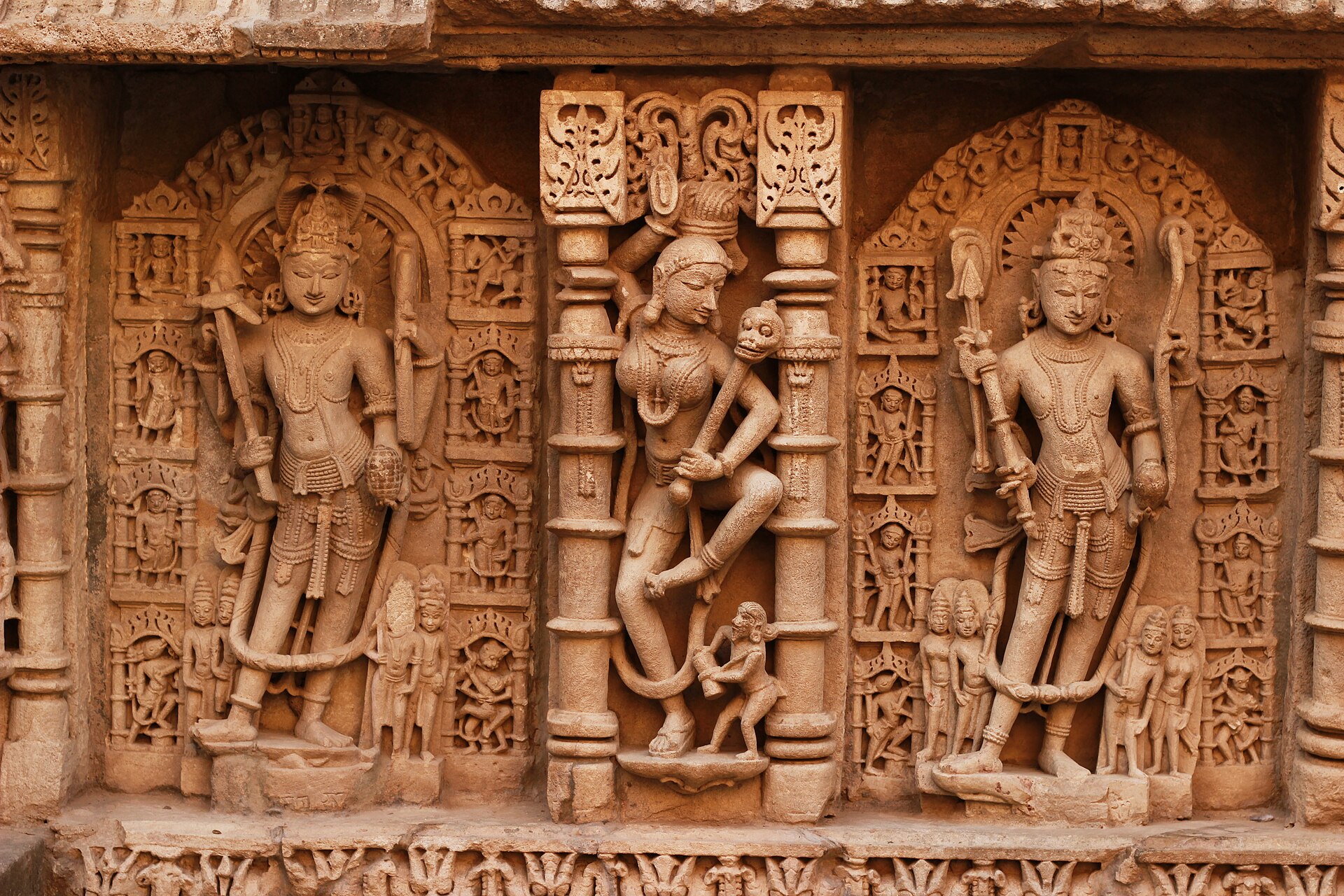

Almost every civilisation that has faced a seasonal water supply has built something to store it. What distinguishes the Indian stepwell is that it inverts the usual solution. Instead of raising water to the people, it takes the people down to the water, cutting a monumental staircase into the ground so that the surface of the aquifer can be reached on foot at any time of year. The result is a building that is entirely subterranean, that has no exterior elevation to speak of, and that is invisible until you are standing at its lip.
The type is concentrated in the arid and semi arid west: Gujarat, where they are called vav, and Rajasthan, where the usual term is baori or baoli, with the form extending into Madhya Pradesh, the Deccan, Delhi and across into eastern Pakistan. Survey work in recent years has been startling in scale. A collaborative mapping project documented more than 2,800 stepwells across India in 2016, and a separate effort recorded over 1,700 in Maharashtra alone. These were not rare monuments. They were common infrastructure, and most of them are unstudied.
How the engineering works
The basic problem is that groundwater level swings enormously between monsoon and late summer. A conventional well with a rope and bucket copes with this poorly, and a tank open to the sky loses a large fraction of its volume to evaporation in a hot dry climate. The stepwell solves both. Builders cut a deep trench to reach dependable year round groundwater, lined the walls with cut stone laid without mortar, and ran a stepped corridor down one axis to a vertical shaft at the far end. As the water table falls through the season, the users simply walk further down the stairs. As it rises after the rains, the lower flights flood and the access point moves up.
Building without mortar was deliberate, not primitive. Dry laid ashlar allows the structure to accommodate ground movement and, critically, permits water to move through the joints rather than building up destructive pressure behind an impermeable wall. It also allows blocks to be lifted out and reset during desilting, which any stepwell requires periodically. The stone acts, in effect, as both retaining wall and filter.
The multi storey pavilions that punctuate the descent, typically at each landing, are usually described as decorative. They are also structural and social. The pillared galleries brace the side walls against the earth pressure, the openings above them light and ventilate the shaft, and the deep shade at the lower levels holds temperatures far below the surface, which is why stepwells doubled as places to rest through the hottest hours. Adalaj's arrangement, with openings at each floor admitting light and air, is the classic demonstration.
Three that show the range
Rani ki Vav at Patan in Gujarat is the most elaborate example and the most instructive about status. It was commissioned by Udayamati, consort of the eleventh century Chaulukya king Bhima I; one tradition dates the commission to 1063 with completion some twenty years later, while other scholars have argued for a date around 1032 on stylistic grounds. It descends through seven levels of stairs to roughly twenty eight metres, with a rectangular tank at the deepest stepped level and a circular well shaft continuing further down. It carries more than five hundred principal sculptures and over a thousand minor ones, in the Maru Gurjara idiom, and is often described as an inverted temple: the descent is organised iconographically as well as practically. The Saraswati river silted it over entirely, which is why it survived so well. It was excavated in the 1940s under Baroda State, restored by the Archaeological Survey of India between 1981 and 1987, and inscribed as a World Heritage site in 2014.
Chand Baori at Abhaneri in Rajasthan is the opposite in character: severe, geometric and almost without figurative sculpture on its principal faces. It is generally dated to the eighth or ninth centuries, with completion around 900, on the basis of stylistic parallels with terraced temples at Paranagar and Mandore. It descends around thirty metres through thirteen storeys, its three walls covered in a dense diagonal lattice of narrow steps. The attribution to Raja Chanda of the Nikumbh dynasty is traditional; no inscription confirms it. Carved stones from the adjacent Harshat Mata temple, damaged in successive raids, are now stored in the well's arcades by the Archaeological Survey.
The Adalaj stepwell near Ahmedabad, dated by its Sanskrit inscription to 1498 during the reign of Mahmud Begada of Gujarat, shows what happened when patronage crossed religious lines. It was built in the name of Rani Rudabai, widow of Rana Veer Singh of the Vaghela line, as a memorial to her husband, in a sultanate under Muslim rule. Five storeys deep on an octagonal plan, with three staircases converging on the water, it carries Hindu and Jain deities carved at various levels within a structural vocabulary that is broadly Solanki. There is a popular legend about Begada and the widow that circulates as fact; it belongs to folklore, and the inscription is the reliable evidence.
Decline, and the reason it matters
Stepwells fell out of use for a mixture of reasons. Under British administration they were judged unhygienic, since a communal reservoir that people bathe in and walk into is difficult to keep clean by nineteenth century sanitary standards, and piped supply and pumps were installed in their place. That verdict was not wholly unreasonable, but the replacement broke the link between a community and a visible, finite, locally managed water body. A stepwell shows you exactly how much water there is; a tap does not.
Many were then filled, built over or abandoned to silt and rubbish, and the desilting labour that kept them working stopped. The renewed interest of the past two decades is partly aesthetic, driven by photographs of Chand Baori's staircases, but the more serious strand is hydrological. In districts where the water table has collapsed under tube well irrigation, restored stepwells and their associated catchment work have been used to recharge aquifers rather than to draw from them, which reverses the structure's original purpose while using the same fabric.
References
- WikipediaStepwell
- WikipediaRani ki vav
- WikipediaChand Baori
- WikipediaAdalaj Stepwell
This is a reference article, written from the sources above. It is background, not news reporting.