Counting Time: The World of Tabla
Reference library · 1040 words
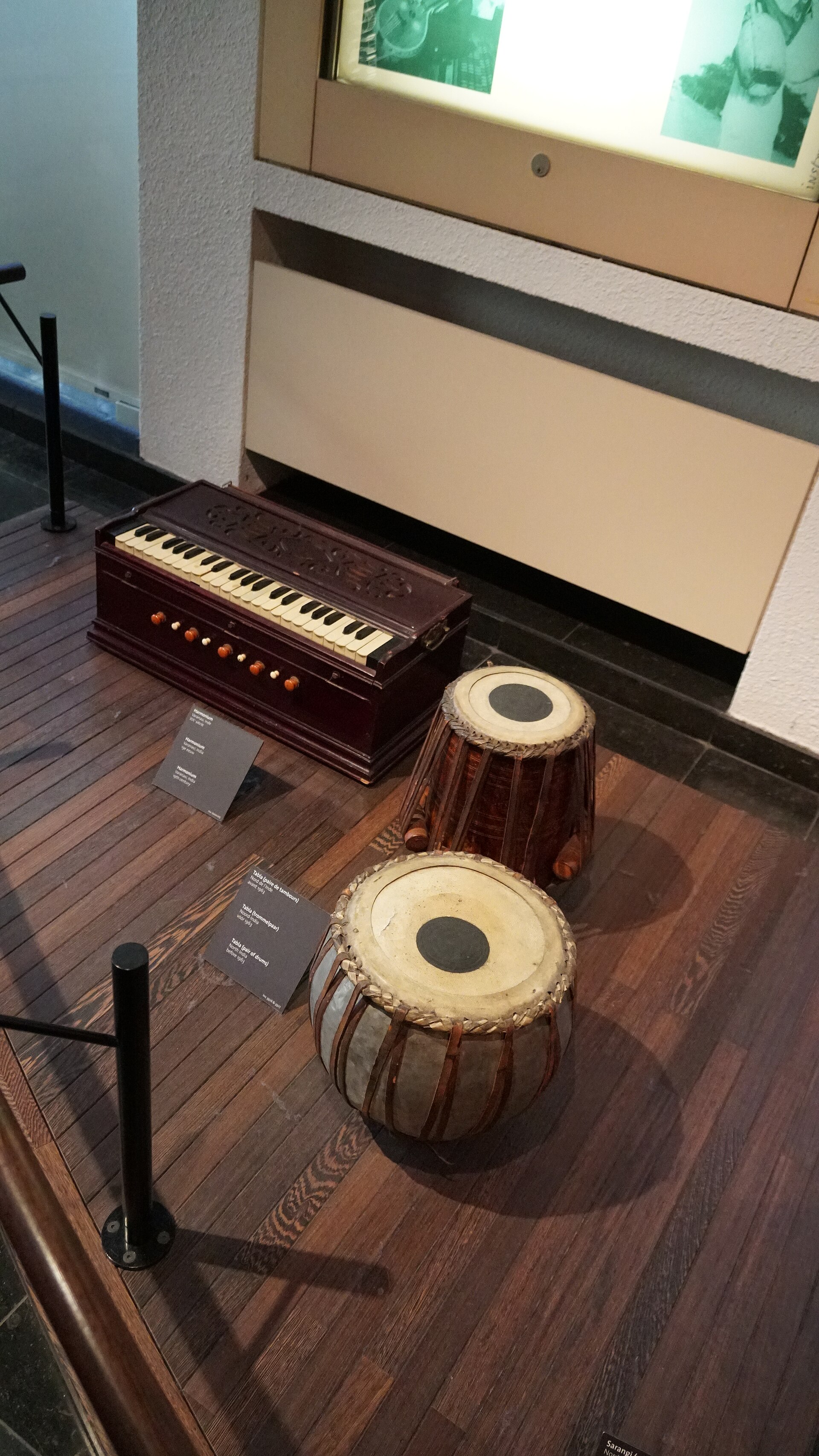
,_Tabla_(pair_of_drums)_(North_India._before_1963._Inv.3926_%26_3927)_-_MIM_Brussels_(2018-05-26_10.44.08_by_Miguel_Discart_@Flickr_44507218890).jpg)
The tabla is two drums that do not match, and the mismatch is the instrument. On the player's right stands the dayan, a small conical drum turned from a solid block of hard wood, usually sheesham or teak, hollowed to roughly half its depth. On the left sits the bayan, a squat kettle shaped drum of metal or clay, wider and lower in pitch. One is tuned precisely, normally to the tonic of the piece. The other is not tuned at all in the same sense: it is bent, in real time, by the heel of the player's hand pressing into the skin.
What makes both drums sound like a tabla and not like any other drum is the black disc at the centre of each head. This is the syahi, a paste built from iron filings or a black powder combined with a starch binder such as boiled rice or wheat, applied in many thin layers and burnished between coats with a stone. It is not decoration. Loading the centre of a membrane with mass suppresses the inharmonic overtones that make most drums sound like a thud, and leaves a set of overtones that are close to harmonic. That is why a tabla can carry a discernible pitch and can be tuned to a singer's tonic, and why replacing the syahi is the most delicate part of maintenance. The dayan head also has a distinct outer annulus, the kinar, which produces the sharp ringing strokes when struck at the rim.
Speaking Before Playing
A tabla student learns to speak the instrument before playing it. Every stroke has a spoken syllable, a bol, and compositions are transmitted, memorised and recited as strings of these syllables. Na and Ta and Tin and Te belong to the right drum. Ghe, Ga and Ka belong to the left. Dha and Dhin are combinations struck on both simultaneously. A student can recite an entire composition at speed, in rhythm, with correct accent, without touching a drum, and this recitation, called padhant, is itself performed on stage. The system is precise enough that a written or spoken bol sequence functions as a complete score, which is remarkable for a tradition that operated for centuries without notation.
The rhythmic architecture the tabla serves is tala. A tala is a fixed cycle of beats, or matras, divided into sections called vibhags, with a first beat, the sam, that carries maximum weight and toward which everything resolves, and one or more khali sections marked by a wave of the hand rather than a clap and played without the bass drum. Teental has sixteen beats in four groups of four and is the most common in Hindustani performance. Jhaptal has ten in a pattern of two, three, two, three. Ektal has twelve in six pairs. Rupak has seven, grouped three, two, two, and begins on a khali. The basic recurring pattern that identifies a tala is its theka, and a tabla player's fundamental job in accompaniment is to state the theka clearly enough that a soloist and an audience always know where the sam is.
Solo tabla playing works outward from that base into an enormous repertoire of composed forms: kaida, a theme systematically varied by permuting its own syllables under strict rules; rela, a fast rolling pattern; tukra and chakradar, cadential compositions engineered to land on the sam, the latter played three times so that its final stroke coincides exactly with the cycle's return; peshkar, an expansive opening; and gat, a fixed composition. Much of the pleasure for an informed listener lies in tracking a phrase across an off centre entry and hearing it arrive, mathematically, on the first beat.
Schools and Origins
Playing traditions are organised into gharanas, lineages defined by descent or apprenticeship and by a distinct technical style. Six are usually named: Delhi, Ajrada, Lucknow, Farrukhabad, Benares and Punjab. The distinctions are technical rather than decorative. The Delhi style is built on two finger playing on the kinar with a closed, precise sound. Ajrada developed a more resonant, bass inflected approach. Lucknow and Farrukhabad, growing out of accompaniment for kathak dance and for the lighter vocal forms, favour open, full handed strokes and dramatic composed pieces. Benares developed powerful flat handed strokes suited to solo performance. The Punjab tradition draws on pakhawaj vocabulary and is associated with dense, rapid patterns.
The instrument's origin is genuinely disputed. One line of argument, resting on carvings such as those at the Bhaja caves that appear to show small paired hand drums, treats the tabla as the descendant of an indigenous Indian drum tradition. Another notes that the word derives from the Arabic tabl, meaning drum, and points to West and Central Asian percussion introduced during the Islamic period. A third view sees the tabla as emerging in Mughal north India from the pakhawaj, the barrel drum of dhrupad, adapted for the newer, more flexible khyal singing and for kathak.
What is not credible is the story everyone repeats, that Amir Khusrau invented the tabla by cutting a pakhawaj in half. Musicologists have examined and rejected it. Khusrau died in 1325 and there is no contemporary evidence of the instrument or the name from anywhere near that period. The tabla as we know it is far more plausibly an eighteenth century development. The legend persists because it is memorable and because Khusrau functions in popular history as a universal origin point, the same role that has attached the sitar and the sarod to his name on equally thin grounds.
In the twentieth century the tabla became a solo concert instrument in its own right, largely through players who could hold a full length recital without a melodic soloist. Alla Rakha and, above all, his son Zakir Hussain took the instrument onto international stages and into collaborations with jazz, rock and orchestral musicians. Kishan Maharaj, Samta Prasad, Anindo Chatterjee and others sustained the classical lineages at the same time. The result is that a listener today may first encounter the tabla in a fusion recording, and only later discover the far more demanding architecture of a solo kaida unfolding over twenty minutes.
References
- WikipediaTabla
- WikipediaTala (music)
- WikipediaGharana
- WikipediaAmir Khusrau
- Sangeet Natak AkademiSangeet Natak Akademi, Ministry of Culture, Government of India
This is a reference article, written from the sources above. It is background, not news reporting.