Building the Dream: Costume and Set Design in Classic Indian Cinema
Reference library · 951 words
_Embroidery_Cushion_Covers.jpg)
For most of the twentieth century, an Indian film set was a workshop before it was a stage. Studios employed painters, carpenters, plasterers, embroiderers and jewellers on salary, and a period picture was assembled from the same trades that built temples and stitched wedding clothes. Understanding classic Indian cinema's look means understanding that it was rarely designed in the modern sense of a single authored vision. It was commissioned, from craft communities, in the same way a merchant would commission a marriage trousseau.
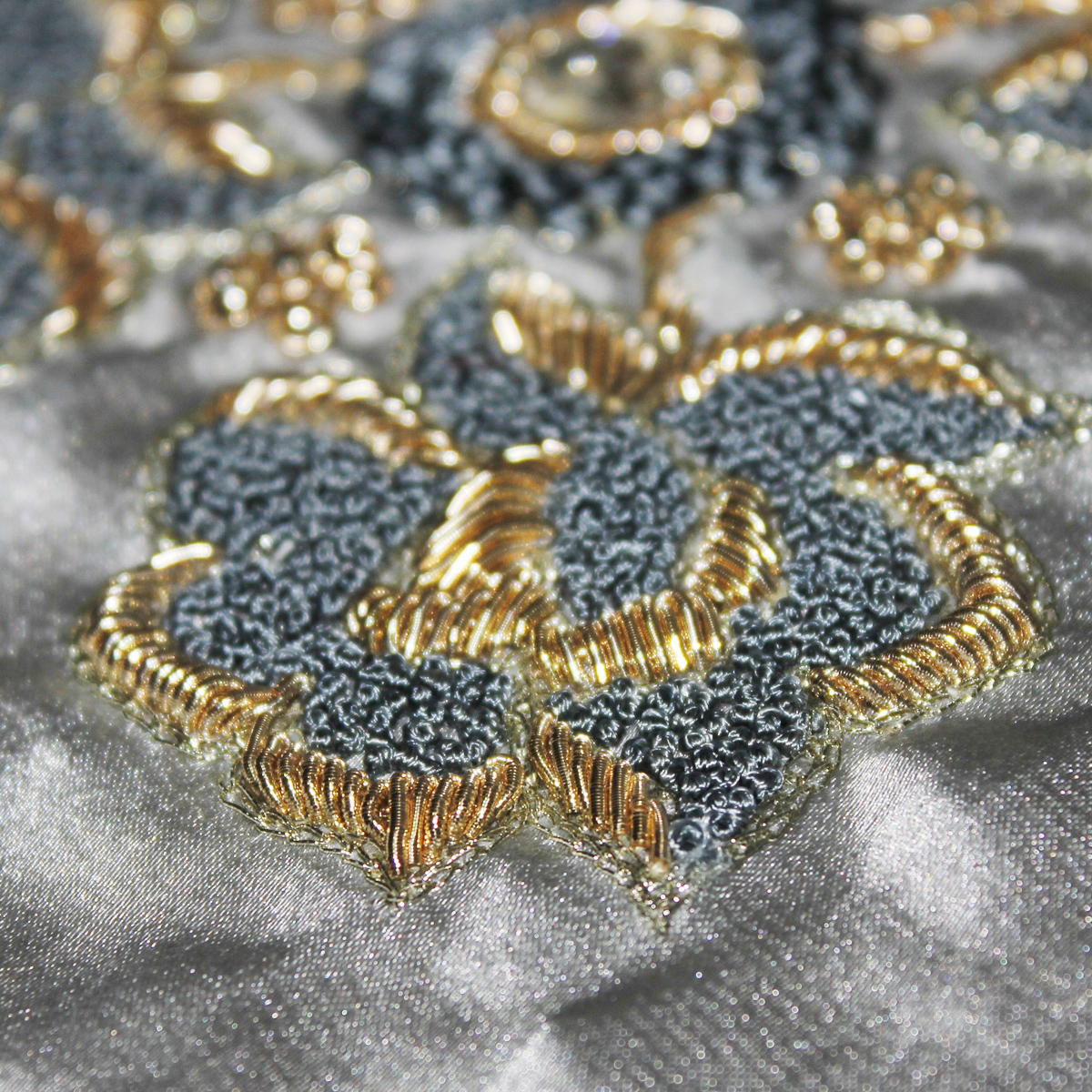
The clearest demonstration is K. Asif's Mughal-e-Azam, released on 5 August 1960 after more than a decade of intermittent production. Its art direction was led by M. K. Syed, and the film's most famous set, a reconstruction of the Sheesh Mahal of Lahore Fort for the song sequence Pyar Kiya To Darna Kya, was reported to be roughly 150 feet long, 80 feet wide and 35 feet high, and to have taken about two years to build. But what matters more than the dimensions is the sourcing. The costume work went to Makhanlal and Company; Mughal garments were stitched by tailors in Delhi working in zardozi, the raised metal thread embroidery of north India, with further zardozi from Surat. Footwear came from Agra, jewellery from goldsmiths in Hyderabad, crowns from Kolhapur, and weapons from blacksmiths in Rajasthan.
That list is a map of the subcontinent's craft geography. Asif was not hiring a costume department; he was placing orders with the same regional specialists a Mughal court would have used, which is why the film's textures read as heavy and real rather than theatrical. Roughly thirty minutes of the picture was shot in Technicolor, including that sequence, because financiers refused to fund a full colour production. The result is a film that shifts into colour precisely where the craft investment is most visible.
Set painting and the studio backlot
Set design in the studio era descended directly from painted theatre backdrops. The Parsi theatre companies of the nineteenth century, touring Bombay, Calcutta and beyond with mythological and historical melodramas, had developed a repertoire of painted drops: the palace hall, the forest, the garden, the throne room. When the studios formed in the 1920s and 1930s, they hired those scene painters. At the Prabhat Film Company in Pune, S. Fatelal came from exactly this background, and his sets combined painted perspective with built architectural fragments in the foreground.
The practical consequence is a distinctive spatial logic. Because a painted drop must be photographed from a limited range of angles to hold its illusion, camera placement was constrained, which encouraged the frontal, proscenium framing that characterises much studio era Indian cinema. When directors of the 1950s began moving cameras more freely, art departments had to build in the round, and set construction costs rose accordingly. The shift from painted to built is one of the underrated economic pressures on Indian film in that decade.
Studio backlots developed standing sets that appeared in film after film: a generic haveli courtyard, a village square, a temple step. Audiences recognised them, and their reuse was not concealed. A recurring courtyard functioned rather as a repertory theatre's standing scenery does, a familiar frame within which particular stories are told.
Costume as social shorthand
Costume in classic Indian cinema carried a heavy semantic load. The Victoria and Albert Museum's material on Indian film art notes how consistently women were coded as either traditional or modern through dress, the sari and rural clothing signalling one register and Western or hybrid dress another. This was rarely subtle, and it was not merely lazy. In a film distributed across many language regions to audiences with varying literacy, clothing did narrative work that dialogue could not.
The career of Bhanu Athaiya shows how that vocabulary was professionalised. She began in film costume with Guru Dutt's C.I.D. in 1956 and worked on Pyaasa in 1957, Chaudhvin Ka Chand in 1960 and Sahib Bibi Aur Ghulam in 1962, then on Guide in 1965, Amrapali in 1966 and much later Lagaan in 2001. She shared the Academy Award for Best Costume Design with John Mollo for Richard Attenborough's Gandhi of 1982, becoming the first Indian to win an Academy Award in any category.
Athaiya's method, as she described it, involved historical research into regional dress rather than invention: for a film set in a particular decade and district, she sought out what people had actually worn there. That approach was unusual in an industry where a leading actress's wardrobe was often determined by what flattered her and what the mill of the moment was producing. It also connects film costume back to the textile trade, since a costume department buying handloom cotton or Banarasi brocade was a customer of the same weaving centres that supplied domestic buyers.
The vanished trades
Two crafts attached to Indian cinema have largely disappeared. The first is the hand painted hoarding, the enormous billboard produced by workshops of painters who scaled up a photograph onto stitched canvas, a trade that collapsed through the 1990s as digital printing became cheap. The second is the hand painted or lithographed film poster, whose designers were often uncredited and whose originals survive mainly because collectors and museums, including the V&A, acquired them.
Both losses matter for how the classic period is now understood. Sets were struck, costumes were reused or sold, and negatives decayed in a climate hostile to nitrate and acetate. A great deal of what we know about how these films looked comes from publicity material made by workers whose names were never recorded, which is a reminder that the visual authorship of classic Indian cinema was collective in a way the director centred histories rarely admit.
References
- WikipediaMughal-e-Azam
- Victoria and Albert MuseumThe art of Bollywood
- WikipediaBhanu Athaiya
- WikipediaPrabhat Film Company
This is a reference article, written from the sources above. It is background, not news reporting.