Bihu: Assam's Triple Celebration of the Farming Year
Reference library · 952 words
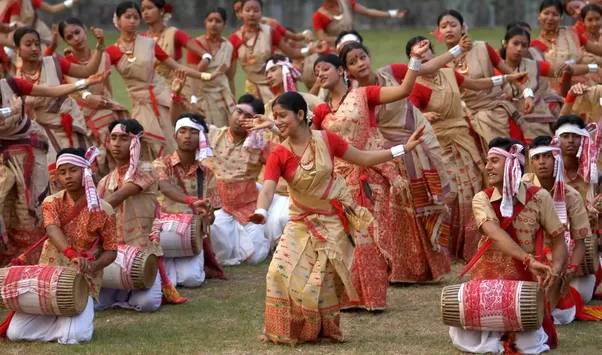

Ask about Bihu outside Assam and you will usually get one answer: dancers in red and white, fast footwork, a big drum. That is one Bihu out of three. The word names a set of festivals rather than a single day, and the three observances that share it could hardly be more different in mood. One is exuberant, one is sombre and lamplit, one is a feast. Together they map the agricultural year of the Brahmaputra valley with a precision that no single festival could manage.
Even the name is unsettled. One derivation traces it to terms connected with the equinox and the sun's transit; another proposes a Tibeto Burman origin in words meaning to ask and to prosper, from the languages of communities long resident in the valley. Neither derivation is proven, and the disagreement matters because it tracks a larger point: Bihu is observed by Assamese people of all religious backgrounds and by many distinct communities, and its practices blend Tibeto Burman, Austroasiatic and Indo Aryan strands rather than descending from any one of them.
Bohag Bihu, the Loud One
Rongali or Bohag Bihu falls in mid April, at the sun's transit into the first sign of the zodiac. That astronomical moment is the same one marked by Vaisakhi in Punjab, Vishu in Kerala, Puthandu in Tamil Nadu and Pohela Boishakh in Bengal, which is why all these new year festivals cluster on the same two or three days regardless of how differently they are celebrated.
Bohag Bihu runs for about a week and each day has a name and a job. It opens with Goru Bihu, the cattle day, when working animals are taken to the river, washed, rubbed with dighloti and makhioti leaves, fed gourd and brinjal, and their old ropes replaced. Manuh Bihu, the human day, is the new year proper: bathing, new clothes, elders touched for blessing, and the gifting of the gamosa, the woven cotton cloth that functions as the Assamese token of respect. Later days extend the greeting to relatives and neighbours.
Two performance traditions belong to this period. Husori troupes move from house to house singing in courtyards and receiving betel leaf and areca nut with a blessing in return. The Bihu dance proper is performed by young men and women, with rapid hip and hand movements, women in mekhela chador, and a band of dhol, the buffalo horn pepa, the bamboo jaw harp gogona, the clapper toka and small cymbals. Figures on ninth century sculpture at Tezpur and Darrang are frequently cited as early evidence of the dance, though identifying them as Bihu dancers is an interpretation rather than a proof. What is documented is that the dance was disapproved of in the colonial period for its frank celebration of fertility and courtship, and that its first formal stage performance in Guwahati took place in the early 1960s, which began its transformation into an emblem of Assamese identity. In 2023 the state organised a mass performance in Guwahati that set a Guinness world record.
Kati Bihu, the Quiet One
Kati or Kongali Bihu falls in mid October and is the opposite of a party. Kongali means poor, and the name is literal: the granaries are empty, the paddy is standing in the fields but not ready, and there is nothing to feast on. The observance is correspondingly restrained. Earthen lamps are lit at the tulsi plant in the courtyard, at the granary and at the edge of the fields. In many households a lamp is raised on a tall bamboo pole as an akash banti, a sky lamp, understood to guide departed ancestors and, in a more practical reading, to draw insects away from the ripening crop. There is no dancing and little music. It is a month of waiting, and the festival says so.
Magh Bihu, the Feast
Magh or Bhogali Bihu comes in mid January, after the harvest, and the name points at bhog, food and enjoyment. The main action happens on the night before, called Uruka. Young men build temporary huts of bamboo, thatch and banana leaf, known as bhelaghar, and the community cooks and eats in them through the night. At dawn a conical structure of wood and thatch called a meji is set alight, offerings of pitha and sweets are made to the fire, and people bathe afterwards.
The food is the point. Pitha, rice flour cakes in many forms including til pitha filled with sesame and jaggery and the fried ghila pitha, sit alongside laru, sweetened balls of coconut or sesame, flattened rice, curd and jaggery. Traditional accompaniments to the day included buffalo fights and other animal contests, which were restricted following court intervention in the 2010s and have since been the subject of continuing legal and cultural argument in the state.
Why Three, and Why It Holds
The three Bihus are not variations on a theme. They correspond to three distinct points in the rice cycle: sowing in April, the lean waiting period in October, and the harvest in January. The calendar was built around what a wet rice growing valley actually requires, which is why the festivals persist even where farming does not. In Guwahati, in Delhi and in Assamese associations in Melbourne, Sydney and Singapore, Bohag Bihu is celebrated with staged dance competitions and community lunches by people who have never bathed a bullock, and Magh Bihu with a bonfire in a rented park.
Something is inevitably compressed in that move. Kati Bihu, the one with no feasting and no music, travels worst and is often skipped entirely. It is also the one that carries the sharpest meaning, because a festival about scarcity is a reminder that the other two were never guaranteed.
References
- WikipediaBihu
- WikipediaBihu dance
- WikipediaAssamese cuisine
This is a reference article, written from the sources above. It is background, not news reporting.