Banarasi Silk: The Weave of Varanasi's Looms
Reference library · 1089 words
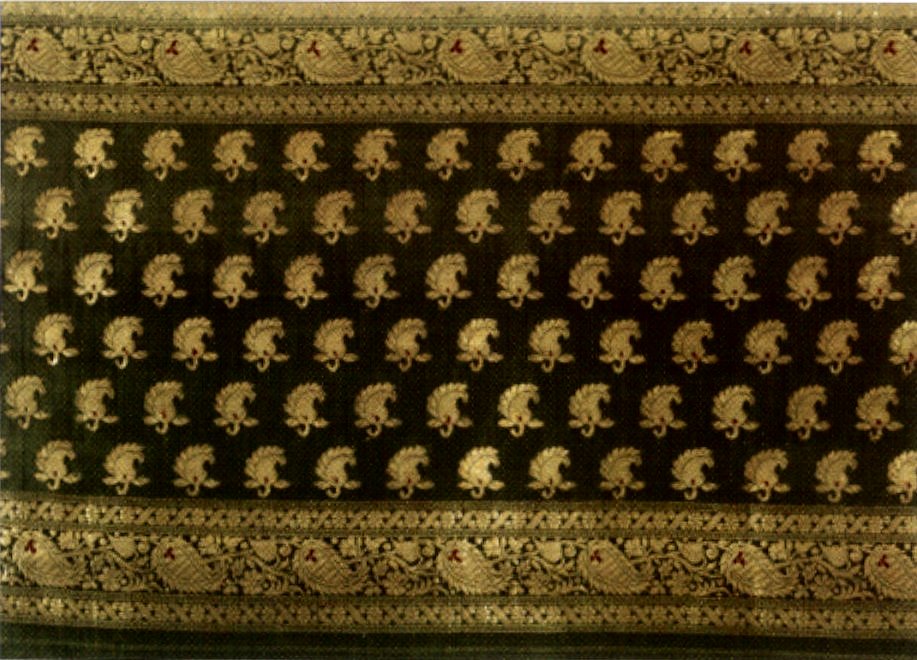
,_silk_and_gold-wrapped_silk_yarn_with_supplementary_weft_brocade.jpg)
A Banarasi sari is defined by a technique rather than a place alone. What makes it Banarasi is brocade: figuring built into the cloth by supplementary weft threads, usually metallic, that float across the surface to form the pattern and are bound in by the ground weave. The metallic thread, zari, is traditionally silver wire wrapped around a silk core and then gilded, which is why old saris are heavy, why they were once treated as stored wealth, and why an heirloom piece could be burnt to recover its metal. Most contemporary zari is tested or coated rather than solid silver, and the difference in price between real and imitation zari is enormous.
The weaving is concentrated in Varanasi and the districts around it, including Chandauli, Bhadohi, Jaunpur, Mirzapur and Sant Ravidas Nagar. That cluster is the area covered by the geographical indication registered in the late 2000s under the name Banaras brocades and sarees, which restricts the use of the name to handloom cloth made within those districts. The weaving workforce is drawn heavily from the Ansari community, Muslim weavers whose families have worked pit looms in the mohallas of Madanpura, Alaipur, Lohta and Ramnagar for generations, while much of the trade, dyeing and retail has historically been in other hands. This division of labour, weaving in one community and selling in another, shapes the economics of the craft and explains why weaver incomes have often stayed low even when the product sells for a great deal.
Techniques and the names for them
The vocabulary of Banarasi weaving is precise and worth learning, because it is where the value lies. Kadhwa is the demanding method: each motif is woven separately, with the extra weft cut and secured at the edge of each figure, leaving the back of the cloth relatively clean and each element structurally independent. It is slow, and a heavily kadhwa sari can occupy a loom for months. Fekuwa, or cutwork, is the faster alternative, in which the supplementary weft is thrown right across the width and the floats between motifs are clipped away afterwards, leaving a fringe of cut ends on the reverse. Both produce handsome cloth, but only the first justifies the highest prices.
Kadiyal refers to a border woven in a colour genuinely different from the body, with the wefts interlocked at the join rather than one colour simply printed or shaded over another. Jangla describes a dense all-over creeping vegetal pattern spread across the whole field. Butidar saris are scattered with small individual motifs. Tanchoi is a satin-based structure using several coloured wefts and no cut floats at all, producing a self-toned, almost jacquard-like surface; its name and technique are generally traced to Chinese and Parsi trade connections through Surat in the nineteenth century, though the details of that transmission are told in several conflicting versions. Shikargah, the hunting-scene pattern with animals, riders and trees among foliage, is the clearest example of Persian and Mughal court taste entering the local design repertoire.
Those Mughal connections are real but often overstated in marketing copy. Silk weaving in the middle Ganges plain is much older than the Mughals, and Varanasi's reputation as a textile centre appears in early Indian literature. What the Mughal period contributed was patronage, gold-thread technology at scale and a design language of stylised florals, the buta and the meandering bel border, that remains the core vocabulary of the cloth. Hindu ritual demand and Mughal courtly taste both shaped the product, and the red Banarasi remains the standard bridal sari across much of north India.
The loom, the punch card and the machine
Patterning of this complexity requires a way of storing the design. The older system was the naqsha or jala: a designer, the naqshaband, translated a drawing into a grid and then into a lattice of knotted cords hung above the loom, which a draw boy lifted in sequence to raise the correct warp threads. From the late nineteenth and early twentieth centuries this was progressively replaced by the jacquard head, in which punched cards perform the same selection mechanically. A jacquard attachment on a handloom is still handloom weaving: the weaver throws the shuttle and beats the weft by hand. Electronic jacquards and powerlooms are a different matter, and the boundary between them is the central commercial dispute of the industry.
That dispute is not academic. Powerloom saris made in Varanasi, in Surat and elsewhere can imitate the appearance of a handwoven brocade at a small fraction of the price and a tiny fraction of the time, and imported synthetic yarns and finished cloth have taken a large share of the lower end of the market. Weavers have shifted to powerlooms in significant numbers, left the trade for other work, or accepted piece rates that make handloom weaving economically marginal. The geographical indication, government handloom marks and cooperative societies are all attempts to defend the handwoven product, with mixed success. For a buyer, the practical tests are the reverse of the cloth (cut ends and clean independent motifs indicate kadhwa handwork), the weight and drape of the silk, the presence of a handloom or GI label from a recognised source, and a price that makes sense: a genuine heavy kadhwa sari cannot be cheap, because the loom time alone forbids it.
Materials and the shape of a working day
The base silk is usually katan, a twisted filament mulberry silk, or organza and tissue variants for lighter cloth. Most of that raw silk now comes from Karnataka, with Bengal supplying some; historically, Chinese silk was also imported through the ports. Yarn is dyed in Varanasi's dyeing lanes, warped in long streets where the threads are stretched between posts, and mounted on pit looms set into the floor of a weaver's house so the treadles can hang below floor level. Two people often work a single loom, and complex saris pass through the hands of a designer, a card cutter, a warper, a dyer and a weaver before reaching a shop.
Varanasi also produces brocaded lengths for furnishings, dupattas, sherwani fabric and the ritual cloth used to dress temple images, and the same looms that make a bridal sari make the small brocade squares sold to pilgrims. A Banarasi sari is best understood not as a souvenir but as a piece of a working urban economy that has been under sustained pressure for a century and is still, against considerable odds, producing some of the most technically ambitious woven cloth in the world.
References
- Victoria and Albert MuseumSouth Asia collection
- Encyclopaedia BritannicaBrocade
- Encyclopaedia BritannicaMughal dynasty
- Intellectual Property India (Government of India)Geographical Indications Registry
This is a reference article, written from the sources above. It is background, not news reporting.