Baisakhi: When Harvest and Faith Meet in Punjab
Reference library · 977 words
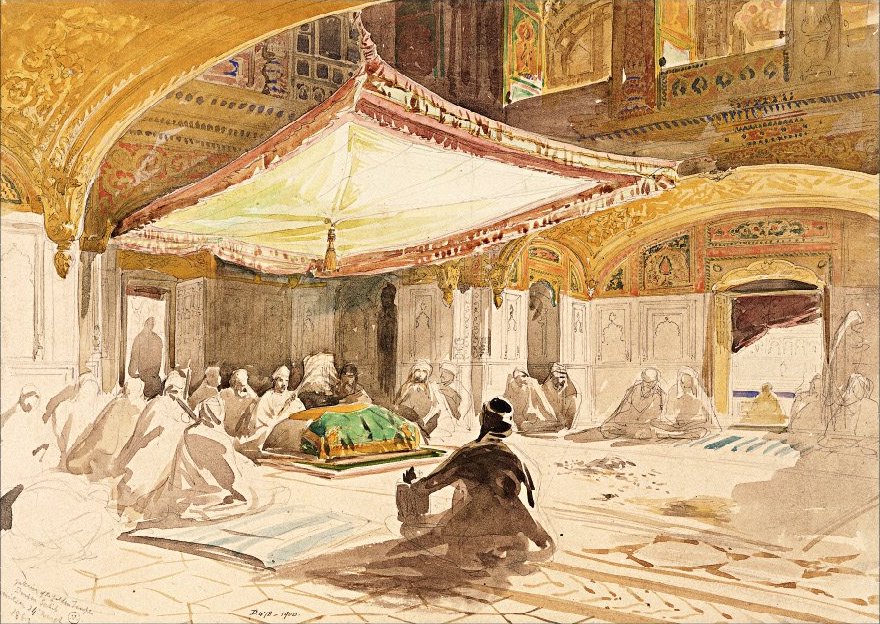
_in_Amritsar_by_William_Simpson,_ca.1860.jpg)
Baisakhi, also written Vaisakhi, is one of the few major Indian festivals whose date barely moves. It is reckoned by the sun rather than the moon, falling on the sankranti when the sun enters the sidereal sign of Mesha, which lands on 13 or 14 April in the present era. That solar anchoring is why the same day carries a different name in almost every region: Puthandu in Tamil Nadu, Vishu in Kerala, Pohela Boishakh in Bengal, Bohag Bihu in Assam, Pana Sankranti in Odisha, Jur Sital in Mithila. Punjab's version is distinctive because two things landed on it, an agricultural fact and a founding event, and they have never quite separated since.
The agricultural fact came first. Baisakhi sits at the end of the rabi season, when the wheat sown after the monsoon stands ready in the plains between the Sutlej and the Ravi. Before mechanised harvesting compressed the work into days, the festival marked the moment when a year's risk resolved: the crop was either in or it was not. Fairs, cattle markets, wrestling bouts and dancing filled the gap between the standing crop and the threshing floor. That is the layer the songs come from, and it explains why Baisakhi is celebrated by Punjabi Hindus and by farming communities in Himachal Pradesh and Haryana as much as by Sikhs, often with ritual bathing in rivers and canals at dawn.
1699 and the Making of the Khalsa
The second layer is the one most people outside Punjab know. On Baisakhi in 1699 at Anandpur Sahib, in the Shivalik foothills, Guru Gobind Singh, the tenth Sikh Guru, called an assembly and asked for a head. According to the tradition, five men came forward in turn and were taken into a tent; all five emerged alive, and were named the Panj Pyare, the five beloved. The Guru then initiated them with khande di pahul, water stirred with a double edged sword and sweetened with patashas, and was in turn initiated by them, an inversion that is the theological centre of the account. From this came the Khalsa, a body of initiated Sikhs bound to a code of conduct and to the five articles of faith commonly called the five Ks: kesh, kangha, kara, kachhera and kirpan. The surnames Singh and Kaur date from the same occasion in the traditional narrative.
Historians treat the details with more caution than most retellings allow. The fullest versions of the 1699 assembly appear in eighteenth and nineteenth century Sikh sources written after the fact, and the accounts differ on points including the number and identity of those who came forward and the exact sequence of the ceremony. Saying so is not an attack on the tradition. It is simply the honest position: the founding of the Khalsa at Anandpur on Baisakhi 1699 is well established, while the cinematic detail that has accreted around it is later devotional literature. Takht Sri Keshgarh Sahib at Anandpur Sahib, one of the five seats of Sikh temporal authority, stands at the site and remains the largest single Baisakhi gathering.
Two further Baisakhi dates carry weight in Punjab. In 1801 Ranjit Singh was formally proclaimed Maharaja at Lahore on Baisakhi, opening four decades of Sikh sovereignty over the Punjab. And on 13 April 1919 at Jallianwala Bagh in Amritsar, a crowd that had gathered partly for the Baisakhi fair and partly for a political meeting was fired on by troops under Brigadier General Reginald Dyer in an enclosed garden with narrow exits. Hundreds were killed. The massacre is inseparable from the festival for anyone who grows up in Amritsar, where the walled garden and the Golden Temple sit a short walk apart.
What the Day Actually Looks Like
Observance begins before dawn. Gurdwaras hold an akhand path, an unbroken reading of the Guru Granth Sahib completed on the morning of the festival, followed by kirtan and the distribution of karah prasad, a dense semolina and ghee offering handed into cupped palms. Nagar kirtan processions move through towns behind the scripture carried on a decorated float, preceded by the Panj Pyare and by displays of gatka, the Punjabi martial art of stick and sword, performed by the Nihang orders in their tall blue turbans. Langar, the free community kitchen, runs all day. Baisakhi is also one of the principal occasions for Amrit Sanchar, the initiation ceremony, so it is a day on which people formally enter the Khalsa rather than merely commemorate its founding. The largest gatherings after Anandpur are at Harmandir Sahib in Amritsar and at Takht Sri Damdama Sahib in Talwandi Sabo, whose great fair falls on Baisakhi.
The dancing needs a word of correction. Bhangra and giddha are genuinely rooted in Punjabi harvest and celebration, but the tightly choreographed stage bhangra familiar from film and from wedding floors is a twentieth century construction, developed in post Partition Indian Punjab as a state and college performance form, then transformed again by British Punjabi musicians in the 1970s and 1980s who fused it with drum machines and reggae. Describing that version as an ancient harvest dance is a flattening. The dhol, the tumbi and the steps are old; the arrangement on a stage with matched costumes is recent, and no less alive for being recent.
A Calendar Still Being Argued
One last complication is worth knowing. The Nanakshahi calendar, adopted by the Shiromani Gurdwara Parbandhak Committee at the end of the twentieth century, fixed Vaisakhi to 14 April and set most Sikh anniversaries to fixed solar dates. Successive revisions and reversals mean different Sikh institutions have at times published different dates for other observances, and the calendar remains a live dispute within Sikh bodies. Baisakhi itself is largely unaffected, sitting on a date the sun would have delivered anyway. Which is fitting for a festival that began as a note about wheat.
References
- Shiromani Gurdwara Parbandhak CommitteeSGPC official site
- Sri Harmandir SahibSri Harmandir Sahib, Amritsar
- Utsav, Ministry of TourismBaisakhi
- Indian Culture Portal, Ministry of CultureBaisakhi
- Incredible India, Ministry of TourismPunjab
This is a reference article, written from the sources above. It is background, not news reporting.