Amrita Pritam and the Voice of Punjabi Letters
Reference library · 960 words
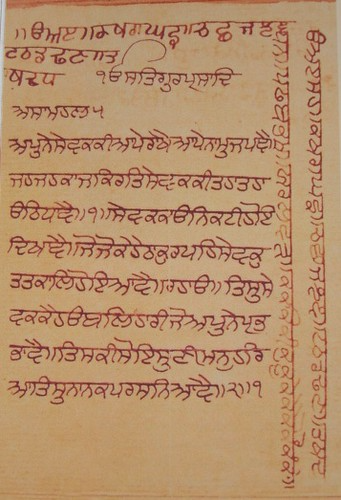
_of_the_Gurmukhi_script.png)
Amrita Pritam, who lived from 1919 to 2005, occupies a position in Punjabi literature that has no exact parallel elsewhere in India. She was the pre eminent woman writer in a language that had produced very few, she wrote across the Partition line in a literature that Partition had split in two, and she conducted her private life in open defiance of the conventions of her community while remaining, throughout, the most widely read Punjabi author of her century. Her career is inseparable from the political catastrophe of 1947, and any account that treats her as simply a lyric poet of love misses what she was doing.
The poem that crossed the border
The work that fixed her reputation is a short poem, Ajj Aakhaan Waris Shah Nu, usually rendered in English as Today I Invoke Waris Shah. She wrote it in 1947 while travelling from Dehradun to Delhi, pregnant, in the middle of the migrations and massacres of Partition. Its device is an address to Waris Shah, the eighteenth century poet whose Heer Ranjha is the great Punjabi verse romance and whose grave lies at Jandiala Sher Khan in what became Pakistan. The poem asks him, who wrote a whole book about the sorrow of one daughter of Punjab, to look now at his province where a hundred thousand daughters weep, and to speak from his grave.
The choice of addressee is the poem's whole argument. Waris Shah was a Muslim Sufi poet of the Chishti order whose romance was and is loved by Sikhs and Hindus as much as by Muslims. By calling on him, Pritam invokes a Punjab that existed before the border and that the border was in the process of destroying, and she does so in a shared literary language rather than in the vocabulary of either new state. The poem became one of the very few texts of 1947 read and taught with equal warmth in both Punjabs, and it is recited at commemorations on both sides.
Her novel Pinjar, published in 1950, extends the same concern into prose. Its title means the skeleton. The story follows a Hindu woman abducted by a Muslim man before Partition and then, when the opportunity to be recovered and returned arrives, choosing not to take it. The novel is unsparing about the fact that women's bodies were the medium through which communal violence was conducted, and about the state programmes of recovery and exchange that treated abducted women as property to be repatriated rather than as people with a view. It was adapted into a Hindi film in 2003.
A career built against the grain
Pritam was born in Gujranwala, in what is now Pakistan, and grew up in Lahore, moving to Delhi after Partition. She began publishing young and produced across her life a very large body of work: poetry, novels, short fiction, essays and autobiography, running to something like a hundred books. She wrote in Punjabi at a time when literary prestige in north India attached to Hindi and Urdu, and when Punjabi's own literary infrastructure was thin and, after 1947, cut in half between two countries with two scripts, Gurmukhi in India and Shahmukhi in Pakistan.
The institutional recognition came steadily. She received the Sahitya Akademi Award in 1956 for Sunehade, a collection whose title means messages, and she remains the first woman to have been given that award for a work in Punjabi. In 1981 she was awarded the Jnanpith, India's highest literary honour, for Kagaz Te Canvas, meaning paper and canvas. She was given the Padma Vibhushan in 2004, the year before her death.
Alongside her own writing she ran Nagmani, a Punjabi literary monthly, for more than three decades, producing it with the artist Imroz. This editorial work matters as much as the awards. A minority literature needs a place to publish, and for a generation of Punjabi writers Nagmani was that place. Running a small magazine for thirty three years is an act of infrastructure building, and Pritam's stature in Punjabi letters rests partly on the fact that she made a space others could occupy.
The private life as public text
Her 1976 autobiography Rasidi Ticket, meaning the revenue stamp, took its title from a remark that her life story was so slight it could be written on the back of a stamp. The book is candid about her long unrequited attachment to the Urdu poet and lyricist Sahir Ludhianvi and about her four decades with Imroz, with whom she lived without marrying after leaving her husband. In mid twentieth century Punjabi society this was extraordinary, and it was held against her.
It is worth being careful here, because the biographical reading has come to dominate discussion of her poetry to an unhelpful degree. A great deal of criticism reads her love lyrics as coded diary entries about identifiable men, which flattens work that is often doing something more formal, adapting the imagery of the Punjabi Sufi kafi and the folk lyric to a first person female voice that the tradition had not previously granted a speaking position. The Sufi poets she drew on wrote as women longing for God; Pritam wrote as a woman longing, and left the object of the longing deliberately unresolved. That is a literary manoeuvre, not a confession.
Her lasting importance is threefold. She gave the Partition its most enduring poem in any Indian language. She proved that a woman could hold the central position in a modern Indian literature rather than a marginal one. And through Nagmani and her own visibility she kept Punjabi functioning as a contemporary literary language during the decades when it was most at risk of being squeezed out between Hindi and English.
References
- WikipediaAmrita Pritam
- WikipediaWaris Shah
- WikipediaBulleh Shah
This is a reference article, written from the sources above. It is background, not news reporting.